dianadarke

Syria and Turkey commentary

Archive for the category “Uncategorized”

The paradox of Iran and its links with Syria

Cameron and Rouhani

How fitting it is that Iranian President Hassan Rouhani  should have used his Twitter account to announce last month’s historic meeting with UK Prime Minister David Cameron: “1st meeting b/w UK & Iran heads of state in 35 years: 1 hour of constructive & pragmatic dialogue, new outlook #UNGA” the tweet boasted, attaching a photo to prove it, of the pair engaged in earnest dialogue. A week later the brief warming in relations was over, as Rouhani criticised Cameron for calling Iran ‘part of the problem in the Middle East’; Tehran headlines again referred to Britain as ‘the old fox.’

What is the Iranian leadership aiming for, in its apparent new accessibility, its seeming new willingness to talk and engage with western governments? How seriously should we take Iran’s ‘new outlook’, as the UK joins the US-led air strikes against ISIS in Iraq (and possibly Syria in future), a fight in which Iran’s help will, sooner or later, almost certainly be needed?

In Twitter-silent Iran, it was the silence of the ordinary Iranian people that struck me most. After the failed Green Revolution of 2009 in which around 100 protesters were killed and over 4,000 arrested, most Iranians learned to be silent – unlike the Syrians. Ordinary Iranians admire the courage of ordinary Syrians. “We gave up when we saw how the regime reacted, but they continued.”

The gulf between the Iranian people and their regime is striking. Rouhani’s smiling face and his carefully managed tweets project one image of Iran to the West, but conditions inside the country tell a very different story. Far from opening up, Iran is busily clamping down on its own people. Since Rouhani took office in August 2013 executions have been on the rise, more than 400 in the first half of 2014 alone according to the NGO Iran Human Rights (to give perspective, Saudi Arabia managed a mere 79 last year). Two gay men were publicly hanged in August for consensual sodomy; in recent weeks ’91 lashes’ were meted out to unveiled Iranians dancing in a YouTube video, and a British-Iranian woman was charged with ‘propaganda against the Iranian regime’ for attending a male volley-ball match. Iran’s hard-line ruling elite back home is determined to suppress any kind of resistance, fearful that, were they to allow greater freedoms in Iranian society, a wave of dissent might rise up and engulf them. Rouhani recently declared his view that internet controls and tight restrictions on women’s headscarves do not work – but will the anti-reformist clerics take any notice?

Iran is not a particularly religious country, given the power of the mullahs. The call to prayer is muted – it took three days till I heard the first one – and mosques are places more to sleep than pray.

Iran 4-18 September 2014 032

Shrines on the other hand are crowded, thanks to a superstition that throwing a few notes or coins through the grille of a holy man’s tomb will resolve life’s problems. “We never did Islam the way the Arabs wanted us to,” grinned a helpful bystander inside the segregated women’s area, confirming what my Syrian friends in Damascus had always told me about the Iranian pilgrims who thronged the city in their all-black chadors. “They are pretending. Underneath they are just on holiday.”

Painted high on random buildings within view of the main highways the faces of Ayatollah Khomeini and the current Supreme Leader Khamenei  smile down on their subjugated flock like a pair of benevolent dictators.

Iran 4-18 September 2014 738

Closer questioning reveals that maybe some 10-15% of the population is tied into supporting the regime for their own economic reasons. Iran is at heart a trading nation. Its entire history has been built on centuries of skilful bartering. Visit any Iranian city and the bazaar is the central nervous system, the driver of the economy. The bazaaris and the clergy were enabled by the 1979 Iranian Revolution to preserve the traditional positions of power threatened by the Shah and his corruption. They do not want to lose this power now through relaxing their grip and allowing Western influence and culture to take over. They rail against the evils of the Western model – drug abuse, family breakdown, immoral behaviour – yet the paradox is that these have all increased on their watch inside Iran anyway, thanks to unemployment, poverty and their own corruption.

Iran 4-18 September 2014 042

Iran is said to have one of the highest rates of drug addiction in the world at 5% of the population, the divorce rate is soaring in the cities where most people now live and prostitution is so rife that even the regime itself mentions it as a problem. And the solution of the hardline clerics? More floggings.

Iran’s demographic is suffering from a ‘Japanese curve’. After 1979 Khomeini encouraged everyone to have many children, resulting in a baby boomer generation. But the middle classes of that generation, now in their mid-30s, are the ones most excluded from influence, struggling with unemployment and deprivation. The average birth rate has plummeted to one child per family, partly because of women’s education, but also for affordability reasons. Worried that this is not enough to sustain the aging population, the regime is offering financial incentives for people to have more children, incentives which are not working: couples say it is still too expensive.

Most Iranians now live in cities, meaning that traditional barriers are breaking down as different groupings find themselves living side by side. Sunni-Shi’a intermarriage is becoming commoner, much to the horror of the mullahs. In schools the clergy controls the syllabus, with Islamic religious education forming a bigger element of the day’s lessons than any other country in the world, leaving less time for other subjects. Iran’s brightest and best are leaving the country.

For those who stay there are subtle ways of showing opposition and Iran has these in abundance. The BBC is banned, yet the BBC’s Farsi channel is the most watched, while Iranian state TV offerings on religion and wildlife languish. Facebook is blocked yet 58% of Iranians circumvent the ban, gmail accounts were till recently banned yet 63% of Iranians use gmail as their preferred email address. Women, for the last ten years or so accounting for more university graduates than men, show passive resistance through pushing the boundaries on Islamic dress, so that in Shiraz, Iran’s most liberal city, the mandatory headscarf is worn tantalisingly far back to reveal a full head of hair, with figure-hugging brightly coloured jackets leaving nothing to the imagination.

Iran 4-18 September 2014 414

So how, in the face of such contradictions, has the political clergy of the Islamic Republic managed to retain its power and control? The answer lies in its ever-increasing dependence on its various law enforcement forces, above all SEPAH and the Basij – another parallel with Syria. SEPAH is the Iranian Revolutionary Guard set up in 1979 to preserve the Islamic nature of the revolution and to pre-empt a military coup or foreign interference, while the Basij is the volunteer militia under its control, numbering up to one million. To cement the loyalty of SEPAH and the Basij, the clerical elite has permitted them to enrich themselves through mafia-style smuggling rackets operating across the Straits of Hormuz to the UAE – shades of Syria again where Assad’s shabiha control the contraband routes through the ports of Lattakia and Tartous. A multi-billion dollar empire has grown up, transparent to ordinary Iranians who follow world affairs closely. Banned from Twitter, most use SMS, sending each other jokes by text message based on the news of the day. SEPAH and the Basij are particular targets, with messages like:  ‘How much do you think SEPAH will charge the mullahs for smuggled fridges? Reply: About five prostitutes a day for a month should do it,’ and ‘How many Basij fighters do you reckon are now in Syria? Reply: I don’t know, but a lot more than in Iran,’ and ‘Who runs Syria these days? Reply: Iran of course!’

The highly experienced Iranian commander of the Quds Force (special operations division of the Iranian Revolutionary Guard), Major General Qassem Suleimani, has since early 2013 been masterminding the Assad regime’s fight against its rebels, sending advisers into Syria, helping bolster depleted ammunition/weapons supplies and re-train Syrian government troops. With consummate skill, he created the 60,000-strong National Defence Force (NDF) in Syria, modelled on the Basij, ostensibly to protect local neighbourhoods, in practice to exploit them and run smuggling rackets.

Prophetic 2007 poster of Bashar in Damascus' Hijaz Railway with the caption: 'We pledge allegiance to you with blood forever.' Blood drips from the words 'with blood'.[DD]

President Bashar al-Assad with the caption: ‘We pledge allegiance to you with blood forever.’ Blood drips from the words ‘with blood’.

Rouhani is an ace negotiator and will feign flexibility while holding tight to his position. He knows that time pressure is on his side: the West needs him now in its fight against ISIS and he has till 24 November to reach a nuclear deal. The conditions are perfect for extracting concessions from the West, and of one thing we may be sure: the Iranian governing elite will do nothing that rocks the status quo domestically, nothing that interferes with its ability to enrich itself. Embassies may open in London and Tehran, cooperation over ISIS in Iraq (though not in Syria) may be forthcoming when its own border region is threatened, but the Iranian regime, SEPAH and the Basij will remain umbilically connected, to each other and to the Syrian regime. Their collective survival is at stake and their loyalty to each other is not negotiable.

Looking back at Rouhani’s Twitter account, I am struck by the fact that, set against his 257K followers, he is only following six people, one of which is his own Iranian language account. The others are Iran’s Supreme Leader Ayatollah Khamenei, Ayatollah Rafsanjani, Ayatollah Khatami, his own Foreign Minister Javad Zarif and his own Vice President and Environment Minister the heavily headscarved Massoumeh Ebtekar – not exactly a broad range of opinion. All of which confirms that however much Rouhani smiles abroad, at home he is beholden to his hard-line masters.

Diana Darke, author of My House in Damascus: An Inside View of the Syrian Revolution (Haus, 2014),http://www.amazon.co.uk/My-House-Damascus-Inside-Revolution/dp/1908323647 has recently returned from an extensive tour of Iran arranged through Travel the Unknown www.traveltheunknown.com.


Shi'a prayer tablets made from the mud of Kerbala

Shi’a prayer tablets made from the mud of Kerbala

Related media:

http://gatesofnineveh.wordpress.com/

http://www.bbc.co.uk/podcasts/series/fooc/all (From Our Own Correspondent of 18 October 2014, starts at 17.25 mins)

Syrian Literary Festivals

This October My House in Damascus: An Inside View of the Syrian Revolution will be featured in three literary festivals:  Cheltenham, Henley and Wimbledon. Full details below with booking via their websites.

First, on Saturday 4 October 2014 at Cheltenham:

In association with Waterstones

diana darke cover - Copy.jpg

PRESENT TENSE: SYRIA

QUICKFIND L066

SAT 4 OCT 2014 9:00PM – 10:00PM

THE STUDIO, IMPERIAL SQUARE

£8 – MEMBERS 10% OFF

If you are a member then login to book your tickets, if you’re not a member then find out how to become a member and get access to priority booking.
Public booking opens on Mon 01 Sep at 12:00pm

The-Times-Logo-March-2011.jpg

DETAILS

Anthony Loyd, The Times war correspondent who was recently injured reporting from Syria, evaluates the Syrian crisis with Diana Darke, author of My House in Damascus, and questions what might happen next.

All Literature events

MEDIA GALLERY

Saving #Syria’s Cultural Heritage – how to help

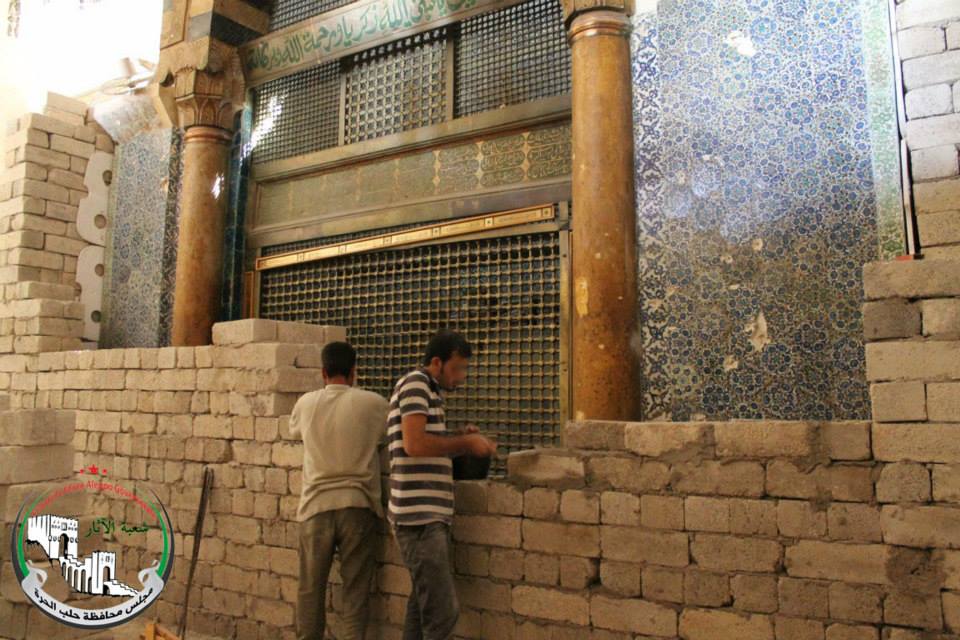
Bricking up the 13th century prayer niche of the Halawiye Madrasa, Aleppo

Bricking up the 13th century prayer niche of the Halawiye Madrasa, Aleppo

Little known and little recognised, groups of Syrians inside Syria are working together to try to save the destruction of their country’s cultural identity. Confronted with the inertia of the international community, the occasional statement and handwringing from UNESCO and the Syrian government’s own narrative presenting itself as the custodian of the country’s rich treasures, these groups are taking matters into their own hands. A mix of academics, archaeologists, students and ordinary citizens with a deep love for their country, they have almost no funding and most are volunteers.

Protecting the tomb of the Prophet Zachariah, inside the Aleppo Great Mosque

Protecting the tomb of the Prophet Zachariah, inside the Aleppo Great Mosque

A recent study (by Heritage for Peace see link below) has shown that 38 organisations are involved worldwide in efforts to highlight the damage to Syria’s cultural heritage, including the big names like UNESCO, Blue Shield, the Global Heritage Fund, the World Monument Fund, ICCROM and ICOMOS. The overwhelming majority are talking shops, gathering data and posting it online. They are largely based outside Syria and function only through the official channel of the Syrian Directorate-General of Museums and Antiquities (DGAM) which in turn only functions in the regime-held areas of the country. Of these 38 organisations, 14 have been formed since 2011 specifically in response to the Syrian crisis, mainly from volunteer groups. Only six of the organisations are Syrian, working on the ground inside the country, and of these only three that we are aware of are taking pro-active, pre-emptive measures to protect ancient buildings. It is a chronic state of affairs, but such is their commitment to doing whatever they can that they are prepared sometimes even to risk their lives in order to protect and save their cultural identity.

Bricking up Zachariah's Tomb, Aleppo Great Mosque

Bricking up Zachariah’s Tomb, Aleppo Great Mosque

Aleppo, once Syria’s largest and richest city, is where such actions have been most prevalent. The Division of Antiquities of the Free Council of Aleppo was founded in 2013 and has sandbagged and walled up the precious sundial in the Aleppo Great Umayyad Mosque, and bricked up its shrine of the Prophet Zachariah. With the help of the Tawhid Brigade from the Free Syrian Army, they have dismantled its 12th century wooden mihrab for safe-keeping away from the front line.

The Syrian Association for Preserving Heritage and Ancient Landmarks was founded in Aleppo in 2013. Its members, many of them archaeology students from Aleppo University, at considerable risk to themselves, saved the stones from the fallen minaret of the Great Umayyad Mosque and have put them safely elsewhere awaiting reconstruction after the war. They also helped the Free Council of Aleppo with protecting the sundial and removing the mihrab.

Protecting the sundial in the courtyard of the Aleppo Great Mosque

Protecting the sundial in the courtyard of the Aleppo Great Mosque

The Association for the Protection of Syrian Archaeology (APSA) was founded in 2012 in Strasbourg by a group of Syrian archaeologists and journalists. Together with collaborators on the ground they have compiled an extensive website cataloguing the damage (www.apsa2011.com) and have also held short workshops in Turkey’s Gaziantep to train Syrians in techniques of how to record damage and how to carry out simple protection measures.

Syrian aircraft dropping barrel bombs to dislodge rebels from the Byzantine Dead City of Shanshara, Idlib Province

Syrian aircraft dropping barrel bombs to dislodge refugees sheltering in the Byzantine Dead City of Shanshara, near Al-Bara, Idlib Province

A team goes to document the damage at the Dead City of Shanshara, part of the UNESCO World Heritage site inscribed in June 2011, Idlib Province

An APSA team goes to document the damage at the Dead City of Shanshara, part of the UNESCO World Heritage site inscribed in June 2011, near Al-Bara and Kafaranbel, Idlib Province

All of this work goes unrewarded financially and unrecognised internationally. Syria’s concentration and range of cultural heritage sites far exceed that of neighbouring Iraq. Yet while Iraq benefited from a UN resolution in 2003 after the US invasion banning trade in its antiquities, the Syrian case has been largely ignored, complicated by politics. Stepping up to the challenge, the Global Heritage Fund UK has recently agreed to help by acting as a channel for funds for anyone who would like to help support this work. The sums involved are small by the standards of international organisations. But international organisations like UNESCO cannot operate inside Syria without the permission of the Syrian government – a permission which has not been forthcoming.

APSA is looking to raise £32,000. So far they have raised £6,400. If each of the 624,000 people who clicked to view the recent BBC feature highlighting the problem (see below) had been able to contribute just £1, the target could have been met 20 times over.

Anyone who would like to do something tangible to help can contact cgiangrande@globalheritage fund.org, or use the donation form below. Even small amounts will make a huge difference. Handwringing and nostalgia, alas, do not.

Global Heritage Fund – 2014DonationFormV2

Related links:

Click to access Towards-a-protection-of-the-Syrian-cultural-heritage.pdf

http://www.apsa2011.com/index.php/en/

http://www.bbc.co.uk/news/magazine-28191181

Presentation given on 30 June by Diana Darke and Zahed Tajeddin to the Global Heritage Fund UK on saving Syria's Cultural Heritage

Presentation given on 30 June by Diana Darke and Zahed Tajeddin to the Global Heritage Fund UK on saving Syria’s Cultural Heritage


Dreams of a better #Syria


Refreshment for passers-by, Souk Al-Hamadiye, Damascus  [DD]

Refreshment for passers-by, Souk Al-Hamadiye, Damascus [DD]

Review as published in The Times Literary Supplement June 20, 2014 by Gerald Butt

http://www.the-tls.co.uk/tls/public/article1423819.ece

“Diana Darke’s My House in Damascus: An Inside View of the Syrian Revolution is written with the pace of a novel and the colour of the best travel writing. The book hangs on the author’s purchase and refurbishment of a house with a courtyard in the Old City of Damascus in 2005 – and all the insights that the legal and bureaucratic battles gave her into Syrian society, echoing in this sense Lawrence Durrell’s Bitter Lemons. But the book offers much more than a personal memoir: it is an eclectic but learned encyclopedia of Syrian history, of the Arabs and their language and traditions, of Islamic art and architecture, and more.

Darke, fluent in Arabic and an authority on Syria, befriends Syrians who, well before 2011, are surviving as best they can in an atmosphere of fear, of “plainclothes policemen, the dreaded mukhabarat, looking grim and brutal in their black leather jackets”. A Syrian tells her: “You must understand. They can arrest me any time they want, throw me in prison. My family would never even know where I was or whether they would ever see me again.”

In the face of such repression, one can understand why the revolution against  Ba’athist rule erupted. But that does not make it easy to predict how it will end. Some of the most insightful passages of Darke’s book describe the dilemma faced by the silent majority of Syrians whose views are least represented in the foreign media. They feel unable or unwilling to choose between the two extremes on offer: the regime or the rebels. This partly explains why, she writes, so many Syrians felt compelled to flee the country: “Had there been a moderate alternative in the middle, a carrot so obviously juicier and bigger than the others, all parties would surely have chosen it long ago.” Instead, the distance between the two extremes is growing. The worsening violence and intimidation in Damascus eventually forced the author, too, to give up her beloved house and leave the country. Since September 2012 the building has served as a refuge for her displaced friends.

Darke muses finally on what must happen for Syria to emerge from the current nightmare. She imagines, for example, a second revolution to secure the middle ground. But for this to succeed, she says, everyone must forget that the first revolution began with peaceful protests, and they must forgive regime troops for gunning down unarmed protesters. “Maybe I am a hopeless dreamer”, she concludes. Hopeless or not, she is right in her assessment that a solution to the Syria crisis still resides only in the realm of dreams.”

Carefree child playing the courtyard of the Umayyad Mosque, June 2010 [DD]

Carefree child playing the courtyard of the Umayyad Mosque, June 2010 [DD]

Assad and ISIS – the ‘marriage of convenience’ is over

By the end of the 15-year Lebanese Civil War, nearly every party had allied with and subsequently betrayed every other party at least once. The age-old pattern is the same: groups like ISIS began in Syria by ingratiating themselves with the local population, as they are doing in Mosul now, offering free fuel, electricity supplies and appearing to restore security to the streets. Next they will provide food and medical services. At first, in such charm offensives, they seem to be a godsend, then in stages, the reality reveals itself and their hard-line Islamist agenda comes to the fore, with compulsory Quranic schools, summary public executions and enforced veiling of women. But just as this was not the real Syria, neither is this the real Iraq. Women will pull their headscarves out of their handbags to put them on at black-bannered checkpoints, then stuff them away again.

In the early months of the Syrian Revolution extremist rebel groups like Jabhat al-Nusra accounted for no more than 3-4 per cent of the rebels overall, maybe reaching 10 per cent around Aleppo. While most fighters in Al-Nusra are from Syria, the extremist group ISIS which appeared over a year later than Al-Nusra in April 2013 is both foreign-led (by an Iraqi) and foreign-dominated. Its fighters come mainly from Saudi Arabia, Libya and Tunisia, though there are also Chechens, Kuwaitis, Jordanians and Iraqis as well as a few Pakistani Taliban and even Chinese. Dressed in their Pakistani-style tunics and menacing black balaclavas, brandishing their weapons, they form a stark contrast to the conservative but moderate Sunni Muslims who make up 74 per cent of Syria’s resident population. Typical communiqués use language like: ‘Our army is full of hungry lions who drink blood and eat bones.’ It is hard to imagine their ideology ever taking root in Syria, despite their ceaseless propaganda videos on YouTube and their thousands of tweets – all the rebel groups have their own highly active Twitter accounts.

Many Syrians told me long before the revolution that the Syrian brand of Islam is close to the tolerant Sufi Islam of Ibn Arabi and Al-Ghazali – open to all and with no coercion. Yet groups like ISIS are so intolerant they even started to ban tobacco as un-Islamic in areas they controlled in Syria’s north, not just alcohol and what they called ‘immoral entertainment’.  The kind of Syria they are trying to usher in would end up destroying the country’s very identity, its tolerant character. Moderate Syrians have begun social media campaigns against them with slogans like: ‘DAESH [Arabic for ‘ISIS’] GO OUT. Bashar and DAESH are one. We didn’t have a revolution against a tyrant for another tyrant to come and control us in the name of religion!  Those who belong to Syria, Syria is for all of you. Those who belong to Al-Qaeda, go to Afghanistan!’ Dozens of Arabic language Facebook pages have been set up rejecting ISIS, its Islamic credentials and its brutal tactics.

The rebel group ISIS now controls the oil fields in Syria’s north eastern provinces. They have broken the pipelines, creating environmental disasters, then welded on crude taps from which they fill queues of tankers. The valuable cargo is then trundled mainly into Turkey and sometimes even into regime-held areas of Syria, where prices rocket. It is a money-making exercise, free of overheads, that has turned the bearded chiefs into millionaires. Thousands of amateur refineries have sprung up, converting the crude oil to petrol, diesel and mazout heating oil, sold in smaller canisters to anyone who has the money. None of them will give that up without a fight. As the ISIS accounts captured in recent days have revealed, the rebels have accumulated huge funds from this oil and from looted Syrian antiquities, enabling them to pay good salaries to new recruits and to acquire proper weaponry for them. From their Syrian headquarters in Al-Raqqa on the Euphrates, they have in recent days swept east into Iraq and taken the second city of Mosul along with vast tracts of adjoining territory, capturing along the way much heavy weaponry from the American-supplied Iraqi army.

So now the equation has changed. Assad and ISIS should be mortal enemies ideologically, yet they have never fought each other. ISIS militants have slept sound in their beds without fear of regime air strikes and barrel bombs. Whereas the Assad regime was before quite happy to turn a blind eye to ISIS and its atrocities in the north and in Al-Raqqa, content that its energies were being directed towards fighting the more moderate rebels, now ISIS has become a real threat.

Therefore it should come as little surprise that as The Times today reported, Syrian government forces for the first time bombed ISIS bases in eastern Syria and Al-Raqqa ‘acting in co-ordination with the Iraqi government’. The Assad regime has re-done its calculations, and is now banking on the expectation that its air-strikes against ISIS will also earn it grudging gratitude from the West. Bashar al-Assad must even be thinking this is his chance to become rehabilitated in the eyes of the international community, and undergo a transformation from ‘murderous dictator’ to ‘saviour from Islamist barbarians’.

The UN Chemical Weapons deal last autumn only happened because there was a rare consensus in the international community and no blame was attributable. Maybe such a consensus can be found again, this time to rid both Syria and Iraq of the growing extremist groups like ISIS. Maybe moderate elements from the rebels too can find a common cause and unite against this greater Al-Qaeda-affiliated menace whose terrorist jihadi agenda threatens not just Syria and Iraq’s future but the future of the entire international community. Maybe it will be Syria’s second revolution, a revolution in which even the ‘silent majority’ may find its voice.

In the meantime we can expect more Syrian air strikes against ISIS bases – their ‘marriage of convenience’ is over.

[This post includes extracts from the book My House in Damascus: An Inside View of the Syrian Revolution ]

Related articles:

http://www.theguardian.com/world/2014/jun/15/iraq-isis-arrest-jihadists-wealth-power?CMP=EMCNEWEML6619I2

http://www.thetimes.co.uk/tto/news/world/middleeast/iraq/article4120205.ece

This post includes extracts from the book.

This post includes extracts from the book.

#Syria – Who is driving the car?

Unbelievably antiquated, an ISIS model maybe? [DD]

Unbelievably antiquated, an ISIS model maybe? [DD]

The crisis in Ukraine has taken the spotlight away from Syria of late,  unfortunate timing, since  huge developments are going largely unnoticed inside Syria. These developments are all being driven by a race to achieve a tangible outcome before 10 June, the date currently set for the Syrian presidential elections, when Bashar Al-Assad could become ‘president for life.’ But who is racing and who is driving the car?

The first racer of course, and the one with most to lose, is the Syrian regime. In recent months it has probably become the favourite to win, now that it has developed such a clever race strategy, making high profile propaganda stunts like yesterday’s release of 13 Greek Orthodox nuns and their three maids in exchange for many more female prisoners and even a few children detained inside regime prisons. Between now and June it is doing whatever it can to project itself as Syria’s only saviour, guardian of the minorities, defender against ‘terrorism’. It is on a course to what it calls ‘reconcilation’ (musaalaha). The car windows are blacked out, so no one on the outside knows who is driving or how many are in the car. Transparency has never been a virtue in Ba’athist eyes.

Shady saloon on Straight Street, Damascus [DD]

Shady saloon on Straight Street, Damascus [DD]

The second racer, extremely determined to knock all other racers right off the track, is the grouping of Al-Qa’ida-affiliated opposition groups. Their ruthless driving technique has served them surprisingly well so far, enabling them to capture whole swaths of northern and eastern Syria, including some oil wells, very handy for pit stops. Their image is in serious need of a boost in the international media, and maybe the release of the nuns will give them that, now that the ladies have said how ‘sweet’ the Jabhat al-Nusra rebels were to them. The particularly rabid extremist group ISIS (Arabic Daesh) looks like it might have been thrown out of the car.

The third racer, something of an outsider for the last year or two and often dismissed as a hopeless case, is the group of moderate,  secular opposition groups loosely known as the Free Syria Army (FSA). But might it come from behind with a sudden surge? Many reports are now appearing, since the driver was changed from General Salim Idriss based in the north, to Colonel Abd al-Ilah al-Bashir based in the south, which suggest that a late bid will soon be made, supported by western intelligence and Saudi backers, to overtake the favourite in the capital. Its car will need to be ultra-serviced and revved-up to achieve that.

Damascus taxi - the FSA maybe? [DD]

Damascus taxi – the moderate FSA maybe? [DD]

Most certainly not driving the car, probably not even in the race any more, is the Geneva ‘peace process’, widely seen as a complete waste of time and money, nothing but a brief media circus. Respected mediator Lakhdar Brahimi, the poor man who never even had a car of his own, is said to be on the verge of resigning his ‘mission impossible’. The Ukrainian crisis has now resulted in a rift in Russian/American relations, so cooperation in the Syrian political arena, recently looking so rosy, is now indefinitely on hold.

Going backwards, like Geneva II [DD]

Going backwards, like Geneva II [DD]

So who is driving the car of Syria? Does anyone even know? What we do know is that the Syrian car is on an unknown course, with unknown drivers, while others, often with the best of motives, try desperately to push it one way or another, convinced they know a better route. Whether or not any of them will succeed before the car loses its way, gets derailed or just straightforwardly crashes is anyone’s guess. Perhaps the best outcome is that it just runs out of petrol and everyone has to get out and push.

http://www.theguardian.com/world/2014/mar/10/greek-orthodox-nuns-freed-syrian-rebel-captors-qatar-lebanon

http://www.independent.co.uk/news/world/middle-east/kidnapped-nuns-bond-with-alqaida-captors-we-werent-harassedat-all-they-were-kind-and-sweet-9182832.html

http://www.thetimes.co.uk/tto/news/world/middleeast/article4029251.ece

http://www.theguardian.com/world/2014/mar/11/syria-war-international-effort-southern-front-assad

http://www.reuters.com/article/2014/03/10/us-syria-crisis-amnesty-idUSBREA290JB20140310

Chemical immunity in Damascus

Carefree child playing the courtyard of the Umayyad Mosque, June 2010 [DD]

Carefree child playing the courtyard of the Umayyad Mosque, June 2010 [DD]

The priceless mosaics with scenes of Paradise, Damascus Umayyad Mosque, June 2010 [DD]


The peaceful mood of the photos above has long since gone in Damascus. For months now the friends living in my house in the Old City have been saying they noticed strange symptoms among themselves of coughing, eye-watering and extreme fatigue. They wondered about chemical weapons but knew no one would believe them if they mentioned anything, so as usual, they kept silent and hoped it would pass.

Now that a huge chemical attack has taken place nearby in the eastern Ghouta, where my caretaker lives, they also know there is no way the regime will permit the UN inspection team to go anywhere near it to investigate. The team will be virtual prisoners in their hotel, unable to go anywhere unless escorted by government minders and then only to places which the regime is content for them to see – in the full knowledge there will be nothing conclusive to find.

To imagine that the UN inspection team will be free to go to where it pleases, is not to understand the regime at all, not to understand its games. Of course the team will be told it is too dangerous to go there, that it cannot go for its own safety, that they, the regime, are responsible for its safety, so are just doing their duty. The excuses will be fulsome and convincingly explained.

The truth is that the UN inspection team, sitting in its hotel in Damascus little over half an hour’s drive away from the site of the chemical weapons attack, is impotent, as is the international community. Once again the Assad regime will run rings round them, laughing privately at how easy it is to retain power when you have a vast security apparatus, held in place by the like of Hizbullah and Iran. They have chemical immunity.

Only Israel may decide the time has come to take action.

Post Navigation