dianadarke

Syria and Turkey commentary

Archive for the tag “Damascus”

Palmyra’s legacy to ISIS
OLYMPUS DIGITAL CAMERA

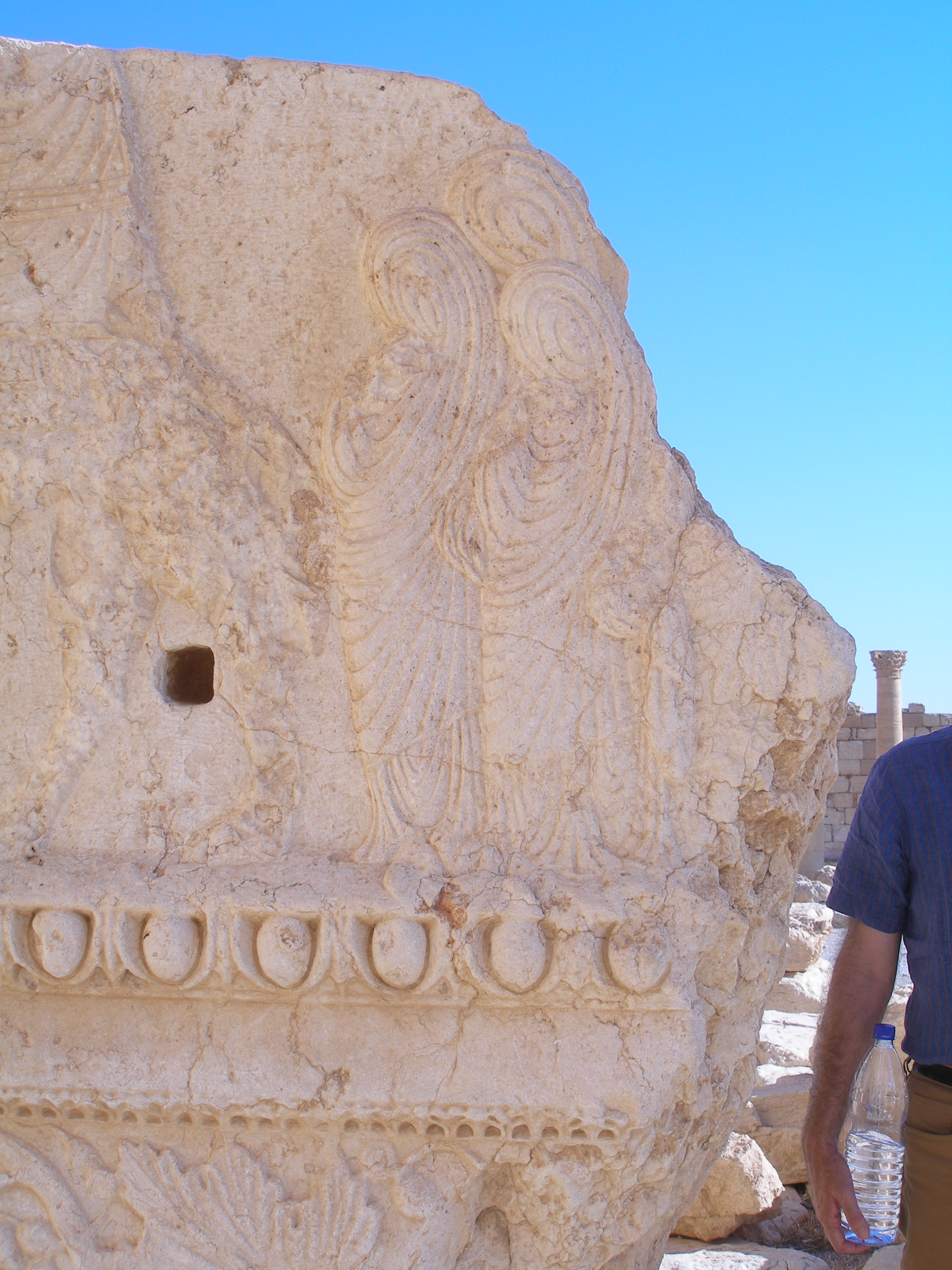
This carved block at Palmyra pre-dates the advent of Islam by four centuries, and is thought to show the world’s earliest representation of veiled women, top right. It is one of the countless examples of how practices we now consider Islamic were often traceable to pagan times.

The early Muslim armies captured Damascus in 636 just four years after the death of the Prophet Muhammad, and went on to make it the capital of their Umayyad Caliphate. It was the first encounter Muslims had with cultures of the Eastern Mediterranean and Mesopotamia, cultures which were themselves the products of rich intermingling of Babylonian, Assyrian, Egyptian and Persian influences and which had in turn been under Greek and Roman influence for centuries. Commerce, as ever the driver of human inter-action, was thriving as new trade routes evolved, while religious and cultural trends co-existed.

The Umayyad Caliphate, far from seeking to ban or wipe out this multicultural heritage of earlier empires and civilisations, simply took over the existing infrastructure from the previous Byzantine and Sassanian rulers, going on to develop its own unique contribution to the art and architecture of the region. The Umayyads absorbed and adopted the customs of the cities they conquered. With the fall of borders, they unified the region thereby encouraging additional cross-fertilisation of ideas and artistic traditions. The results can be seen in all their buildings, from Jerusalem’s famous Dome of the Rock to the lesser known desert palaces like Mushatta (see photos below) and Khirbat Mafjar now scattered all over the deserts of Jordan, the West Bank and Syria.

Mshatta facade 2mshatta facade

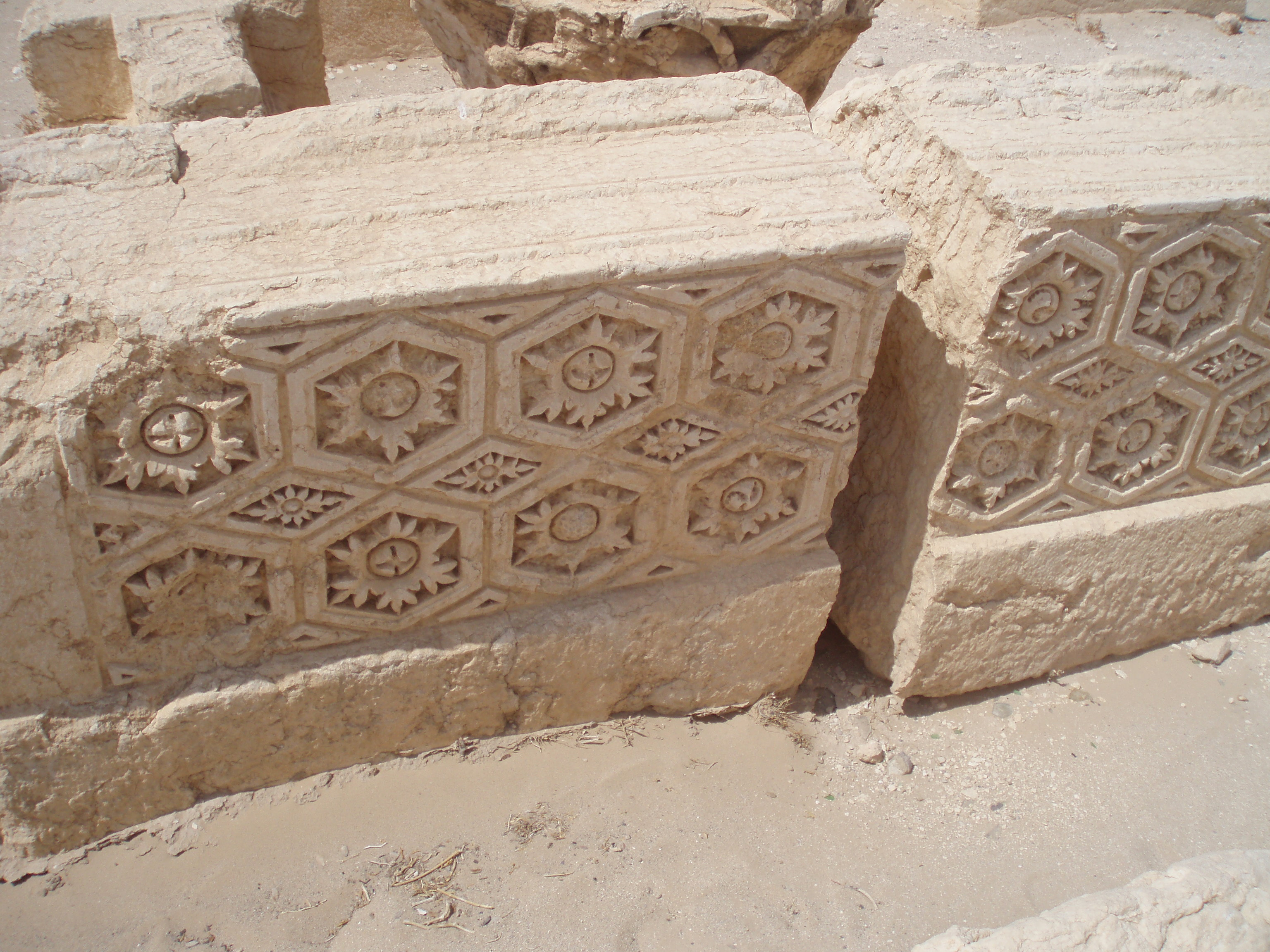
When it comes to the case of Palmyra, this rich cultural legacy is especially clear. The carved stone blocks carry motifs of flowers, including the famous Palmyrene Rose, ringed with acanthus and lotus leaves.

OLYMPUS DIGITAL CAMERAOLYMPUS DIGITAL CAMERAOLYMPUS DIGITAL CAMERA

The Palmyra drawings by English architects Wood and Dawkins went on to influence directly the classical revival of the 18th century, where Palmyrene roses are often to be seen on the ceilings of grand British country houses.

The Umayyad desert palace of Qasr al-Hayr al-Sharqi which stands in the desert some 100km northeast of Palmyra, has a mosque which incorporates columns and capitals brought from the site of Palmyra. The architecture of its monumental gateway displays an eclectic mix of Byzantine, Mesopotamian and Persian styles, with many recycled Roman and Byzantine capitals. Its twin, Qasr al-Hayr al-Gharbi, which lies in the desert  80km southwest of Palmyra, likewise boasted a monumental 8th century facade, now incorporated into the modern entrance of the Damascus National Museum.

OLYMPUS DIGITAL CAMERA

These fusions are clearly visible in the vine scrolls, the bunches of grapes symbolising wealth, fertility and prosperity in both the stone carvings of Palmyra and the decorative patterns of the Umayyad palaces, not to mention later Islamic tile patterns.

OLYMPUS DIGITAL CAMERAOLYMPUS DIGITAL CAMERA

Mythical creatures like griffins, together with birds like peacocks and eagles, animals like gazelles and lions are often found entwined in the Tree of Life, an ancient concept pre-dating Islam by centuries, yet all such motifs are still found on the borders of prayer rugs across the Muslim world. If ISIS claims that such things are idolatrous, it would also have to destroy most of the Islamic carpets and tiles of the Middle East.

And what of the many mosques across the Muslim world that were built on the foundations of earlier churches and temples, such as the Umayyad Mosque of Damascus?

OLYMPUS DIGITAL CAMERAOLYMPUS DIGITAL CAMERA

Would they too have to be destroyed, like these early Islamic mosaic visions of fantasised trees and palaces?

In the nihilistic vision of ISIS there is, it seems, no room for diversity. They have set their course on the total destruction of relics from earlier cultures, thereby denying the roots of the very Islamic civilisation to which they claim to be returning. By destroying Palmyra, they will be destroying their own roots, ensuring their own eventual downfall, since a caliphate devoid of culture cannot endure. What a perfect contradiction.

Schizophrenia in Damascus

Nothing in Damascus was as expected. Convinced there would be food shortages, I had vowed to eat very little during my stay. Yet while the besieged suburbs are starving, the central food markets are overflowing.

OLYMPUS DIGITAL CAMERA

The fruit stalls of Sharia al-Amin boast bananas from Somalia, the Bzouriye spice markets are buoyant with top-quality saffron from Iran and walnuts from Afghanistan. Lebanese wine and beer are freely available. Prices are higher than before, but still largely affordable for most people.

Sandwiched between the heavily-armed checkpoints, street stands selling thick hot Aleppan sakhlab, a sweet white drink, are everywhere.

Cafes and pastry shops are bursting with sticky delicacies, the famous Bakdash ice-cream parlour is buzzing with people as ever.

Bakdash ice cream parlour, October 2014

To judge from the carpets of cigarette butts on the pavements, smoking rates, always high, are higher than ever. In the main thoroughfare of Souq al-Hamidiya all the usual clothes and flamboyant underwear outlets are still thronging with customers – not a single boarded shopfront – quite a contrast to the average British high street.

Sporadically, in the days as well as the nights, shelling is disturbingly loud, but strangely offstage.

President Bashar al-Assad’s artillery is fired from Mount Qassioun, directly above the city, towards the eastern Ghouta region – the scene of last year’s chemical attack, whose pockets of resistance are still a thorn in the side of the government. Villages there have suffered a food blockade for the last 18 months.

But by all accounts there is much less noise than there was a year ago.

Mount Qassioun, seen from DamascusMount Qassioun, seen across the rooftops of Damascus

From that point of view, very gradually, life in central Damascus is getting better. Yet from other points of view, just as gradually, it is getting worse.

Beyond the 3.5 million who have fled the country as refugees, a further 7.5 million have been internally displaced – added together that accounts for half of Syria’s entire population. Homes which are left empty, if they have not been flattened, are vulnerable to immediate seizure by others – usually the owners have no idea who has moved in and it is too dangerous to go back and find out.

Almost as often, but rarely reported, Syrian homes are taken by profiteers, exploiting the weak or the absent.

My own house in the Muslim quarter of the Old City of Damascus, bought and restored in 2005, fell victim a few months ago.

It had been lived in for more than two years, from the summer of 2012 to the summer of 2014, with my consent by displaced friends whose homes had been destroyed in the suburbs. Now they had been evicted by my ex-lawyer and the previous owner conniving together to take it for themselves and split it 50:50.

Determined to get it back I recently returned to Damascus to throw them out and after 15 roller-coaster days, I succeeded. Things can happen surprisingly fast in Syria. You go to meet the judge one day, and he comes to inspect the house the next – without payment.

The old and the new doors to the houseA blacksmith made a new metal door to cover the smashed antique one.

Among the many moments of high drama were two break-ins, six changes of lock, the installation of two metal doors and the exposure of the bogus security reports which had led to my friends being evicted in the first place.

Bit parts were played by a fake general on a forged 25-year lease, and a Baathist single mother in the house with her newborn baby. It was with her that I felt most threatened by violence.

But in some ways life goes on almost as normal: dining with one friend in her 50s, whose car was lost in a random mortar attack, she explains how she now accompanies her 16-year-old nephew by taxi to play in the orchestra at the Opera House to make sure he is not picked up and enlisted into the army. At the checkpoints she clutches his cello between her legs so that the soldiers will not take it.

Checkpoints and road blocks in Yusuf al-Azma SquareCheckpoints and road blocks, such as this one in Yusuf al-Azma Square, are a common sight

Another friend works for the national electricity grid: his job is to repair electric cables damaged in the clashes. Over lunch at his home with his family, he tells me how one of his team stepped on a mine and was blasted to pieces in front of him – the man next to him had his eyes blown out.

He himself was lucky, escaping only with shrapnel in his intestine. He spent two weeks in hospital, two weeks at home recuperating, then went straight back to work. His attitude is simple: anyone who damages Syrian infrastructure is hurting the Syrian people.

The alleys of the Old City are full of children playing football. Many go to the school round the corner from my house.

Such is the overcrowding – some say Damascus’s population has risen from four to seven million because of internally displaced refugees – that their school-day is from 11:00 to 15:00, with one shift before them and another shift after them. They have 50 to 60 in their class but their enthusiasm to learn and to do their homework is undiminished.

The only other foreigners I saw on the streets were Iraqi Shia, men and women led round in groups to visit the shrines by a man wielding an orange lollipop sign.

When I met an old friend at the tourism ministry who still works at his office every day, he explained how this kind of religious tourism is now all they have left, some 200,000 pilgrims a year, after 8.2 million foreign visitors in 2010. He expresses no political views – he is just someone who has chosen to stay and do his job as best he can, like millions of others.

All over the country, even in ISIS-held Raqqa, I was reliably informed, government employees now draw their salaries direct from cash points on specific days, causing long queues outside the banks.

For the last two nights when I was finally able to sleep in my house in Old Damascus I experienced what everyone else has to suffer on a daily basis – scarcely four hours of electricity a day, no gas, no hot water, limited cold water.

It was tough, yet strangely invigorating, crossing the chilly courtyard to wash in a dribble of icy water, warmed by the knowledge I was surrounded by loyal neighbours who were looking out for me. Without them I could never have retaken my house: they protected me, helped me at every turn.

Bait Baroudi

A crisis brings out the worst and the best in people. What I found in Damascus was that a genuine kindness, a shared humanity and an extraordinary sense of humour are well and truly alive. Decent Syrian citizens are together doing their best to fight against immorality and corruption. Morale, in spite of everything, is high. Laughter keeps them sane.

Not once did anyone mention sectarianism. “DA’ESH” (the Arabic acronym for ISIS used across the Middle East) was universally condemned as beyond the pale.

How much longer, as the war approaches its fifth year and the number of greedy opportunists in society increases, such neighbourhood camaraderie can survive is an unanswerable question. But after this fortnight in Damascus I am more optimistic than before.

Diana Darke, Middle East cultural expert and Arabic speaker, is the author of My House in Damascus: An Inside View of the Syrian Revolution, new 2015 edition now available as paperback and e-book from:

http://www.bookhaus.co.uk/shopexd.asp?id=11301

My House in Damascus

Related post:

http://www.bbc.co.uk/news/magazine-30494989


Syrian Literary Festivals

This October My House in Damascus: An Inside View of the Syrian Revolution will be featured in three literary festivals:  Cheltenham, Henley and Wimbledon. Full details below with booking via their websites.

First, on Saturday 4 October 2014 at Cheltenham:

In association with Waterstones

diana darke cover - Copy.jpg

PRESENT TENSE: SYRIA

QUICKFIND L066

SAT 4 OCT 2014 9:00PM – 10:00PM

THE STUDIO, IMPERIAL SQUARE

£8 – MEMBERS 10% OFF

If you are a member then login to book your tickets, if you’re not a member then find out how to become a member and get access to priority booking.
Public booking opens on Mon 01 Sep at 12:00pm

The-Times-Logo-March-2011.jpg

DETAILS

Anthony Loyd, The Times war correspondent who was recently injured reporting from Syria, evaluates the Syrian crisis with Diana Darke, author of My House in Damascus, and questions what might happen next.

All Literature events

MEDIA GALLERY

Syrian ‘World of Interiors’

My Damascus House (photo credit copyright Fiona Dunlop)

My Damascus House (photo credit copyright Fiona Dunlop)

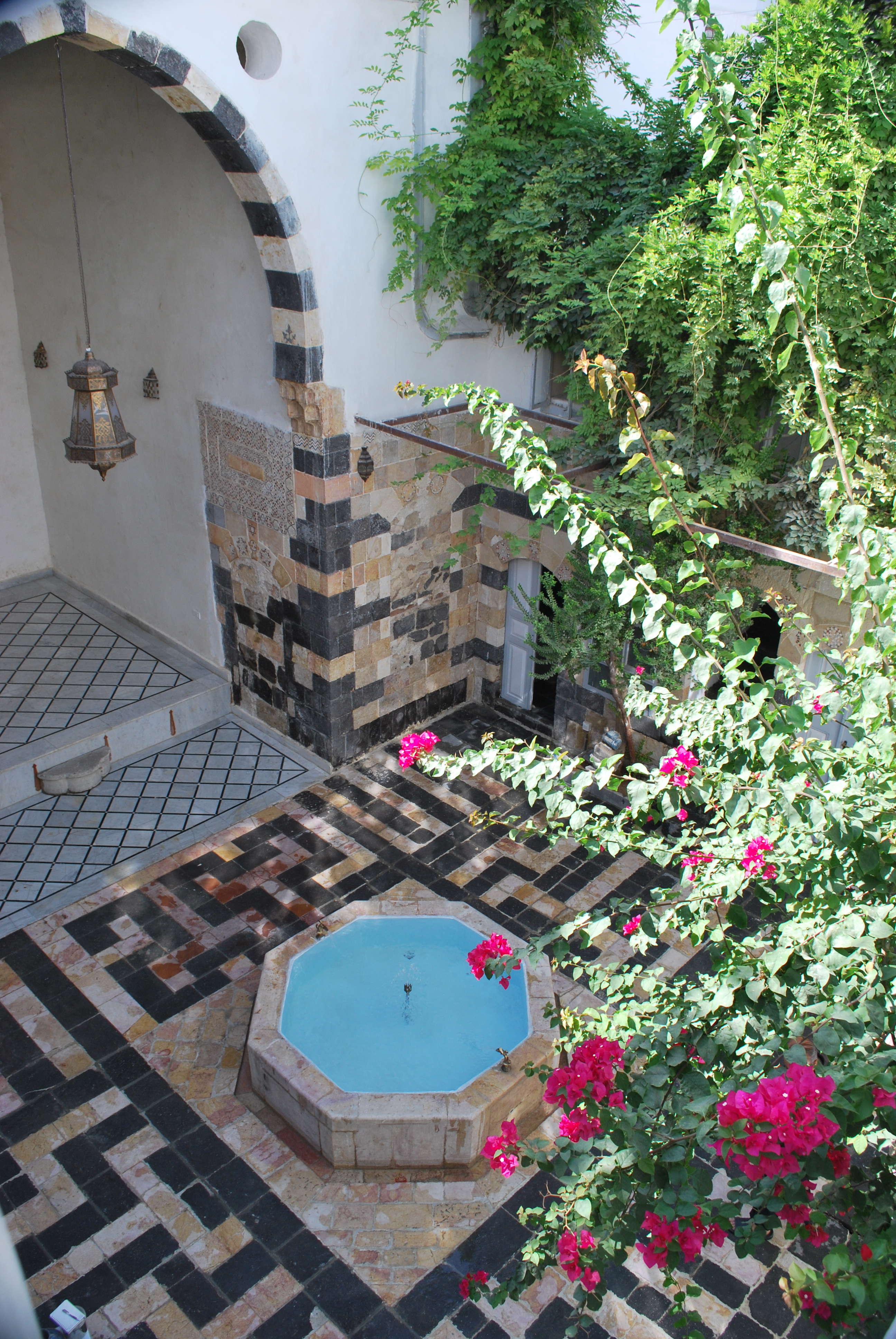
In peaceful times World of Interiors might easily have been the sub-title for My House in Damascus. The Arabic concept of the baatin meaning the internal aspect that can only be sensed, as opposed to the zaahir  signifying the outward visible surface, is one of the leitmotivs of the book, re-awakened from my distant undergraduate days studying medieval Arabic literature at Oxford. From the outside the historic house I bought nine years ago in Old Damascus presented nothing but a plain facade, but on the inside it was a secret world. Even after a lifetime’s specialisation as an Arabist, I had never dreamt of buying property in the Arab world. But a chance encounter with an antiquities architect whilst researching a guidebook to Syria led me in an unexpected direction and together we spent four unforgettable years of restoration and discovery.

Inside that sanctuary I have experienced, more than anywhere else, a powerful sense of unity with nature and with my surroundings. The way the light stroked the ancient stones, the way the vibrant bougainvillea fell in a magenta trail, the way the palm doves swooped from their nests in the heavy foliage to peck at invisible delicacies, the way the tortoise meandered silently in and out of the shadows. The music of the call to prayer from the myriad mosques echoed round the walls and on Sundays the church bells chimed in melodiously.  Overwhelmed by the palimpsest of Syria’s complex past and present embodied in the multi-layered heritage of the house, I felt embraced as if by some archetypal womb.

To reach that point was hard. The path was strewn with near-impassable obstacles, blocked with bureaucratic nightmares beyond imagining.  But Syrian friends patiently helped me through the labyrinth. Only after painstaking deconstruction did I get there, a process which came to be symbolic of Syria’s own years of deconstruction, still alas ongoing.

First the breezeblock wall dividing the courtyard two-thirds one-third had to be pulled down to reunite the space as one, a move I identified as the reunification of Syria’s population, broadly two-thirds Sunni Muslim, and one third minorities like Kurds, Alawis, Christians and Druze. Next the uniform white-painted cladding had to be stripped off the walls revealing the centuries-old stonework of contrasting soft limestone and black basalt. This was a particularly lengthy stage, as we chipped away carefully with hand tools, struggling not to damage what lay beneath. The uniform cladding of the Ba’ath Party system and the tentacles of its omnipresent security system have been suffocating Syria’s identity for the last 50 years. Concrete is tough stuff.

Even so, the day will surely come when Syria too has its rotten infrastructure, its faulty wiring and its dodgy plumbing ripped out. Like the house, it will gradually emerge from the wreckage, as kaleidoscope colours begins to blend subtly with mellow shades from across the ages. The human quest for the perfect space – what I found in my magical courtyard – will never die.  Once ‘tasted’, as Islam’s greatest philosopher Al-Ghazali  wrote, the memory cannot be taken away. Today’s tragedy inside Syria leaves many wondering  how and when it will all end. How can a nation and its people endure such suffering?

Yet what I have learnt from my Damascus courtyard, is that despite the extremism and corruption currently ravaging the country, Syria’s core identity, firmly-rooted in centuries of moderation and tolerance, will survive. Its  zaahir looks hideously damaged, but its  baatin, its ‘World of Interior’ will remain intact.

The 'secret ceiling', an accidental discovery, that comes to represent the multi-coloured complexity of Syrian society [DD, 2013]

The ‘secret ceiling’, an accidental discovery, that comes to represent the multi-coloured complexity of Syrian society [DD, 2013]

As published in World of Interiors, August 2014, under Journal of an Arabist:

In renovating the house she bought in Damascus in 2005, Diana Darke has chipped away at the modern layers to find the harmonious structure beneath. A similar deconstruction is needed to recover the tolerant, pluralistic  Syria hidden by war.

‘My House in Damascus: An Inside View of the Syrian Revolution’ is published by Haus, Amazon price match paperback and ebook£10.49:

http://www.bookhaus.co.uk/shopexd.asp?id=727

My House in Damascus


Saving #Syria’s Cultural Heritage – how to help

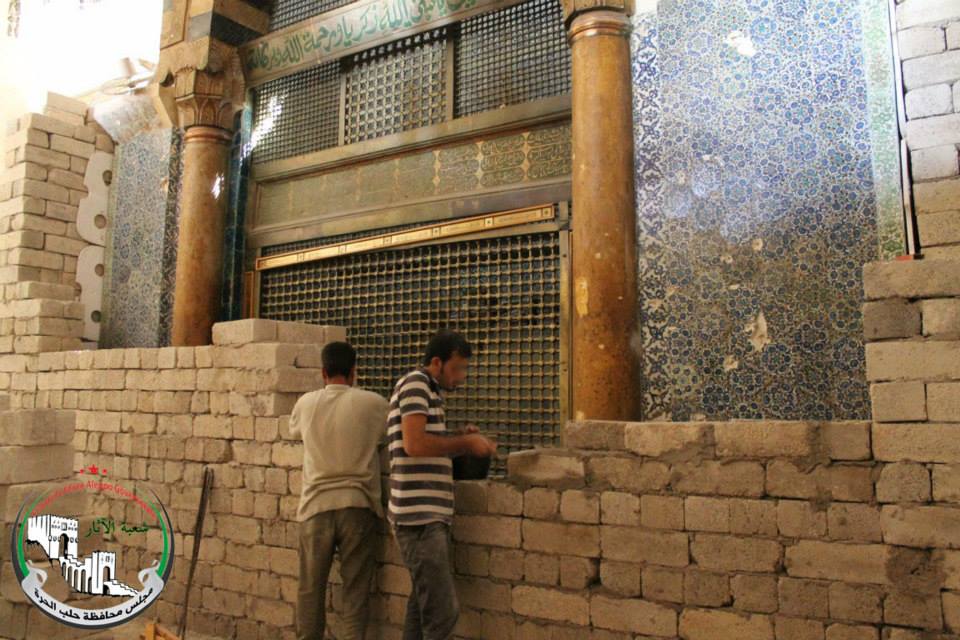
Bricking up the 13th century prayer niche of the Halawiye Madrasa, Aleppo

Bricking up the 13th century prayer niche of the Halawiye Madrasa, Aleppo

Little known and little recognised, groups of Syrians inside Syria are working together to try to save the destruction of their country’s cultural identity. Confronted with the inertia of the international community, the occasional statement and handwringing from UNESCO and the Syrian government’s own narrative presenting itself as the custodian of the country’s rich treasures, these groups are taking matters into their own hands. A mix of academics, archaeologists, students and ordinary citizens with a deep love for their country, they have almost no funding and most are volunteers.

Protecting the tomb of the Prophet Zachariah, inside the Aleppo Great Mosque

Protecting the tomb of the Prophet Zachariah, inside the Aleppo Great Mosque

A recent study (by Heritage for Peace see link below) has shown that 38 organisations are involved worldwide in efforts to highlight the damage to Syria’s cultural heritage, including the big names like UNESCO, Blue Shield, the Global Heritage Fund, the World Monument Fund, ICCROM and ICOMOS. The overwhelming majority are talking shops, gathering data and posting it online. They are largely based outside Syria and function only through the official channel of the Syrian Directorate-General of Museums and Antiquities (DGAM) which in turn only functions in the regime-held areas of the country. Of these 38 organisations, 14 have been formed since 2011 specifically in response to the Syrian crisis, mainly from volunteer groups. Only six of the organisations are Syrian, working on the ground inside the country, and of these only three that we are aware of are taking pro-active, pre-emptive measures to protect ancient buildings. It is a chronic state of affairs, but such is their commitment to doing whatever they can that they are prepared sometimes even to risk their lives in order to protect and save their cultural identity.

Bricking up Zachariah's Tomb, Aleppo Great Mosque

Bricking up Zachariah’s Tomb, Aleppo Great Mosque

Aleppo, once Syria’s largest and richest city, is where such actions have been most prevalent. The Division of Antiquities of the Free Council of Aleppo was founded in 2013 and has sandbagged and walled up the precious sundial in the Aleppo Great Umayyad Mosque, and bricked up its shrine of the Prophet Zachariah. With the help of the Tawhid Brigade from the Free Syrian Army, they have dismantled its 12th century wooden mihrab for safe-keeping away from the front line.

The Syrian Association for Preserving Heritage and Ancient Landmarks was founded in Aleppo in 2013. Its members, many of them archaeology students from Aleppo University, at considerable risk to themselves, saved the stones from the fallen minaret of the Great Umayyad Mosque and have put them safely elsewhere awaiting reconstruction after the war. They also helped the Free Council of Aleppo with protecting the sundial and removing the mihrab.

Protecting the sundial in the courtyard of the Aleppo Great Mosque

Protecting the sundial in the courtyard of the Aleppo Great Mosque

The Association for the Protection of Syrian Archaeology (APSA) was founded in 2012 in Strasbourg by a group of Syrian archaeologists and journalists. Together with collaborators on the ground they have compiled an extensive website cataloguing the damage (www.apsa2011.com) and have also held short workshops in Turkey’s Gaziantep to train Syrians in techniques of how to record damage and how to carry out simple protection measures.

Syrian aircraft dropping barrel bombs to dislodge rebels from the Byzantine Dead City of Shanshara, Idlib Province

Syrian aircraft dropping barrel bombs to dislodge refugees sheltering in the Byzantine Dead City of Shanshara, near Al-Bara, Idlib Province

A team goes to document the damage at the Dead City of Shanshara, part of the UNESCO World Heritage site inscribed in June 2011, Idlib Province

An APSA team goes to document the damage at the Dead City of Shanshara, part of the UNESCO World Heritage site inscribed in June 2011, near Al-Bara and Kafaranbel, Idlib Province

All of this work goes unrewarded financially and unrecognised internationally. Syria’s concentration and range of cultural heritage sites far exceed that of neighbouring Iraq. Yet while Iraq benefited from a UN resolution in 2003 after the US invasion banning trade in its antiquities, the Syrian case has been largely ignored, complicated by politics. Stepping up to the challenge, the Global Heritage Fund UK has recently agreed to help by acting as a channel for funds for anyone who would like to help support this work. The sums involved are small by the standards of international organisations. But international organisations like UNESCO cannot operate inside Syria without the permission of the Syrian government – a permission which has not been forthcoming.

APSA is looking to raise £32,000. So far they have raised £6,400. If each of the 624,000 people who clicked to view the recent BBC feature highlighting the problem (see below) had been able to contribute just £1, the target could have been met 20 times over.

Anyone who would like to do something tangible to help can contact cgiangrande@globalheritage fund.org, or use the donation form below. Even small amounts will make a huge difference. Handwringing and nostalgia, alas, do not.

Global Heritage Fund – 2014DonationFormV2

Related links:

Click to access Towards-a-protection-of-the-Syrian-cultural-heritage.pdf

http://www.apsa2011.com/index.php/en/

http://www.bbc.co.uk/news/magazine-28191181

Presentation given on 30 June by Diana Darke and Zahed Tajeddin to the Global Heritage Fund UK on saving Syria's Cultural Heritage

Presentation given on 30 June by Diana Darke and Zahed Tajeddin to the Global Heritage Fund UK on saving Syria’s Cultural Heritage


Syria – a book to help you understand it differently

http://www.timeoutistanbul.com/en/books/189/My-House-in-Damascus-An-Inside-View-of-the-Syrian-Revolution

Full text of review in Time Out Istanbul by Pat Yale below:

My House in Damascus: An Inside View of the Syrian Revolution

Diana Darke was one of the first foreigners to buy a house in Damascus, offering her a unique view into the Syrian conflict.

Three years of increasingly savage fighting. More than 150,000 dead. Many thousands more injured. Nearly three million people turned into refugees. Another 6.5 million displaced inside their own country.

 The bald statistics for the damage done to its citizens by the Syrian conflict are utterly shocking, but for most people the initial “Something Must Be Done” attitude has gradually been replaced by a grim acceptance that nothing probably can be done in a situation that lacks clear goodies and baddies. And so we tune out the horror of it all, unable to focus on so much human suffering day by day.

 Into the void left by those who have turned away has stepped Syria guidebook writer Diana Darke, one of the first (if not the first) foreigners to buy a house in the country. Darke offers just the sort of first-person account of what has been going on that makes it possible for people to re-engage with the story. Her book ‘My House in Damascus’ describes how the chance sighting of an open door in the old city in 2005 brought her into contact with an architect engaged in the then-blossoming business of restoring the lovely old mansions.

 “You realize that you can buy property here,” he tells her, thus triggering a search for the perfect bolthole. It turns out to be the lovely if dilapidated house of Bait Baroudi just round the corner from the great Umayyad Mosque.

This is no story of love lost and refound against a Middle Eastern background. Darke was no ingénue, stumbling uncertainly into a country about which she knew little. Instead, she was an old hand with form in this part of the world, a fluent Arabic speaker whose research for the Bradt Guide to Syria had taken her to every corner of the country. Read her description of exploring the great Byzantine “Dead Cities” north of Aleppo and weep for what has almost certainly been lost.

But the heart and soul of the book is always Bait Baroudi, a courtyard house that still retained its lovely original decorations, albeit partially obscured, when she bought it. Darke poured her savings into a gentle restoration aimed at preserving the building’s heritage; when the work was completed after three years “the house looked and felt as if the inhabitants of earlier centuries had only just left.” But as she skips over the bureaucracy she encountered and revels in every detail of the restoration process, always lurking in the background is the knowledge of what is to come: the day when she will no longer be able to live in the house and its courtyard will have to be turned into a mini-refugee camp for some of those with whom she had worked over the years.

Despite the book’s subtitle, ‘An Inside View of the Syrian Revolution’, Darke doesn’t bother with the finer details of which armed group is doing battle with which other one. Instead she introduces us to a roll call of colorful characters – Ramzi the Philosopher, her state-imposed guide in the early days, Maryam the Christian bank manager, Marwan the lawyer, and Bassim the architect – all of whose lives are irrevocably changed as the conflict intensifies.

All books eventually come to an end but of course the story of the Syrian civil war has yet to reach its conclusion. As you turn the last page of the book you know that you can go straight online to continue reading on Darke’s blog, dianadarke.com. Tragically Darke herself is no longer able to get a visa to enter Syria, but in her blog she recounts the ultimate absurdity of when she travels to Sidon in Lebanon and meets up with Marwan. He hands her some rental agreements that she must sign to ensure that the refugees now living rent-free in Bait Baroudi will not be booted out by the authorities.

War may ravage and destroy people’s lives, it seems, but the wheels of the bureaucracy will keep on turning until the end.  Pat Yale

Damascus June 2011 061

Living in the eye of Syria’s storm

Book Review of My House in Damascus, An Inside View of the Syrian Revolution

by Mary Russell, The Irish Times, 28 June 2014

Diana Darke’s account of her life in the ancient city glows with an understanding of and affection for its people.

While so many commentators and journalists write about Syria the victim, and zoom in on the death and destruction of that great country, Darke affords the Syrians she meets the dignity of being individuals.

Click here for the full review:

http://www.irishtimes.com/culture/books/living-in-the-eye-of-syria-s-storm-my-house-in-damascus-1.1846142

My House in Damascus

To vote or not to vote – Syria’s elections

Prophetic 2007 poster of Bashar in Damascus' Hijaz Railway with the caption: 'We pledge allegiance to you with blood forever.' Blood drips from the words 'with blood'.[DD]

Prophetic 2007 poster of Bashar in Damascus’ s Hijaz Railway Station with the caption: ‘We pledge allegiance to you with blood forever.’ Blood drips from the words ‘with blood’.[DD]

As published in The Guardian on 2 June 2014:

http://www.theguardian.com/commentisfree/2014/jun/02/syria-election-vote-for-assad-or-else

What an irony. Fear of the Syrian government and its many-tentacled security apparatus is greater now even than it was before the revolution began.  Why should that be? The government is generously offering ‘reconciliation’ deals across the country, with gracious amnesties like the one that enabled several hundred rebel fighters to leave the exhausted city of Homs with light weapons in early May. Yet anyone who knows Syria from the inside knows full well that the Assad regime’s generosity and grace is to be feared above all else.

When peaceful calls for dignity and reform were met in March 2011 by crushing violence from the outset, the protesters knew what awaited them if they were arrested. Their bravery in breaching the fear barrier even to take part in such demonstrations is beyond admirable. Tens of thousands have gone missing over the last three years, detained in prison, never seen again, or sometimes simply returned to their families in a body-bag as a warning, like the mutilated body of the 13-year old Hamza Al-Khatib, early icon of the revolution. Like so many, Hamza was not even demonstrating – he was simply in the wrong place at the wrong time.

As the presidential election is held on 3 June all over the country in regime-held areas only, Syrians know full well what it means. It is not so much an election – everyone knows the result after all – it is more like a census, a head count of government supporters. To vote anything other than for Bashar Al-Assad is to sign your own death warrant and that of your family, and not to vote at all means you are forfeiting your chance of any kind of future in Syria. Of Syria’s 23 million population some 4 million are estimated to have left and some 9 million are thought to be internally displaced. At least a further million have lost their identity papers in the fighting and are thereby disqualified. Only refugees outside the country who fled ‘legally’ – just 200,000 out of 3 million according to the Syrian Ministry of Interior’s own figures  –  are eligible to vote, thereby ensuring a situation cannot arise where one of Bashar’s two opponents might actually win abroad.  These ‘legal’ expatriate Syrians can vote in Syrian embassies in certain selected countries like Russia and Romania, and those living in a country where the embassy is closed, like the UK, have been cordially invited back  to Syria ‘to exercise their civil right’. Some have taken up the offer knowing that they must, if they ever wish to return to their country while the Assad regime still holds sway. In Paris I was reliably informed of one Syrian who went, not to vote since France has banned the embassy from participating, but to renew his passport. Known to be anti-regime, he had his passport torn up in front of him and was told: ‘There – now go and get yourself a new passport from your Friends of Syria.’

In this country we face no repercussions for not voting – in Syria it is very different. ‘If you are not for us, you are against us.’ We in the West may dismiss the Syrian election as an absurd process, a mockery of democracy. We have that luxury. But if you are Syrian it is a matter of life and death.

Fear is forcing thousands to vote for Assad, whose tender mercies are well known. Stories are circulating about the ways in which the regime seeks to take revenge on those whom it considers have betrayed it. Even those who have done nothing and never taken sides are at risk. All it takes is one report written by one security official who takes a dislike to you. It has already happened to several of my neutral Syrian friends.

Whilst western democracies will scoff at Syria’s election process, Russia and Iran will use it to their advantage. It plays beautifully into their narrative of supporting ‘whoever is elected by the Syrian people’ and legitimises their unwavering support of Assad.

Syria has lost c40% of its GDP since 2011 according to the Damascus-based Syrian Center for Policy Research in conjunction with the UN and the IMF.  Eleven million have lost their livelihood. Fear of losing their right ever to live in their country again is driving them to vote. Hard as it may be for us to grasp, for them it is a vote for life or death.

#Syria – Sidon and Damascus, Theatre of the Absurd in a Tale of Two Cities

Sidon's Crusader Sea Castle guards what was once the port of Damascus [DD, 2014]

Sidon’s Crusader Sea Castle guards what was once the port for Damascus [DD, 2014]

Marwan, my chain-smoking Syrian lawyer, has left his war-torn country for the day to meet me in the Lebanese port of Sidon. He wants to complete some paperwork and tell me news from Damascus.

The Syrian accents at the tables all around us suggest he is not the only visitor. We sit with a view of Sidon’s Crusader Sea Castle and try hard to strike a holiday mood. He has brought magnificent gifts of Damascene produce – dried apricots, almonds and seed-covered biscuits.


Sidon's souks are just like Damascus's - even the doves are the same. [DD 2014]

Sidon’s souks are just like Damascus’s – even the doves are the same. [DD 2014]

He refuses a meal, even though the journey has just taken him six hours thanks to overcrowding on the border. His only appetite is for tea and cigarettes.

“What news of Abu Khalil?” I ask. Last time it was he, my elderly caretaker, who came out to meet me, so proudly braving the checkpoints from his village east of Damascus. But that was where the massive chemical attack took place last summer.

“He’s been blockaded in his village since October,” says Marwan. “It’s easy to get money to him. We give it to someone going in on the special buses. But food is impossible. The soldiers search the buses and throw away whatever they find.”

We almost laugh at the absurdity, but more absurdity follows.

Marwan asks me to sign the rental contracts for the refugees living in my Damascus house. They pay no rent, but this is vital documentation they must show when regime soldiers call round unannounced. Without it, arrest and imprisonment will follow. Each street is cordoned off in turn, each person’s papers checked, each room searched for weapons.

I ask about the checkpoints inside the Old City. “Are the lijaan sha’bia (peoples’ committees) still guarding the neighbourhood?”

“Yes,” he replies, “but now they are all either very old or very young. The young ones are easily recruited because of the salary. Their families are desperate for the income, so they agree to it, thinking their sons will be just round the corner. But sometimes the boys are transferred with no warning to the frontline, lambs to the slaughter. They come back to their families in a body-bag labelled ‘shaheed’ (martyr) with a pittance as compensation, but no one dares say anything.”

We cannot laugh, but both of us sense more absurdity, not least because of where we’re sitting. Sidon is in some ways a mini Damascus-on-Sea, a tinderbox just 40 minutes’ drive south from Beirut. There are photos all over town of one of Sidon’s most famous sons, the former Lebanese prime minister Rafiq Al-Hariri, who was blown up on Valentine’s Day 2005. Sidon’s buildings bear the scars of Lebanon’s own 15-year-long civil war.

Banner of Rafiq al-Hariri adorns the Khan al-Franj, caravanserai of the Franks, restored by Rafiq al-Hariri to be a craft centre and tourist office, now empty [DD, 2014]

Banner of Rafiq al-Hariri adorns the 17th C Khan al-Franj, Caravanserai of the Franks, restored by the Hariri Foundation to be a craft centre and tourist office, now empty [DD, 2014]

Sidon's Khan al-Franj, once seat of bustling commerce, sits empty [DD, 2014]

Sidon’s Khan al-Franj, once seat of bustling commerce, now languishes unused [DD, 2014]

 Like Damascus it has a Sunni Muslim majority, a sizeable Christian minority and Palestinian refugee camps incorporated in its suburbs. The same blend of church towers and minarets rises from its bustling bazaars. But it also shares the increasing sectarian flare-ups, like the arson attack on a Sidon mosque that happened the very next day. The highly combustible city is surrounded on all sides by Hizbullah, the well-disciplined Lebanese  Shi’ite militia led by the cleric Hassan Nasrallah. We joke grimly about how in Damascus Hizbullah is considered not the enemy but the ally, openly fighting alongside President Bashar Al-Assad to keep him in power.

Marwan flicks his ash compulsively.

“God knows,” he says, “how Syria will ever get out of this swamp. Now the regime is preparing us for the June elections, being gentler with us at the checkpoints, announcing a policy of ‘musaalaha’ (reconciliation), freeing prisoners and doing deals to let people back into their homes in the suburbs. Their slogan is everywhere, ‘Bashar al-Assad ila al-Abad’ It’s a rhyme which means ‘Bashar al-Assad forever’.”

You realise,” Marwan continues, “that if he gets voted in a third time, like his father, the constitution says it is for life. Hafez Al-Assad was born in 1930 and ruled for 30 years; Qaddafi was born in 1942 and ruled for 42 years; Bashar was born in 1965 – so maybe he will rule for 65 years!”

We laugh uncontrollably.

“How do you feel about going back?” I ask, when I have recovered.

His laughter erupts again.

“I have the female Russian teachers to look forward to, now that Russian will become our first language. Farsi will soon become our second, there are so many Iranians on the streets. And Hassan Nasrallah is billed as our saviour, side by side with Bashar on the posters.

Damascus feels safer to me than Sidon!” Marwan insists. And he explains, “The regime’s control is so tight, nothing can happen there. Sidon might explode. Damascus cannot. The regime has taken out the fuse!”

First broadcast on Friday 28 March 2014:

http://www.bbc.co.uk/iplayer/episode/p01vzjqj/From_Our_Own_Correspondent_Cyprus_and_Lebanon/

Starts 4.12 mins in. Full text above. Identities changed.

Sidon's old souks are indistinguishable from the souks of Old Damascus [DD, 2014]

Sidon’s old souks are indistinguishable from the souks of Old Damascus [DD, 2014]

Interior of Sidon's Great Mosque, formerly Church of St John of the Hospitallers - Damascus's Great Mosque was formerly the Cathedral of Jhn the Baptist. [DD, 2014]

Interior of Sidon’s Great Mosque, formerly Church of St John of the Hospitallers. Damascus’s Great Mosque was formerly the Cathedral of John the Baptist. [DD, 2014]

Debbane Palace in Old Sidon, now restored as a museum. 200 refugees sheltered here for five years duing the Lebanese Civil War [DD, 2014]

18th C Debbane Palace in Old Sidon, now restored as a museum. Hundreds of refugees sheltered here for five years during the Lebanese Civil War [DD, 2014]

Entrance to Sidon's Great Mosque, once the Church of St John of the Knights Hospitaller, restored by Rafiq al-Hariri and winner of the 1989 Aga Khan Award for Architecture [DD, 2014]

Entrance to Sidon’s Great Mosque, once the Church of St John of the Knights Hospitaller, restored by the Hariri Foundation and winner of the 1989 Aga Khan Award for Architecture [DD, 2014]

Crusader vaulting in Sidon's Great Mosque [DD, 2014]

Crusader vaulting in Sidon’s Great Mosque [DD, 2014]

As the #Syrian uprising enters its 4th year, some reflections

Damascus' Great Umayyad Mosque with its Jesus Minaret

Damascus’ Great Umayyad Mosque with its Jesus Minaret [DD]

In a recent clear-out of my study I came across a Syria Today magazine with the cover feature “Unlocking Civil Society”, 15 pages of in-depth coverage of how civil society inside Syria could move forward. It was dated March 2010. Re-reading the feature now, after three years of devastating conflict, is especially poignant.

I was in Damascus during March 2011 when the first peaceful demonstrations took place. On 15 March I even tried to find them, but they were over so quickly I could not get there in time. The atmosphere inside the city was tense and the regime was very edgy, all too aware of what had just happened in Tunisia and in Egypt. Police and security officials were under instruction be to nicer to members of the public, not to do anything that might provoke a reaction. For a brief and wonderful interlude, drivers were waved on at red traffic lights, and government offices became places of politeness,  joviality even.

Three days later, the instruction was broken. The over-zealous governor of Dera’a ordered troops to fire on a crowd of protesters whose children had been arrested for drawing graffiti, resulting in the first deaths of the revolution. The die was cast, and as protests quickly escalated all over the country in the following weeks, the government response switched to its default setting – violence.

The scale of what has happened since defies credulity – at least 140,000 dead, untold thousands injured, missing or imprisoned, 6.5 million internally displaced and 2.5 million forced to flee as refugees to neighbouring countries. Where is it all heading?

Every Syrian I have ever spoken to about what they want for the future of the country has always said the same thing, namely, that top levels in government, the police, the armed forces and the security services should leave the country, that the rest should stay, and that a transitional temporary government should be put in place till new elections. Thereafter the priority would have to be reconciliation. Those without blood on their hands would have to be forgiven and re-assimilated. Most Syrian people are proud of the diversity of their society and want to preserve it. Its loss makes them value it all the more and they want it restored as soon as possible. Syrians have a very distinctive character, even the poorest ones. They have a natural sense of dignity and identity, a strong sense of self. It must somehow be the legacy of their deep and rich Syrian history, absorbing  the complexities of many cultures that have ruled the region over the centuries.

The timing of the country’s descent into war was particularly ironic in Damascus: the new EU-funded Modernisation of Administration Management (MAM) project had just come to fruition with a series of themed walks round historic Damascus; the new basalt paving in all the neighbourhoods of the Old City around Straight Street had just been completed; and Al-Jaza’iri’s famous 19th century house on the Barada River just north of the Old City had just been restored and was serving as a museum and regional centre for sustainable development.

The last time I was inside Syria in April 2012, Christian and Muslim friends alike agreed that the Ba’ath Party had destroyed the country. For over 40 years they destroyed the education system, with a kind of brainwashing of the young in state schools, a Bashar cult, making all children worship, obey and love him.  Both Hafez al-Assad and his son Bashar settled their fellow Alawis in the mountainous parts of Damascus like Mezzeh 86 close to the Presidential Palace. After the 2006 war in Lebanon between Israel and Hizbullah, Bashar was very influenced by and impressed by Hassan Nasrallah because of their success in bloodying Israel’s nose. He became closer to Iran and the Shi’a at that time. Lots of Sunnis were actually paid to become Shi’a, given salaries.

The last voting farce inside Syria was the February 2012 ‘referendum on the constitution’. Syrian friends living in the city told me no one went out to vote except those who had their IDs taken away at checkpoints and were therefore forced to go and vote in order to get them back again. Government employees were obliged to vote of course, but most ordinary people stayed at home and were very angry at the way the Syrian state TV then showed people queuing at voting booths, presenting it so misleadingly, as if 86% of people really went out. It made even the doubters realise what this regime would do to stay in power. In Damascus the streets in the Old City and elsewhere were full of banners for candidates, men in their 30s, 40s and 50s, with slogans below reading  something like: ‘Your independent candidate for Damascus’. It was ridiculous and fooled no one. Not one of the men was ‘independent’ All were regime-sanctioned.

A similar farce awaits the country with the upcoming presidential elections in June. On 13 March 2014 the Syrian parliament unanimously approved a new election law permitting other candidates to run against Bashar al-Assad for the first time. Theoretically this is wonderful – in practice it will be the same as the constitution vote, entirely controlled from behind the scenes, with approved candidates notionally standing against the president. The constitution states that:

  1.  A candidate must be Muslim
  2. A candidate must have the support of 35 members of the parliament
  3. A candidate must be 40 years old or more
  4. A candidate must have lived in Syria for 10 years before the election
  5. A candidate must be Syrian by birth, of parents who are Syrians by birth
  6. A candidate must not be married to a non-Syrian spouse

By these rules all external opposition figures are rendered  ineligible.

Given that the ‘international community’  cannot agree on anything about Syria except that the statistics are terrible, Syrians are on their own. No one is coming to their rescue. The rich have mainly left to start new lives abroad. Those that are left behind will need to work overtime if Syrian civil society is ever to free itself from the 43-year stranglehold of Assad rule. Syria deserves to be rescued and needs all the help it can get. It will be a long struggle but I am certain it will eventually succeed.

Young and old arm in arm in Damascus {DD}

Young and old arm in arm in Damascus {DD}

Post Navigation