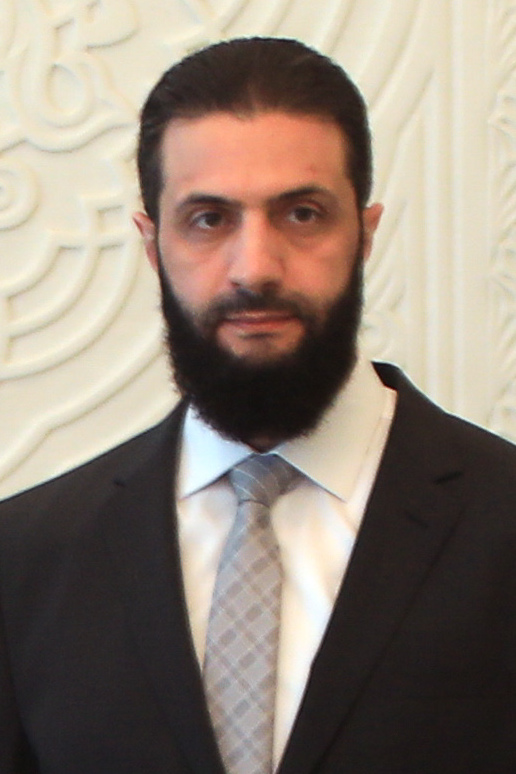
Tonight Donald Trump announced he will order the lifting of sanctions on Syria ‘to give them a chance at greatness’. It is a momentous declaration of confidence in the new man at the top, a man widely dismissed in the West as a religious militant, a jihadi extremist.
I am writing this post tonight because I profoundly disagree with the profiles put forward in recent months of Ahmad al-Sharaa, formerly Abu Muhammad al-Jolani, by The Economist, the Financial Times and The New York Times. They are all obsessed with his past, with his changes of direction and allegiance, with what they call his ‘chameleon’ nature. They are also convinced that he is driven by a lust for power, calling him ‘the great pretender.’
In my view, they are wrong. They misjudge and misunderstand the man, basing their analyses on the factual details they have been able to glean from various sources about al-Sharaa’s previous history and his background. They do not understand how his brain works, with some even confessing that they are puzzled by how he has managed to persuade other people to follow his directives and gain a following.
Here, I should reveal that I have an extra tool at my disposal – namely, a professional qualification in graphology earned over twenty years ago which enables me to analyse his handwriting and to see into his mind, to understand his motivations and his priorities. Handwriting is brainwriting and cannot lie. Through its subconscious elements like spacing, flow, direction, continuity, pressure and speed, it reveals the secrets of a person’s makeup, their character, their drive, their moral integrity, their strengths and weaknesses. These are elements that apply irrespective of the language or the script. I was trained on English and French handwriting, a two-year course of study with French external examiners in written and oral papers, but the same principles apply in Arabic, or indeed in any other language. Obviously when talking about a script direction being progressive, in English progressive is left to right, while in Arabic it is right to left. For regressive it is the other way round – in Arabic left to right, in English right to left.
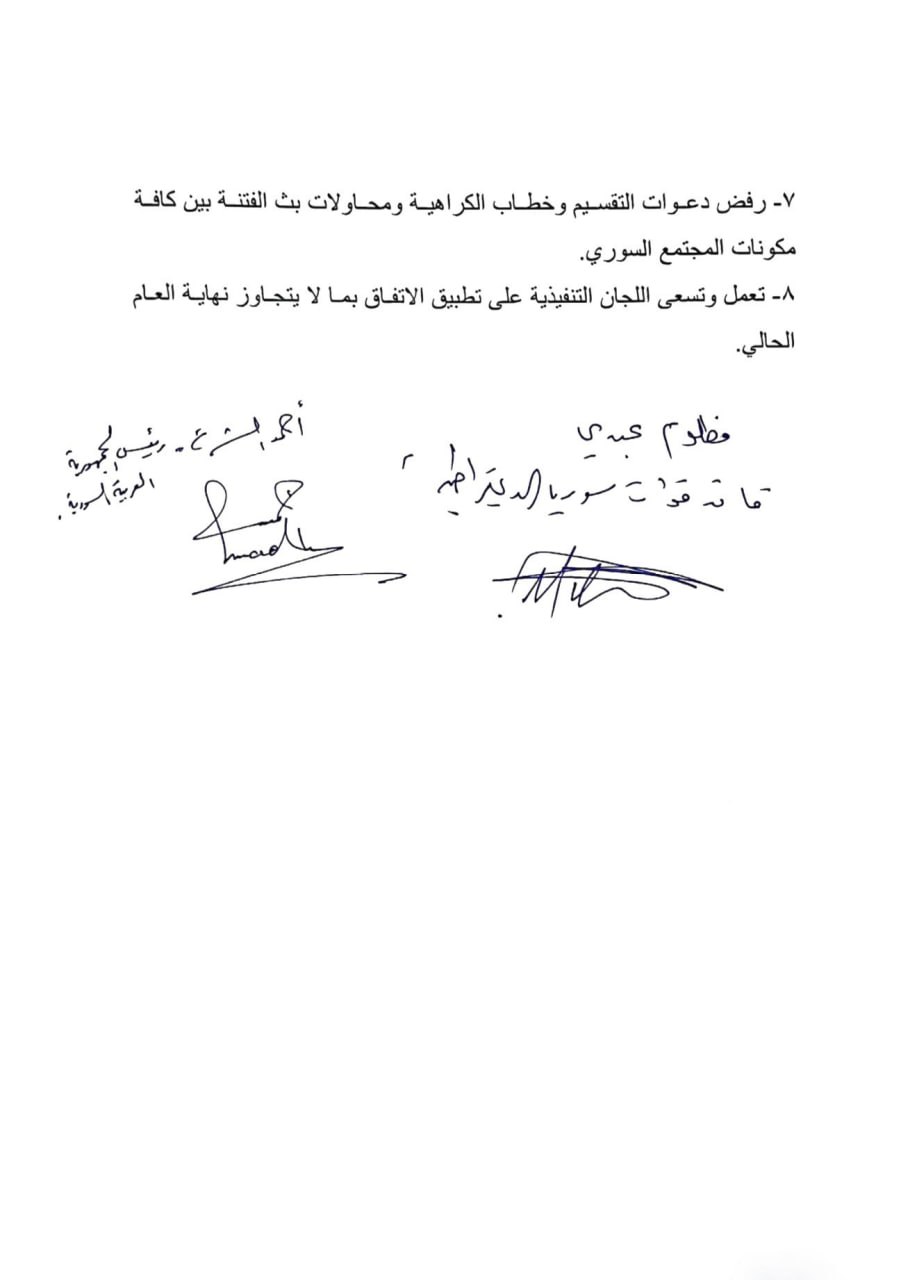
Let us look at the case of Ahmad al-Sharaa. I first saw his handwriting when it appeared online at the end of the 10 March 2025 agreement signed between him and Mazloum Abdi, commander of the SDF, the Kurdish-led Syrian Democratic Forces. The contrast between the two men’s handwriting and above all their signatures was striking.
Looking at Mazloum Abdi, his signature is not progressive, but doubles back over itself, unsure of its direction, hesitant, and ends in an unnecessary and cautious dot. Bashar al-Assad, incidentally, had a cautious, self-cancelling signature that tried to big itself up in energy-wasting flourishes that lacked direction. Some years ago I wrote a comparative analysis of Assad father and son, concluding that while Bashar might have been the face of the Assad regime, he was certainly not its backbone.
Ahmad al-Sharaa on the other hand has the most remarkable signature I have ever seen, in English or in Arabic. The sheer ingenuity and agility in the way it is formed is astonishing. It begins in the top right corner with the four Arabic letters of Ahmad – alif, Ha, mim and dal, before moving back towards the right and seamlessly becoming the letters of Ahmad in English – A, h, m, a, d. The free-flowing movement at the end of the Arabic ‘dal’ cleverly doubles as the ‘A’ of the English Ahmad. The signature then reverts to the Arabic ‘al-‘ of the start of his family name, before ending in a final progressive flourish where the letters of Sharaa are not legible. There are four changes of direction, and the pen never leaves the paper. It is all one smooth stroke, carried out at speed. The movements throughout are highly progressive, never regressive. This is a man who only moves forwards, never backwards, and who is always open to all manner of solutions, approached from a variety of angles. He thinks outside the box and shows great adaptability and flexibility, whilst remaining true to his own vision. He is not driven by greed for power or money, but rather by a genuine belief that he has the ability to bring Syria forward into a new and progressive future. He is not dogmatic, stubborn or difficult.
His writing illustrates clearly the complex journey he has been on in his life to arrive at where he is now. His many changes of direction have been integral and necessary parts of his life. A signature of this complexity has taken many years to evolve, and certainly did not suddenly appear on 8 December 2024 with the fall of Assad. It is not just pragmatism, as western analysts like to describe it. It is far more than that. It is his ability to adapt quickly to changing situations and to move progressively with the flow of events as they unfold. This is a skill that requires deep intelligence, thoughtfulness and good judgement combined, all exercised simultaneously and at pace. On top of that there is also an element of playfulness and humour, making him likeable and popular. The New Syria would be hard pushed to find a better man to navigate the challenging road that lies ahead.
When Russia entered the Syrian war in September 2015, I started to watch RT, Russia’s state-controlled TV network. That’s a six-year dose of studying how Russia projects its worldview to a global audience, a master class in alternative reality and information manipulation. These same techniques are now being reprised in Russia’s reporting of its “special military operation to liberate Ukraine from neo-Nazis.” All independent media outlets in Russia have been forced to close, ensuring that only President Vladimir Putin’s version of events reaches Russian ears and eyes.
The Arab proverb, “He who speaks the truth must not pitch his tent near ours,” might have been written for Putin. With skills honed through decades of working for the KGB, including time spent as a liaison officer to the Stasi in East Berlin, President Putin is a true aficionado of the art of disinformation. He knows how important it is to seize the narrative from the outset and never to deviate from the script. Syria provided him the perfect training ground for Ukraine. RT journalists were allowed free rein inside the country to report the Russian government’s version of events, while Western journalists were denied visas. Russian media repeatedly discredited the work of the White Helmets, whose first-hand film footage of Russian and Syrian regime airstrikes on schools, hospitals, and markets across the country flatly contradicted Russian propaganda. The BBC extensively researched and exposed this tactic in their Intrigue: Mayday podcast series.
To counter Western outrage in Ukraine, Putin uses tactics familiar from Syria, claiming Russian attacks were faked or that Ukrainians themselves conducted them as part of an anti-Russian smear campaign. In Syria Russia claimed to conciliate, while simultaneously denying humanitarian aid to rebel-held areas under siege, in the same way that humanitarian corridors for the evacuation of civilians are routinely thwarted in Ukraine. Residents under siege in Syria were given the choice — starve or surrender. When they eventually surrendered, the Russians brokered “reconciliation deals,” which were then reneged on. Russia used “de-escalation zones” as temporary strategic measures, allowing it to buy time to refocus on military efforts in other areas, exactly as it is doing in Ukraine now. In Syria it then broke the de-escalation agreements, blaming the “terrorists” for violations. To this day, the false narrative persists in many Western quarters that the Syrian war was all about fighting “terrorists” like ISIS. But research has established that more than three-quarters of the deaths in the Syrian war were perpetrated, not by ISIS terrorists and other extremists, but by the Assad regime and its supporters — Russia, Iran, and Hezbollah. ISIS and its ilk killed just 6%. Rarely did Bashar al-Assad and his Russian bosses target ISIS. Instead they went after the moderate opposition — as did ISIS — well aware that they were the real threat. Of the half million Syrians killed, the overwhelming majority were innocent civilians, women and children, not “terrorists.”
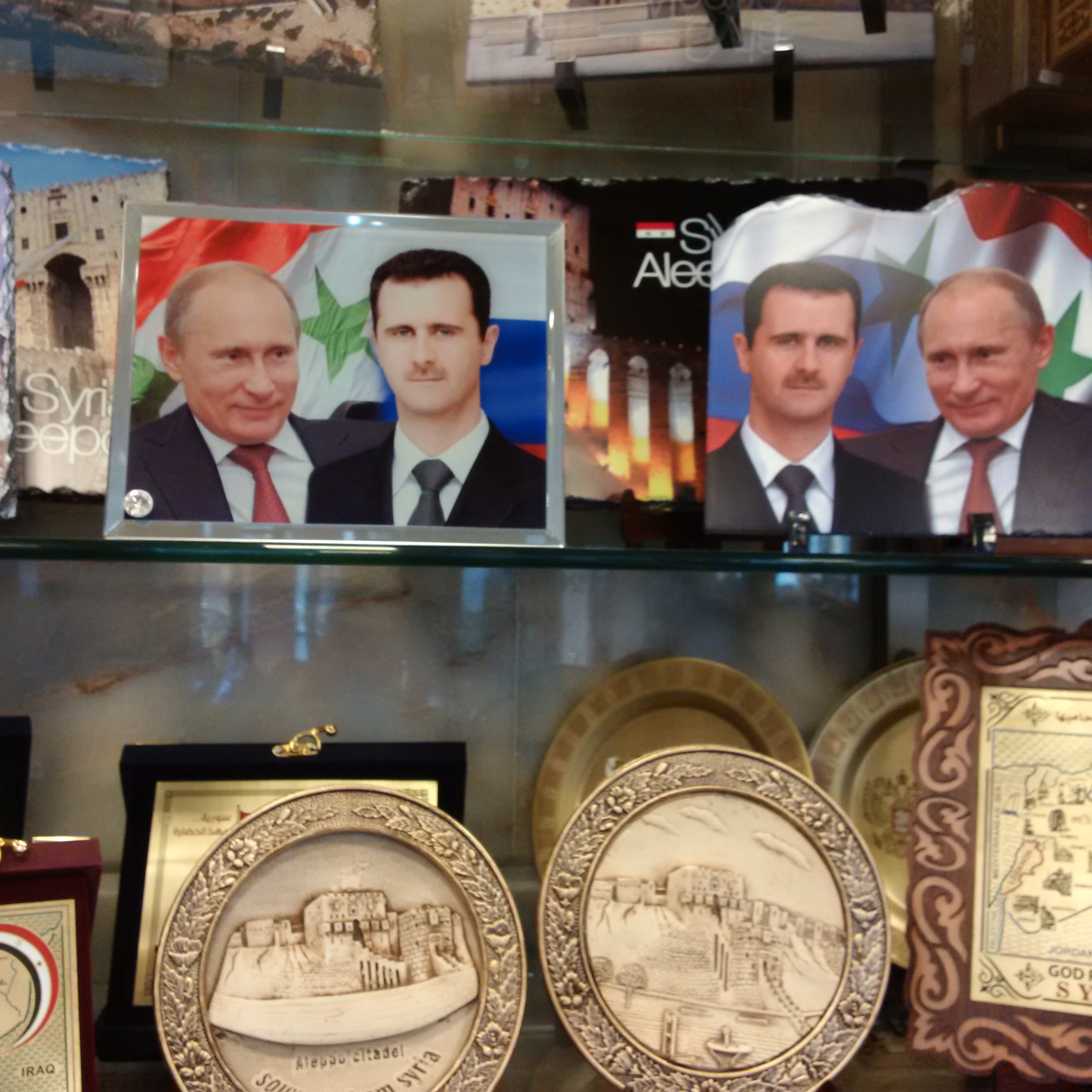
Putin and Bashar merchandise on sale in an Aleppo hotel, in April 2018, author’s photo.
As reports mount of chemical weapon use by Russian forces in Ukraine, expect more lessons learned in Syria. Russian media claimed the numerous horrific photos of dead gassed Syrians, uploaded by witnesses at the scene, were fakes, using “actors.” When teams from the Organization for the Prohibition of Chemical Weapons (OPCW) tried to reach sites to collect evidence, they were barred for “security reasons” and told that soldiers were making the area “safe.”
While Russian-sponsored trolls and bots were active on social media in support of Syria’s President Assad, just as they are today in support of Putin’s actions in Ukraine, Assad apologists, including respectable British academics and Members of Parliament, were seduced into parroting these Russian memes, causing untold damage to public perceptions of the Syrian war. The Times newspaper conducted its own investigation into such people. In April 2018 I myself travelled with a delegation dubbed “the Crazy Club” to undermine its message from within. Invited to visit and tour Syria by the Syriac Orthodox Church, we were treated like royalty, and it was easy to see how Christians throughout the 11-year war chose to align themselves with Assad to ensure their own survival. The same thing is happening today with the Russian Orthodox Church, where Patriarch Kirill in Moscow is standing by Putin, giving the Ukraine invasion his blessing and branding it “a Holy War.” By contrast, a multi-faith mission of Christians, Muslims, Jews, Hindus, and Buddhists led by Rowan Williams, former archbishop of Canterbury, has travelled, at some risk to themselves, to Ukraine to meet refugees, hoping to persuade President Putin and the Russian Orthodox Church of the error of their ways. Williams is even supporting calls for the Russian Orthodox Church to be excluded from the World Council of Churches.
If only a similar high-level multi-faith group had spoken out years ago against the way both President Assad and President Putin have used their relationships with the Orthodox Church to project themselves as guardians of the minorities, the war might have taken a different course and much bloodshed might have been avoided.
Instead, tragically, despite initially appearing to support anti-Assad protesters, Western governments, weary of Middle Eastern conflicts, and with no appetite for involvement, kept their distance, leaving a vacuum that first ISIS in 2013 and then Russia in 2015 stepped in to fill. Their inaction was a gift to Russia, emboldening Putin to pursue his goals in Ukraine.
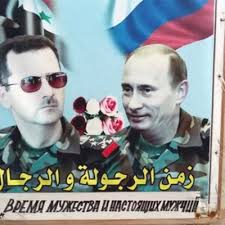
Bashar and Putin together in their ‘virility’ poster: the caption reads ‘The Age of Virility and Men’ in Arabic and in Russian.
Putin understood from the outset how to ensure Russia benefitted from the conflict. He enlarged the Russian naval base at Tartous and developed an air base at Hmeimeem near Latakia, extending the Russian state’s lease to operate them by 49 years. A Russian import-export village was established in Latakia port after 2015 and Russia’s military hardware was showcased. Putin boasted of testing over 320 weapons systems in Syria, while 85% of Russian army commanders gained combat experience in Syria. The cruelest and most efficient of them, Gen. Alexander Dvornikov, has now been appointed to take charge of operations in the Donbas region of eastern Ukraine.
Neither nation-building nor reconstruction were ever on the Russian agenda in Syria. On the contrary, the Kremlin was content to have a client state that was just stable enough to safeguard Russia’s interests, but not so strong that it no longer needed Moscow’s protection. The same is likely to be true in Ukraine, with Russia spending just enough money in areas it considers strategic, but avoiding large-scale investment that would bog it down, as happened in Afghanistan. Unlike Western governments that require clean endings and to bring their troops home, Russia has shown in Syria that it is comfortable with protracted low-level conflict, often using mercenaries as cannon fodder. In Ukraine battle-hardened Syrian soldiers are said to be recruited at 25 times their Syrian salary to fight for Russia. The Russian TV network Zvezda News, owned by the Russian Ministry of Defense, posted a recent video showing Brig. Gen. Suhail al-Hassan, “The Tiger,” commander of the Russian-backed elite 25th Special Mission Forces Division, involved in air landing operation drills in northern Syria. The Russians are clearly in charge, while the Syrian soldiers are interviewed afterwards, raving about the experience and praising their Russian trainers. Russian media likewise show upbeat interviews with Syrian soldiers purportedly queuing up to fight for Russia in Ukraine, while Western media report coercion among Syrian recruits, who acknowledge that 90% of them die.
Putin and Bashar watching over a Syrian regime checkpoint, January 2019.
Today Syria is a puppet state, with Russia controlling security and defense, while Iran has taken charge of the religious and cultural files. An Aleppo businessman summed up the situation well, describing Bashar as “a man with two false legs, one Russian, one Iranian, hopping from one leg to another as the ground he is standing on is very hot.”
As for the Russian propaganda climax, that came in Palmyra on 5 May, 2016. Knowing the world was fascinated by the fate of Syria’s most iconic ancient site, a magical trading city in a desert oasis first seized by ISIS in 2015, Putin flew in a Russian orchestra from Moscow, led by his favorite conductor, to stage a victory concert in the Roman theatre after Russian forces helped recapture it from ISIS. To crown it all, with the eyes of the world watching, Putin popped up by videolink on the Palmyra stage to project himself as “the Saviour of Syria,” the only international leader truly fighting terrorism. Pocketing massive credit, it was the moment he moved from the Palmyra stage to the world stage, his dream come true, a global player at last.
Soviet ties to Syria go back to the 1970s when the USSR was Syria’s main economic partner and one of its strongest political and military allies. Hafez al-Assad’s long-term vice-president from 1984-2005, Abdel Halim Khaddam, said in an interview from exile in Paris: “You have to understand that, at some point, practically half the Syrian population worked for the Secret Police. Remember that we were formed by the Soviets. That’s why they were so powerful. The intelligence services soon became the main factor in maintaining the regime. The model was the KGB or Stasi. They were everywhere. Thousands of Syrians went to Russia to train and study, learnt Russian, and married Russians.”
Putin has learned much from his Syria playlist, tactics perfected over the years in which he had a free hand in the country. After the fighting in Ukraine is over, with many cities reduced to empty shelled buildings, expect the same tactics employed in Syria, where the regime confiscated all property from people it deemed “terrorists,” using new laws on land it had taken to prop up regime agendas and create facts on the ground, a sly way of gaining revenue while avoiding sanctions.
Today, ironically, I can no longer watch RT on Freeview, Sky, or other Western media channels because, just days after Russia’s invasion of Ukraine, it was taken off the air across Europe and the U.K., deemed “unfit to hold a license.” If only such a concerted Western consensus had been garnered against Russian disinformation in Syria, providing a challenge to the Russian and Syrian regime’s narrative that it was always “fighting the terrorists,” the Syrian war might, in my view, have ended by now, instead of dragging on into its twelfth year. May the Ukraine war at least not share that fate.
As fewer and fewer people write by hand, graphology, the analysis of handwriting, is something of a dying art. I qualified as a graphologist at the London-based British Academy of Graphologists in 2002 after a three year course and tough final written and oral examinations for which French examiners were flown over from Paris. The French have long been devotees and it is still widely used there in recruitment tests.
The key principle is that the unconscious elements in handwriting – spacing, continuity, flow, type of movement, pressure and stroke – come directly from the brain and therefore cannot lie or be disguised. That is why it gives such a useful insight into the true character of a person, his or her preoccupations, insecurities, drives and aspirations. People can superficially change their writing – as often happens in fraud cases – but a trained graphologist’s eye can spot the signs.
I have given Expert Witness statements on Arabic handwriting in a number of court cases in the UK and have also had extensive professional experience of Arabic handwritings while working in government and in commercial companies. Bashar al-Assad’s “lies” have been a recurring theme in media coverage of the Syrian crisis. It seems he took in the majority of the international community, presenting himself as a modern IT-savvy leader with an intelligent and beautiful British-born wife. Through clever use of PR firms, including the British Bell Pottinger, he cultivated the image of a reformer, keen to bring progress and liberalisation to his country.
But gradually, as people watched how violently the Assad regime handled the 2011 uprising from the start, year after year, many came to realise that this image was false.
The same conclusion was reached by the new three-hour BBC2 documentary series A Dangerous Dynasty: The House of Assad after months of detailed research by the production team, together with scores of interviews with key players who knew him.
Handwriting analysis provides a way to get closer to understanding the psychology of this enigmatic man, to know whether he is weak or strong, a manipulator or manipulated, and above all whether he has the stomach to fight on.
Before the War
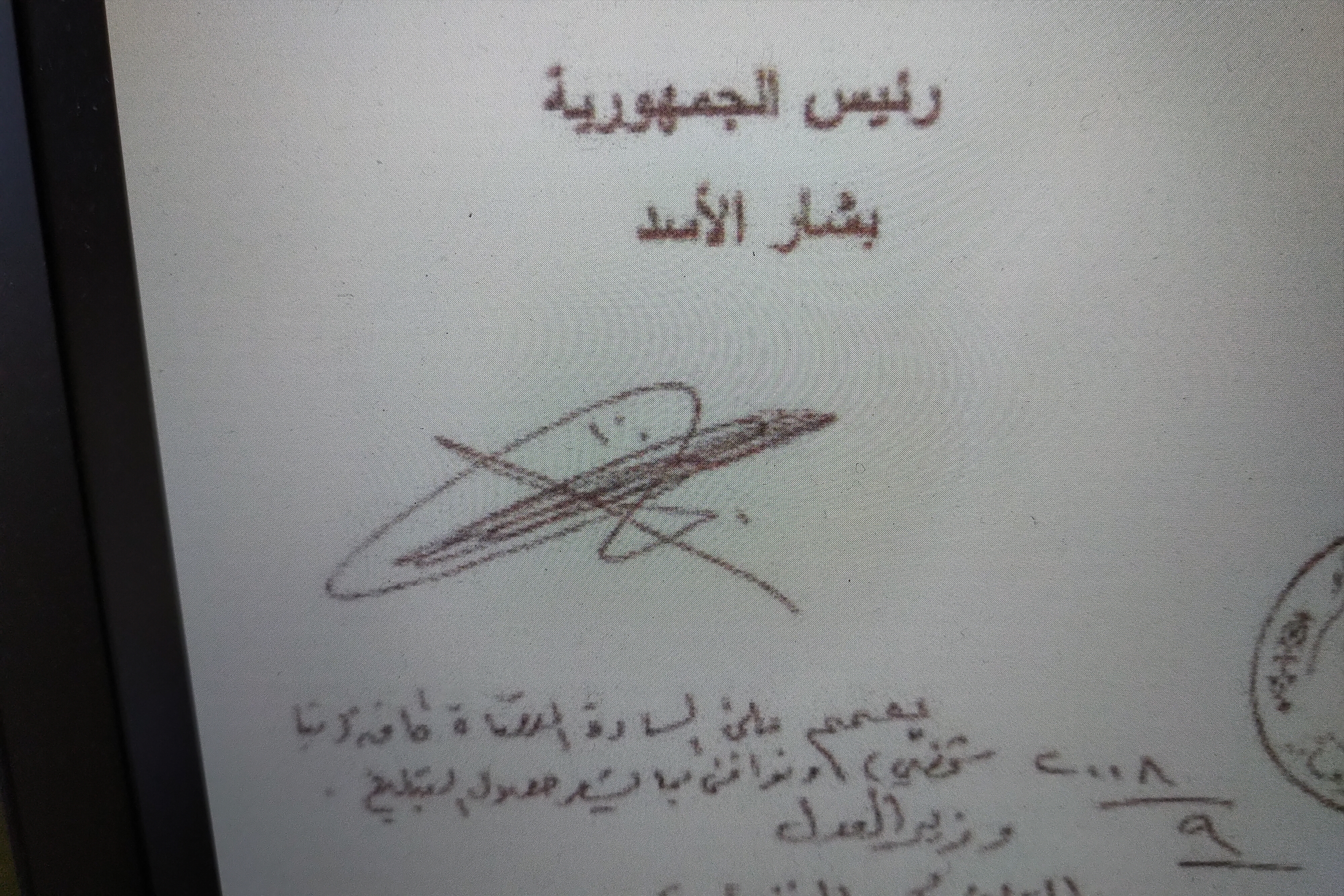
In 2012 after months of searching, both online and by asking everyone I could think of who might conceivably be able to help, I finally tracked down a sample of Bashar Al-Assad’s handwriting. It was only his signature, as it appears on a legal document – Decree 49 dated 10/9/2008, a piece of legislation designed to make it impossible for Kurds in Syria’s northern border regions to buy or rent property, thereby aiming to drive them from their ancestral agricultural land.
But as a qualified graphologist with considerable experience of examining Arabic signatures, and also having come across some months earlier a sample of his father Hafez Al-Assad’s signature (from a book published in 1995), I was sure that I would be able to make a number of deductions and draw some potentially enlightening conclusions. A signature is the key to the writer’s inner life, showing his ability to realise his potential, his own evaluation of himself, his sincerity and the subconscious influences of his family background. I published an article comparing father and son in the May 2012 issue of the journal of the British Academy of Graphology:
The Father/Son Contrast
The contrast between the signatures of father and son was immediately striking. In fact the only area where they shared a similarity was in the horizontal space they took up on the page. The father’s was written with a bold strong stroke and a progressive, upwardly rising movement. It was the signature of a true visionary, imbued with self-belief, drive and dynamism – all the more remarkable given his humble village origins and basic schooling. The son’s much thinner, less confident stroke could hardly be more different. It starts by zigzagging back and forth almost on top of itself, wasting effort and energy, lacking in direction and focus, as if trying to make a strong statement while in effect almost cancelling itself out.
This is one of the many signs of insincerity in the writing, along with regressive slant, unnecessary dots and exaggerated ornamentations. The regressive and descending movements indicate stubbornness and a denial of the present, an attempt to avoid what is coming. The signature finishes by attempting an upward flourish to aggrandise itself. But this flourish turns into a regressive and protective upper zone loop that then plunges down into the lower zone. It then tries again, attempting another upward flourish that pierces the protective upper zone loop briefly before plunging down in a final and dramatic regressive stab straight through the middle of itself, like a huge sharp spike or dagger.
The son is evidently struggling to ‘big himself up’, to live up to his father’s expectations, but without the father’s drive, vision or strength, despite his educational advantages. A final centripetal stroke of this kind that cuts the rest of the signature in half is in graphological terms a very significant dominant. It shows great underlying tensions, a split between what he is trying outwardly to be and what he is at core. It is self-sabotaging and self-destructive, the mark of a man who would even be capable of committing suicide, something his father or, for that matter, Saddam Hussein, would never have contemplated. [In 2003 I wrote an analysis of Saddam’s handwriting for The Times newspaper based on several letters he wrote from hiding which were published in Ash-Sharq Al-Awsat Arabic daily newspaper. The analysis showed his level of self-belief was such that he would never have admitted defeat, a conclusion that was borne out when, after capture and trial, he went to his execution in 2006 still insisting he was president of Iraq.]
Appearance versus Substance
With his greater emphasis on the vertical axis than his father’s progressive horizontal sweep, Bashar is more preoccupied with how he appears to the world, while his father’s energies were focused on achieving his vision. Directly undermining his own attempts to project a dynamic front, Bashar ends by carefully placing the three individual dots of the ‘sh’ letter in the middle of his name within the protective loop of the upper zone, and then, as an even more cautious afterthought, adds a final full stop in the lower zone, which signals his mistrustful attitude towards the world. In his father’s confident and progressive signature, the two dots that should appear as part of his name are not bothered with at all. His flourish is real, not an act.
In today’s Syria it is always Bashar’s face you see on both the pro-regime and anti-regime banners to proclaim either their loyalty or their opposition to the Assad regime. “Tel pere, tel fils” some of the protesters’ placards used to announce. But what this analysis of their signatures shows is that while Bashar may be the face of the Assad regime, he is far from being its backbone. That is the preserve of the innermost Assad clan – his mother, his sister and brother Maher. He is locked inside it and cannot break out – he would never dare.
After the War
The final episode of the BBC2 documentary series on 23 October 2018 showed Arabic documents smuggled out of Syria, bearing Bashar’s signature, signing off on clampdown orders from his newly established Crisis Management Unit in Damascus. They date from early 2012, four years later than my original 2008 sample. A comparison of the 2008 and the 2012 signature shows three important changes. The 2012 signature can be viewed here, in episode 3, at 28.38 minutes in, as BBC licencing protocol does not permit the image to be reproduced from the programme.
Firstly, one year into the war, it shows a more squashed and flattened shape, as if weighed down by pressures from above. Graphologically this is significant as it shows the expectations from what is known in psychology terms as the ‘superego’ – namely the pressures from parents, from society at large, weighing on him more heavily than in 2008. Interviewee after interviewee in the BBC2 series talked about the power and influence of Bashar’s mother, urging him to act more decisively, to maintain what his father, who ruled Syria for 30 years from 1970-2000, had created.
Secondly, the initial fast zigzagging to and fro has lost its energy and intensity. In 2008 the signature began with at least four fast movements back and forth. In 2012 there are only two, much weaker, slower strokes.
Thirdly, the final flourish is much weaker, flabbier, with the final downward stroke more like a limp piece of string than the sharp spike of the 2008 signature. His choice of a thicker nib gives the appearance of a bolder stroke, but the final movement is still regressive rather than progressive, the three dots from the ‘sh’ of Bashar are still cowering at the back of the protective shield he builds round himself for security, and the final full stop is still placed even behind that (remembering that the movement in Arabic is right to left, so the full stop, if used at all, would normally appear to the left not the right of the signature).
Conclusion
All this adds up to a picture of a deeply troubled man, struggling to carry on. Syrian state media is projecting him as victorious, as having won the war against ‘the terrorists.’ But psychologically, this is the most dangerous time for him, when he may let his defences down a little. His mother died in February 2016 so her influence is over. Were his wife Asma to die – she is currently suffering from breast cancer and looks extremely thin and ill – would Bashar still have the appetite to continue as president of Syria? I wonder. Maybe he would take the early retirement he joked about when the French documentary maker in episode two of the BBC2 programme asked if he enjoyed being president. “Sometimes I get tired,” he said. And that was before the war.
Putin, Assad, Rouhani and Nasrallah. The Arabic caption reads: “Men who do not bow down except to God.”
Complexity reigns in Syria, with multiple players still engaged on the world’s most chaotic battlefield. But three new books, despite their very different approaches, share a simple refrain – the ruling Assad regime sees no need to discuss a political solution. Thanks to the consistent military backing of its powerful allies Russia, Iran, and Lebanese Hezbollah, it is incrementally getting its own way.
Ghaith Armanazi’s The Story of Syria makes “no apology for a work I always intended to be a personal take on Syrian history.” Such a statement coming from a former diplomat often labelled an Assad apologist might put many a reader off. Yet Armanazi uses his position of particular privilege to provide not just an interesting collection of early photos (one of which shows Syrian women demonstrating in the 1950s) but a surprisingly candid account of how his country became ‘Assad’s Syria.’
The real meat comes halfway through, where he unravels the unique Hafez al-Assad methodology, essential to understanding how the Syrian state has survived nearly seven years of war. The detailed chapter on Assad senior’s thirty-year rule takes up a quarter of the book, explaining his trademark caution and how his 1970 coup was ‘the most understated in a long line of coups for the last twenty years’.
Hafez al-Assad in November 1970 soon after taking power in Syria
Armanazi charts how the rising trend of political Islamism from the 1970s onwards was driven by a flow of funds from a newly oil-rich Saudi Arabia, leading to feverish building of mosques and religious schools, and how this in turn led to the rising power of the Muslim Brotherhood, culminating in Assad’s revenge, now known as the 1982 Hama massacre.
From that point on, we learn, Hafez al-Assad styled himself ‘Commander for Eternity’ (Qaiduna ila al-Abad), following the useful models of Kim Il Sung in North Korea and Nicolae Ceausescu in Romania. Large public portraits and statues proliferated, a leadership cult which passed to his son Bashar, together with the bloated, inefficient government institutions, the corruption, the nepotism and the ‘shadowy security agencies… silencing all voices of dissent.’
The narrative peters out in a much shorter chapter on Bashar’s rule from 2000. It stops before the current war, as if fearful of saying too much, but the tone conveys Armanazi’s clear anger at the international community’s ‘frenetic mood of activity over Daesh’ while the root cause of Daesh is ignored. ‘The inescapable truth,’ he ends prophetically, ‘is that Daesh is a symptom and all efforts to deal with it independently of Syria’s sickness are doomed to failure.’
Nikolaos Van Dam’s short book Destroying a Nation is precisely that ‘product of meticulous and dry academic research’ which Armanazi’s is not. But after the excellence of Van Dam’s seminal earlier work The Struggle forPower in Syria, this new one disappoints. Focussing on what it calls ‘the civil war in Syria’, over a quarter is taken up with lengthy notes, bibliography and lists of abbreviations and factions together with an extensive 16-page index. One of its stranger entries is ‘Wishful thinking’, listed ten times, more entries than ‘Kurds’.
Van Dam was, like Armanazi, a career diplomat, and has been Dutch Special Envoy for Syria for the last two years, deeply engaged, with the support of an expert Dutch Syria team, in the Geneva and Riyadh peace talks. As a result this is a book for political analysts who are interested in the minutiae of the ever-shifting alliances, first within the ruling Ba’ath Party and now, within the opposition parties, which would be fine if the book were up to date. But it went to press before the 2017 Astana talks between Russia, Turkey and Iran – the vital trio with most at stake inside Syria – agreed on the current de-escalation zones, thereby rendering the previous processes immaterial.
What the book does succeed in illustrating however, only too clearly, through its depressing account of those convoluted processes thus far, are the gulfs in belief between all parties, the different versions of a future Syria which they hold, all shades of which are in any case irrelevant since the Assad regime ‘is not prepared to negotiate its own departure, downfall or death sentence.’
A shopkeeper displays Bashar al-Assad flags for sale, 2017
With its overlong paragraphs and ponderous style, the book claims to deal with prospects for a solution to the conflict, yet ducks the issue and simply ends with another inconclusive summary of the ‘Basic elements of the Syrian Conflict since the Revolution of 2011’. Other Western political analysts are quoted at length but the only Syrian voice to appear is that of Bashar al-Assad himself, declaring on the final page that he will remain president till at least 2021 when his third seven-year term ends, and that he will rule out any political changes before winning the war.
Street posters in Damascus, 2017
By contrast, Wendy Pearlman’s carefully crafted book We Crossed a Bridge and it Trembled allows displaced Syrians to speak for themselves – 87 of them – men and women, young and old, ranging across students, mothers, doctors, poets, accountants, lawyers, beauticians, playwrights, musicians, barbers, computer programmers, engineers, business owners, teachers and finance managers. An American Arabic-speaking academic from Chicago’s Northwestern University, Pearlman conducted hundreds of interviews from 2012-16 with Syrians now living outside their country in Jordan, Turkey, Sweden, Denmark, the UAE, the USA, Lebanon and Germany, using a team of over twenty transcribers and translators to help her arrive at this selection.
Unencumbered by footnotes and other end material, its 292 pages can be easily read in a day. Pearlman’s introduction explains the book’s eight-part structure, offering a sensitive and compelling overview of the war to date. The voices then tell the story of Syria under the Assads, starting with Hafez’s rule, then Bashar’s, before passing through the phases of the war, from the early euphoria of the Revolution and its peaceful demonstrations, to the onset of disillusion and hopelessness, to their ultimate flight from the country as refugees. Imad, a student from Salamiyeh now in Berlin, explains their predicament: “Media has tied the revolution to terrorism,” so “it’s easier to say that you’re simply running away from war…not to mention the revolution, or even the regime.”
By selecting a particular group of voices there is always the problem that others will accuse you of skewing the narrative. But while Pearlman’s refugees necessarily reflect the anti-Assad views held by the majority of Syrian refugees, they also lend weight to the prevailing picture of what remains inside Syria today, chiming with much else that has emerged from other sources. What they confirm is that nothing has essentially changed since March 2011 when Abu Tha’ir, an aeronautical engineer from Daraa now in Jordan, witnessed regime soldiers storm the mosque, kill unarmed demonstrators, burn the holy books and scribble on the walls: “Do not kneel for God. Kneel for Assad.”
Nothing, that is, except the death of 500,000 people and the displacement of over half the population. Sham, a relief worker from Douma now in Sweden, is “disgusted by humanity. We’re basically the living dead.” He jokes sarcastically that all Syrians should all be killed: “Then we’ll all go to heaven and leave Bashar al-Assad to rule over an empty country.”
“One wonders,” Pearlman reflects, “what might have been different had we listened to Syrians’ voices earlier.”
A Syrian-Lebanese border crossing which re-opened in December 2017. The sign reads: “Welcome to Assad’s Syria.”
This piece was originally published in Chatham House’s The World Today Oct/Nov 2017 issue:
“Politics is all about interests, everyone knows this of course,” said Muhammad, his earnest brown eyes looking directly into mine. “But none of us imagined it would end like this.”
In those intelligent philosophical eyes I could see echoes of Ramzi Read more…
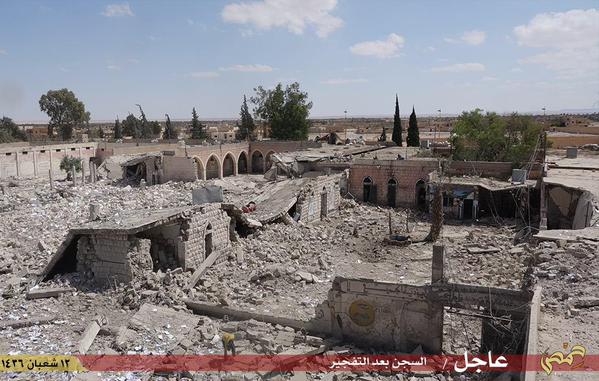
ISIS has confounded its critics. Instead of dynamiting the priceless temples and colonnades of Palmyra, Syria’s most visited UNESCO World Heritage site, it has blown up the cells and torture chambers of nearby Tadmur prison, Syria’s most powerful symbol of Assad regime brutality. Palmyra’s prison, synonymous with suffering in the minds of Syrians, represents perhaps more than any single building in Syria, the 40-year Assad stranglehold on its people.
This carefully staged PR coup will have gained it many friends, even from among those who would have thought themselves anti-ISIS. It is like a loud fanfare announcing: Beware, Bashar, your days are numbered and we are on our way to get you.
Think of the wealth that ISIS now has at its disposal through its capture of Palmyra. With the prize of the ancient city came other prizes: the oilfields to the north and the military hardware captured from the regime’s nearby airbase, T4, thought to include 21 tanks, 12,000 machine guns and 40 ammunition stores. Then came capture of the last regime-held border crossing into Iraq, at al-Tanf due east of Damascus with its own road linking into the Palmyra highway to the capital. And don’t forget the sheep. The Sunni tribes of this Syrian semi-desert steppeland, known as Badiat ash-Sham, still number around one million, and are mainly nomadic Bedouin from the Rwala, Beni Sakhr and Beni Khaled tribes. Syria was one of the first lands to be inhabited by the Bedouin outside the Arabian Peninsula and today these Bedouin still rear most of Syria’s sheep, considered the tastiest in the Middle East. Every year 10 million of them are exported to Saudi Arabia, earning high yields.
Four centuries before the advent of Islam the historic oasis city of Palmyra grew wealthy from the taxes it levied on goods transiting the Silk Road via camel caravans. The highest taxes, according to the famous bilingual Greek/Aramaic ‘Palmyra Tariff’ stone, were due on perfumes, dried fish, olive oil, water and prostitutes. Now ISIS has captured today’s equivalent wealth for itself – oil, military equipment, sheep plus potential extra manpower from the local Sunni tribes. In addition it will no doubt harvest the archaeological site for artefacts, levying its usual 20% tax on anything dug up from the outlying areas.
Armed with all Palmyra’s many forms of wealth, ISIS sees the open road to Damascus, to the exposed heart of the Assad regime.
There are few settlements en route, just two more airbases where even more military hardware can be harvested. Inside Syria ISIS has seen that the international community is impotent, with no unified strategic policy, while Assad’s army is in retreat.
The world’s media pours out articles eulogising the ruins, while ISIS thrives like a germ in the perfect environment on the chaos deep inside Syria. May the world’s attention remain focussed on Palmyra long enough to understand that until Syria’s chaos is solved, ISIS will multiply exponentially and grow beyond anyone’s ability to stop it. Damascus is in their sights and Palmyra has been their launchpad.
Ali Ferzat, drawn as St George killing the dragon, aka Assad the lion, with his sharp pen, by Palestinian cartoonist Ramzi Taweel
The Arab world loves satirical cartoons. BBC Arabic’s current affairs TV show 7 Days even used to devoted the final ten minutes of each programme to a discussion of the week’s cartoons from the Arab press. So what is all this fuss about the Charlie Hebdo cartoons?
The Koran explicitly tells Muslims how to react when their religion is mocked, in verse 140 of Sura Al-Nisa:
“God has sent down upon you a commandment in the Book, that if you hear disbelievers denying and mocking the verses of God, do not sit with them until they change to a different topic, otherwise you will become like them.”
The Koran, regarded by all Muslims as the word of God, is not open to dispute.
Why therefore does the mockery of Islam using cartoons of the Prophet Muhammad provoke such extreme reactions across the Islamic world?
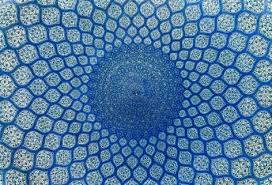
The obvious answer lies in orthodox Islam’s position on religious figural art, whereby images of God, the Prophet Muhammad and other prophets, though not explicitly forbidden in the Koran, are not permitted according to longstanding tradition: only God is permitted to create humans, not humans themselves. That is seen as idolatry and therefore blasphemous. Traditional religious Islamic art is therefore overwhelmingly composed of geometric shapes and designs through which it seeks to represent God’s infinity, beauty, all-embracing nature and much more.
Dome of Istanbul’s Blue Mosque
Dome of Isfahan mosque
But there is another answer, behind the obvious, which has its roots, not in religion, but in socio-economic frustration and the perceived hypocrisy of the West.
All too often, when westerners look East, they see nothing but the chaos of the Middle East apparently created by Islamic extremism. A few, looking more closely, see the socio-economic inequalities fuelled by the rise of greedy dictators and their equally greedy cronies. They may even see how the rise in literacy across the region has led, not to better opportunities for employment, but to a massive dissatisfaction with the status quo among the under 30s who account for at least 60% of the population. Few realise that even in Saudi Arabia 60% are under 21 and far from rich.
Very rarely do westerners acknowledge their own governments’ role in creating the conditions for such chaos to flourish; in the creation of artificial states whose boundaries were drawn to suit western political and economic interests; in the creation of mandates whose remits were supposedly to protect and lead local populations to independence after World War I, but which in practice exploited them and set the various religious groupings against each other, sometimes in an expressly ‘divide and rule’ policy; and last but not least, in the creation of the state of Israel imposed on existing local populations without consultation.
Fake Ali Ferzat cartoon, doctored by pro-regime activists to add sheep holding ‘Freedom’ banners
When Muslims look West, they in turn see extreme, and in their eyes often hypocritical, reactions. Why does the West make so much fuss over the death of 17 people in France, four of whom were Jews, when over 200,000 Arab lives have been lost in Syria to apparent western indifference? Why does the execution of four western hostages trigger a massive wave of outrage, when the earlier execution of hundreds of Muslims by ISIS inside Syria and Iraq drew no reaction? Why does the plight of the Yezidi minority, escaping up Mt Sinjar in Iraq, attract worldwide attention and lead to US air strikes, when indigenous Muslims have already been killed in their thousands by ISIS?
Then on 19 January British Communities Secretary Eric Pickles sent a letter to 1,100 imams across Britain which, though well-intentioned, clumsily implied blame on the Muslim community for allowing Islamic extremism to flourish, as if it were in some way their fault and responsibility. The letter did not acknowledge that such a global phenomenon cannot be pinned on one community, that it is spread more than anything by savvy propaganda on the internet and social media.
Tragically, such faux-pas feed into a western perception that Islam cannot take criticism, and into a Muslim perception that the West is always setting itself up above Islam, taking the moral high ground. The many instances of Christian and Jewish extremism across history are somehow seen differently by their own adherents, as excusable reactions to unreasonable provocation. Guantanamo Bay sums it up. This is why the West’s ‘holier than thou’ approach often leads to accusations of hypocrisy from inside the Islamic world.
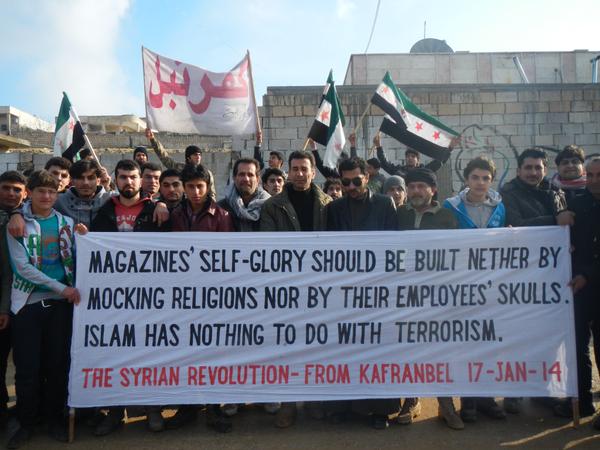
A recent slogan tweeted by the Kafranbel activists inside Syria gave their balanced reaction to the Charlie Hedbo massacres and the subsequent adulation across the West of the satirical magazine via the ‘Je suis Charlie’ campaign:
“Magazines’ Self-Glory should be built neither by mocking religions nor by their employees’ skulls. Islam has nothing to do with terrorism.”
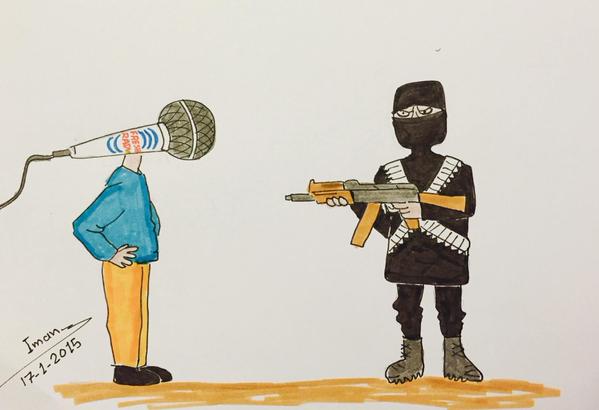
Kafranbel’s own media centre satirising Bashar al-Assad, and its Radio Fresh broadcasting outlet was recently closed down by Jabhat an-Nusra extremists, on the pretext of it being against Islam: at the same time they closed down the Kafranbel Women’s Centre where local women trained as hairdressers, nurses and seamstresses, telling them they would be beheaded if they returned. The real reason for the closure was that the extremist group could not cope with being mocked, like all dictatorial regimes round the world. The widely circulated hashtag #We are all Hadi against Nusra (Hadi Al-Abdullah was the Kafranbel activist attacked by Al-Nusra) proved that Muslims will freely criticise other Muslims when necessary.
Kafranbel cartoon on ISIS v Free speech with a jihadi shooting the microphone of Radio Fresh at the Kafranbel Media Centre, by Iman
Satire of political leaders has long been popular in the Arab world, much to the chagrin of autocratic dictators. Egypt’s former president Muhammad Morsi hated being mocked by the ultra-popular comic satirist Bassem Youssef on TV. The current President Al-Sisi was equally unable to handle it, and Youssef’s slick show, modeled on that of American comedian Jon Stewart, went off air.
The Arab world’s most famous cartoonist Ali Ferzat was allowed in 2000 to set up a satirical magazine called Ad-Domari, The Lamplighter, in Syria, the first such magazine since the Ba’athists took power there in 1963. The new president, Bashar al-Assad, had been his friend and encouraged him during what was called ‘The Damascus Spring’. Three years later, the magazine was closed down for its irreverent cartoons against the Syrian regime, and in 2011 Ali Ferzat was beaten up on a Damascus street, his hands broken to punish his satirical cartoons against his former friend.
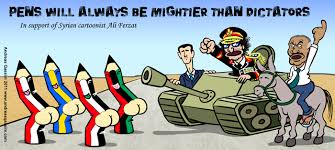
In support of Ali Ferzat by Andreas Qassim, Swedish cartoonist
Ali Ferzat cartoon from 2009 re leaders staying in safe places while fighters die
The singer Ibrahim al-Qashoush who wrote a popular anti-regime song was found in the river Orontes with his vocal chords cut out.
Ali Ferzat cartoon re torturer’s empathy with TV romance but not with his victim
Torturers inside Assad’s prisons were known to force detainees to pray to a picture of Bashar and recite: “There is no God but Bashar”.
Defending free speech is easy if you like what is being said. But many Muslims feel damaged by the Charlie Hedbo media circus, misunderstood and unfairly vilified by the West. Islam’s absence of a conventional hierarchy also makes it difficult for moderate Muslims, especially Sunnis who account for about 85% of Muslims worldwide, to have a unified voice. While the minority Shia, largely found in Iran and Iraq, look to a handful of Grand Ayatollahs to guide them, Sunnis have no Pope or head of the church equivalent. No one Sunni group can speak for another and there are at least four main Sunni schools of law, each with their own theologians.
The West fears what it does not understand. But it must not allow distorted views of Islam’s nature to take hold. In the past, in its foreign interventions in the Arab world, the West has been driven by self-interest, despite its rhetoric to the contrary. Its own economic ambitions have been paramount, leading it to exploit the Middle East’s strategic location and natural resources.
If Western countries could honestly declare that their actions will in future also consider the interests of local populations, it might be a first step towards healing the misunderstandings which have led to so many of the region’s seemingly intractable problems. Respect between the West and Islam is essential.
Cartoon of Ali Ferzat fighting with his pen against oppression, by Matt Wuerker
By the end of the 15-year Lebanese Civil War, nearly every party had allied with and subsequently betrayed every other party at least once. The age-old pattern is the same: groups like ISIS began in Syria by ingratiating themselves with the local population, as they are doing in Mosul now, offering free fuel, electricity supplies and appearing to restore security to the streets. Next they will provide food and medical services. At first, in such charm offensives, they seem to be a godsend, then in stages, the reality reveals itself and their hard-line Islamist agenda comes to the fore, with compulsory Quranic schools, summary public executions and enforced veiling of women. But just as this was not the real Syria, neither is this the real Iraq. Women will pull their headscarves out of their handbags to put them on at black-bannered checkpoints, then stuff them away again.
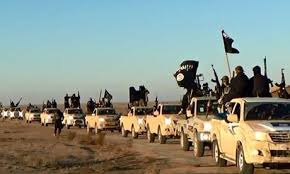
In the early months of the Syrian Revolution extremist rebel groups like Jabhat al-Nusra accounted for no more than 3-4 per cent of the rebels overall, maybe reaching 10 per cent around Aleppo. While most fighters in Al-Nusra are from Syria, the extremist group ISIS which appeared over a year later than Al-Nusra in April 2013 is both foreign-led (by an Iraqi) and foreign-dominated. Its fighters come mainly from Saudi Arabia, Libya and Tunisia, though there are also Chechens, Kuwaitis, Jordanians and Iraqis as well as a few Pakistani Taliban and even Chinese. Dressed in their Pakistani-style tunics and menacing black balaclavas, brandishing their weapons, they form a stark contrast to the conservative but moderate Sunni Muslims who make up 74 per cent of Syria’s resident population. Typical communiqués use language like: ‘Our army is full of hungry lions who drink blood and eat bones.’ It is hard to imagine their ideology ever taking root in Syria, despite their ceaseless propaganda videos on YouTube and their thousands of tweets – all the rebel groups have their own highly active Twitter accounts.
Many Syrians told me long before the revolution that the Syrian brand of Islam is close to the tolerant Sufi Islam of Ibn Arabi and Al-Ghazali – open to all and with no coercion. Yet groups like ISIS are so intolerant they even started to ban tobacco as un-Islamic in areas they controlled in Syria’s north, not just alcohol and what they called ‘immoral entertainment’. The kind of Syria they are trying to usher in would end up destroying the country’s very identity, its tolerant character. Moderate Syrians have begun social media campaigns against them with slogans like: ‘DAESH [Arabic for ‘ISIS’] GO OUT. Bashar and DAESH are one. We didn’t have a revolution against a tyrant for another tyrant to come and control us in the name of religion! Those who belong to Syria, Syria is for all of you. Those who belong to Al-Qaeda, go to Afghanistan!’ Dozens of Arabic language Facebook pages have been set up rejecting ISIS, its Islamic credentials and its brutal tactics.
The rebel group ISIS now controls the oil fields in Syria’s north eastern provinces. They have broken the pipelines, creating environmental disasters, then welded on crude taps from which they fill queues of tankers. The valuable cargo is then trundled mainly into Turkey and sometimes even into regime-held areas of Syria, where prices rocket. It is a money-making exercise, free of overheads, that has turned the bearded chiefs into millionaires. Thousands of amateur refineries have sprung up, converting the crude oil to petrol, diesel and mazout heating oil, sold in smaller canisters to anyone who has the money. None of them will give that up without a fight. As the ISIS accounts captured in recent days have revealed, the rebels have accumulated huge funds from this oil and from looted Syrian antiquities, enabling them to pay good salaries to new recruits and to acquire proper weaponry for them. From their Syrian headquarters in Al-Raqqa on the Euphrates, they have in recent days swept east into Iraq and taken the second city of Mosul along with vast tracts of adjoining territory, capturing along the way much heavy weaponry from the American-supplied Iraqi army.
So now the equation has changed. Assad and ISIS should be mortal enemies ideologically, yet they have never fought each other. ISIS militants have slept sound in their beds without fear of regime air strikes and barrel bombs. Whereas the Assad regime was before quite happy to turn a blind eye to ISIS and its atrocities in the north and in Al-Raqqa, content that its energies were being directed towards fighting the more moderate rebels, now ISIS has become a real threat.
Therefore it should come as little surprise that as The Times today reported, Syrian government forces for the first time bombed ISIS bases in eastern Syria and Al-Raqqa ‘acting in co-ordination with the Iraqi government’. The Assad regime has re-done its calculations, and is now banking on the expectation that its air-strikes against ISIS will also earn it grudging gratitude from the West. Bashar al-Assad must even be thinking this is his chance to become rehabilitated in the eyes of the international community, and undergo a transformation from ‘murderous dictator’ to ‘saviour from Islamist barbarians’.
The UN Chemical Weapons deal last autumn only happened because there was a rare consensus in the international community and no blame was attributable. Maybe such a consensus can be found again, this time to rid both Syria and Iraq of the growing extremist groups like ISIS. Maybe moderate elements from the rebels too can find a common cause and unite against this greater Al-Qaeda-affiliated menace whose terrorist jihadi agenda threatens not just Syria and Iraq’s future but the future of the entire international community. Maybe it will be Syria’s second revolution, a revolution in which even the ‘silent majority’ may find its voice.
In the meantime we can expect more Syrian air strikes against ISIS bases – their ‘marriage of convenience’ is over.
[This post includes extracts from the book My House in Damascus: An Inside View of the Syrian Revolution ]
Prophetic 2007 poster of Bashar in Damascus’ s Hijaz Railway Station with the caption: ‘We pledge allegiance to you with blood forever.’ Blood drips from the words ‘with blood’.[DD]
What an irony. Fear of the Syrian government and its many-tentacled security apparatus is greater now even than it was before the revolution began. Why should that be? The government is generously offering ‘reconciliation’ deals across the country, with gracious amnesties like the one that enabled several hundred rebel fighters to leave the exhausted city of Homs with light weapons in early May. Yet anyone who knows Syria from the inside knows full well that the Assad regime’s generosity and grace is to be feared above all else.
When peaceful calls for dignity and reform were met in March 2011 by crushing violence from the outset, the protesters knew what awaited them if they were arrested. Their bravery in breaching the fear barrier even to take part in such demonstrations is beyond admirable. Tens of thousands have gone missing over the last three years, detained in prison, never seen again, or sometimes simply returned to their families in a body-bag as a warning, like the mutilated body of the 13-year old Hamza Al-Khatib, early icon of the revolution. Like so many, Hamza was not even demonstrating – he was simply in the wrong place at the wrong time.
As the presidential election is held on 3 June all over the country in regime-held areas only, Syrians know full well what it means. It is not so much an election – everyone knows the result after all – it is more like a census, a head count of government supporters. To vote anything other than for Bashar Al-Assad is to sign your own death warrant and that of your family, and not to vote at all means you are forfeiting your chance of any kind of future in Syria. Of Syria’s 23 million population some 4 million are estimated to have left and some 9 million are thought to be internally displaced. At least a further million have lost their identity papers in the fighting and are thereby disqualified. Only refugees outside the country who fled ‘legally’ – just 200,000 out of 3 million according to the Syrian Ministry of Interior’s own figures – are eligible to vote, thereby ensuring a situation cannot arise where one of Bashar’s two opponents might actually win abroad. These ‘legal’ expatriate Syrians can vote in Syrian embassies in certain selected countries like Russia and Romania, and those living in a country where the embassy is closed, like the UK, have been cordially invited back to Syria ‘to exercise their civil right’. Some have taken up the offer knowing that they must, if they ever wish to return to their country while the Assad regime still holds sway. In Paris I was reliably informed of one Syrian who went, not to vote since France has banned the embassy from participating, but to renew his passport. Known to be anti-regime, he had his passport torn up in front of him and was told: ‘There – now go and get yourself a new passport from your Friends of Syria.’
In this country we face no repercussions for not voting – in Syria it is very different. ‘If you are not for us, you are against us.’ We in the West may dismiss the Syrian election as an absurd process, a mockery of democracy. We have that luxury. But if you are Syrian it is a matter of life and death.
Fear is forcing thousands to vote for Assad, whose tender mercies are well known. Stories are circulating about the ways in which the regime seeks to take revenge on those whom it considers have betrayed it. Even those who have done nothing and never taken sides are at risk. All it takes is one report written by one security official who takes a dislike to you. It has already happened to several of my neutral Syrian friends.
Whilst western democracies will scoff at Syria’s election process, Russia and Iran will use it to their advantage. It plays beautifully into their narrative of supporting ‘whoever is elected by the Syrian people’ and legitimises their unwavering support of Assad.
Syria has lost c40% of its GDP since 2011 according to the Damascus-based Syrian Center for Policy Research in conjunction with the UN and the IMF. Eleven million have lost their livelihood. Fear of losing their right ever to live in their country again is driving them to vote. Hard as it may be for us to grasp, for them it is a vote for life or death.
Sidon’s Crusader Sea Castle guards what was once the port for Damascus [DD, 2014]
Marwan, my chain-smoking Syrian lawyer, has left his war-torn country for the day to meet me in the Lebanese port of Sidon. He wants to complete some paperwork and tell me news from Damascus.
The Syrian accents at the tables all around us suggest he is not the only visitor. We sit with a view of Sidon’s Crusader Sea Castle and try hard to strike a holiday mood. He has brought magnificent gifts of Damascene produce – dried apricots, almonds and seed-covered biscuits.
Sidon’s souks are just like Damascus’s – even the doves are the same. [DD 2014]
He refuses a meal, even though the journey has just taken him six hours thanks to overcrowding on the border. His only appetite is for tea and cigarettes.
“What news of Abu Khalil?” I ask. Last time it was he, my elderly caretaker, who came out to meet me, so proudly braving the checkpoints from his village east of Damascus. But that was where the massive chemical attack took place last summer.
“He’s been blockaded in his village since October,” says Marwan. “It’s easy to get money to him. We give it to someone going in on the special buses. But food is impossible. The soldiers search the buses and throw away whatever they find.”
We almost laugh at the absurdity, but more absurdity follows.
Marwan asks me to sign the rental contracts for the refugees living in my Damascus house. They pay no rent, but this is vital documentation they must show when regime soldiers call round unannounced. Without it, arrest and imprisonment will follow. Each street is cordoned off in turn, each person’s papers checked, each room searched for weapons.
I ask about the checkpoints inside the Old City. “Are the lijaan sha’bia (peoples’ committees) still guarding the neighbourhood?”
“Yes,” he replies, “but now they are all either very old or very young. The young ones are easily recruited because of the salary. Their families are desperate for the income, so they agree to it, thinking their sons will be just round the corner. But sometimes the boys are transferred with no warning to the frontline, lambs to the slaughter. They come back to their families in a body-bag labelled ‘shaheed’ (martyr) with a pittance as compensation, but no one dares say anything.”
We cannot laugh, but both of us sense more absurdity, not least because of where we’re sitting. Sidon is in some ways a mini Damascus-on-Sea, a tinderbox just 40 minutes’ drive south from Beirut. There are photos all over town of one of Sidon’s most famous sons, the former Lebanese prime minister Rafiq Al-Hariri, who was blown up on Valentine’s Day 2005. Sidon’s buildings bear the scars of Lebanon’s own 15-year-long civil war.
Banner of Rafiq al-Hariri adorns the 17th C Khan al-Franj, Caravanserai of the Franks, restored by the Hariri Foundation to be a craft centre and tourist office, now empty [DD, 2014]
Sidon’s Khan al-Franj, once seat of bustling commerce, now languishes unused [DD, 2014]
Like Damascus it has a Sunni Muslim majority, a sizeable Christian minority and Palestinian refugee camps incorporated in its suburbs. The same blend of church towers and minarets rises from its bustling bazaars. But it also shares the increasing sectarian flare-ups, like the arson attack on a Sidon mosque that happened the very next day. The highly combustible city is surrounded on all sides by Hizbullah, the well-disciplined Lebanese Shi’ite militia led by the cleric Hassan Nasrallah. We joke grimly about how in Damascus Hizbullah is considered not the enemy but the ally, openly fighting alongside President Bashar Al-Assad to keep him in power.
Marwan flicks his ash compulsively.
“God knows,” he says, “how Syria will ever get out of this swamp. Now the regime is preparing us for the June elections, being gentler with us at the checkpoints, announcing a policy of ‘musaalaha’ (reconciliation), freeing prisoners and doing deals to let people back into their homes in the suburbs. Their slogan is everywhere, ‘Bashar al-Assad ila al-Abad’ It’s a rhyme which means ‘Bashar al-Assad forever’.”
You realise,” Marwan continues, “that if he gets voted in a third time, like his father, the constitution says it is for life. Hafez Al-Assad was born in 1930 and ruled for 30 years; Qaddafi was born in 1942 and ruled for 42 years; Bashar was born in 1965 – so maybe he will rule for 65 years!”
We laugh uncontrollably.
“How do you feel about going back?” I ask, when I have recovered.
His laughter erupts again.
“I have the female Russian teachers to look forward to, now that Russian will become our first language. Farsi will soon become our second, there are so many Iranians on the streets. And Hassan Nasrallah is billed as our saviour, side by side with Bashar on the posters.
Damascus feels safer to me than Sidon!” Marwan insists. And he explains, “The regime’s control is so tight, nothing can happen there. Sidon might explode. Damascus cannot. The regime has taken out the fuse!”
Starts 4.12 mins in. Full text above. Identities changed.
Sidon’s old souks are indistinguishable from the souks of Old Damascus [DD, 2014]
Interior of Sidon’s Great Mosque, formerly Church of St John of the Hospitallers. Damascus’s Great Mosque was formerly the Cathedral of John the Baptist. [DD, 2014]
18th C Debbane Palace in Old Sidon, now restored as a museum. Hundreds of refugees sheltered here for five years during the Lebanese Civil War [DD, 2014]
Entrance to Sidon’s Great Mosque, once the Church of St John of the Knights Hospitaller, restored by the Hariri Foundation and winner of the 1989 Aga Khan Award for Architecture [DD, 2014]
Crusader vaulting in Sidon’s Great Mosque [DD, 2014]













![Prophetic 2007 poster of Bashar in Damascus' Hijaz Railway with the caption: 'We pledge allegiance to you with blood forever.' Blood drips from the words 'with blood'.[DD]](https://dianadarke.com/wp-content/uploads/2013/11/travellers-syria-12-13-bashar-is-pledged-allegiance-in-dripping-blood.jpg)
![Sidon's Crusader Sea Castle guards what was once the port of Damascus [DD, 2014]](https://dianadarke.com/wp-content/uploads/2014/03/2005-01-01-00-00-00-12.jpg)
![Sidon's souks are just like Damascus's - even the doves are the same. [DD 2014]](https://dianadarke.com/wp-content/uploads/2014/03/2014-03-03-12-41-38.jpg)
![Banner of Rafiq al-Hariri adorns the Khan al-Franj, caravanserai of the Franks, restored by Rafiq al-Hariri to be a craft centre and tourist office, now empty [DD, 2014]](https://dianadarke.com/wp-content/uploads/2014/03/2014-03-03-12-14-31.jpg)
![Sidon's Khan al-Franj, once seat of bustling commerce, sits empty [DD, 2014]](https://dianadarke.com/wp-content/uploads/2014/03/2014-03-03-12-17-37.jpg)
![Sidon's old souks are indistinguishable from the souks of Old Damascus [DD, 2014]](https://dianadarke.com/wp-content/uploads/2014/03/2014-03-05-07-40-32.jpg)
![Interior of Sidon's Great Mosque, formerly Church of St John of the Hospitallers - Damascus's Great Mosque was formerly the Cathedral of Jhn the Baptist. [DD, 2014]](https://dianadarke.com/wp-content/uploads/2014/03/2014-03-04-14-54-02.jpg)
![Debbane Palace in Old Sidon, now restored as a museum. 200 refugees sheltered here for five years duing the Lebanese Civil War [DD, 2014]](https://dianadarke.com/wp-content/uploads/2014/03/2014-03-04-12-33-23.jpg)
![Entrance to Sidon's Great Mosque, once the Church of St John of the Knights Hospitaller, restored by Rafiq al-Hariri and winner of the 1989 Aga Khan Award for Architecture [DD, 2014]](https://dianadarke.com/wp-content/uploads/2014/03/2014-03-04-14-59-50.jpg)
![Crusader vaulting in Sidon's Great Mosque [DD, 2014]](https://dianadarke.com/wp-content/uploads/2014/03/2014-03-04-14-58-43.jpg)
 dianadarke