dianadarke

Syria and Turkey commentary

Archive for the category “Syria”

On Arab cartoons and western hypocrisy

Arab's world most famed cartoonist, Ali Ferzat, drawn as St George killing Assad the lion, alias the dragon, by Ramzi Taweel

Ali Ferzat, drawn as St George killing the dragon, aka Assad the lion, with his sharp pen, by Palestinian cartoonist Ramzi Taweel

The Arab world loves satirical cartoons.  BBC Arabic’s current affairs TV show 7 Days even used to devoted the final ten minutes of each programme to a discussion of the week’s cartoons from the Arab press. So what is all this fuss about the Charlie Hebdo cartoons?

The Koran explicitly tells Muslims how to react when their religion is mocked, in verse 140 of Sura Al-Nisa:

“God has sent down upon you a commandment in the Book, that if you hear disbelievers denying and mocking the verses of God, do not sit with them until they change to a different topic, otherwise you will become like them.”

The Koran, regarded by all Muslims as the word of God,  is not open to dispute.

Why therefore does the mockery of Islam using cartoons of the Prophet Muhammad provoke such extreme reactions across the Islamic world?

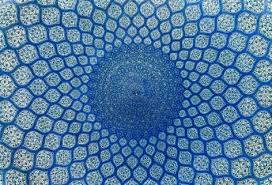
The obvious answer lies in orthodox  Islam’s position on religious figural art, whereby images of God, the Prophet Muhammad and other prophets, though not explicitly forbidden in the Koran, are not permitted according to longstanding tradition: only God is permitted to create humans, not humans themselves. That is seen as idolatry and therefore blasphemous. Traditional religious Islamic art is therefore overwhelmingly composed of geometric shapes and designs through which it seeks to represent God’s infinity, beauty, all-embracing nature and much more.

Dome of Istanbul's Blue Mosque

Dome of Istanbul’s Blue Mosque

Dome of Isfahan mosque

Dome of Isfahan mosque

But there is another answer, behind the obvious, which has its roots, not in religion, but in socio-economic frustration and the perceived hypocrisy of the West.

All too often, when westerners look East, they see nothing but the chaos of the Middle East apparently created by Islamic extremism. A few, looking more closely, see the socio-economic inequalities fuelled by the rise of greedy dictators and their equally greedy cronies. They may even see how the rise in literacy across the region has led, not to better opportunities for employment, but to a massive dissatisfaction with the status quo among the under 30s who account for at least 60% of the population. Few realise that even in Saudi Arabia 60% are under 21 and far from rich.

Very rarely do westerners acknowledge their own  governments’ role in creating the conditions for such chaos to flourish; in the creation of artificial states whose boundaries were drawn to suit western political and economic interests; in the creation of mandates whose remits were supposedly to protect and lead local populations to independence after World War I, but which in practice exploited them and set the various religious groupings  against each other, sometimes in an expressly ‘divide and rule’ policy; and last but not least, in the creation of the state of Israel imposed on existing local populations without consultation.

Fake Ali Ferzat cartoon, doctored by pro-regime activists to add sheep holding 'Freedom' banners

Fake Ali Ferzat cartoon, doctored by pro-regime activists to add sheep holding ‘Freedom’ banners

When Muslims look West, they in turn see extreme, and in their eyes often hypocritical, reactions. Why does the West make so much fuss over the death of 17 people in France, four of whom were Jews, when over 200,000 Arab lives have been lost in Syria to apparent western indifference? Why does the execution of four western hostages trigger a massive wave of outrage, when the earlier execution of hundreds of Muslims by ISIS inside Syria and Iraq drew no reaction? Why does the plight of the Yezidi minority, escaping up Mt Sinjar in Iraq, attract worldwide attention and lead to US air strikes, when indigenous Muslims have already been killed in their thousands by ISIS?

Then on 19 January British Communities Secretary Eric Pickles sent a letter to 1,100 imams across Britain which, though well-intentioned, clumsily implied blame on the Muslim community for allowing Islamic extremism to flourish, as if it were in some way their fault and responsibility. The letter did not acknowledge that such a global phenomenon cannot be pinned on one community, that it is spread more than anything by savvy propaganda on the internet and social media.

Tragically, such faux-pas feed into a western perception that Islam cannot take criticism, and into a Muslim perception that the West is always setting itself up above Islam, taking the moral high ground. The many instances of Christian and Jewish extremism across history are somehow seen differently by their own adherents, as excusable reactions to unreasonable provocation. Guantanamo Bay sums it up. This is why the West’s ‘holier than thou’ approach often leads to accusations of hypocrisy from inside the Islamic world.

A recent slogan tweeted by the Kafranbel activists inside Syria gave their balanced reaction to the Charlie Hedbo massacres and the subsequent adulation across the West of the satirical magazine via the ‘Je suis Charlie’ campaign:

“Magazines’ Self-Glory should be built neither by mocking religions nor by their employees’ skulls. Islam has nothing to do with terrorism.”
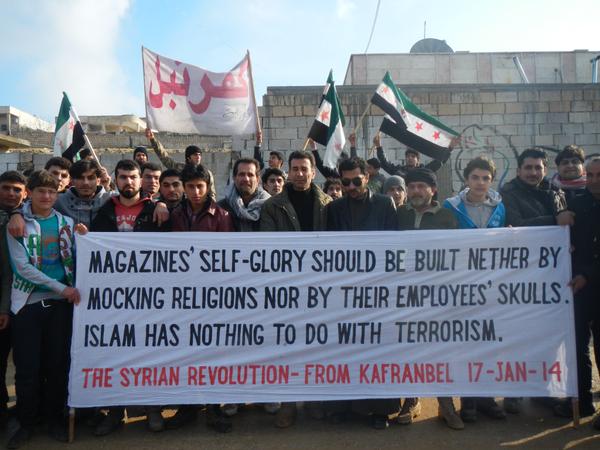
B7jZvDVIcAAE04C

Kafranbel’s own media centre satirising Bashar al-Assad, and its Radio Fresh broadcasting outlet was recently closed down by Jabhat an-Nusra extremists, on the pretext of it being against Islam: at the same time they closed down the Kafranbel Women’s Centre where local women trained as hairdressers, nurses and seamstresses, telling them they would be beheaded if they returned. The real reason for the closure was that the extremist group could not cope with being mocked, like all dictatorial regimes round the world. The widely circulated hashtag #We are all Hadi against Nusra (Hadi Al-Abdullah was the Kafranbel activist attacked by Al-Nusra) proved that Muslims will freely criticise other Muslims when necessary.
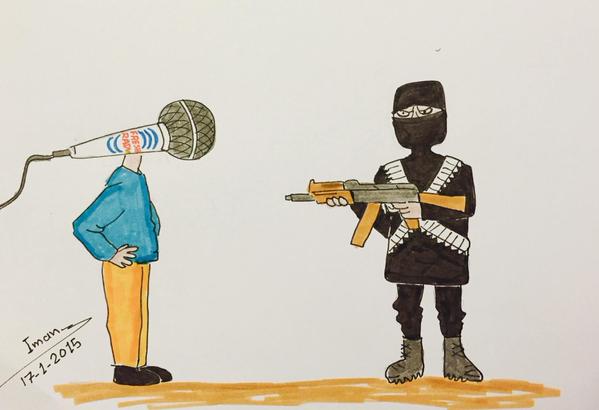
Kafranbel cartoon on ISIS v Free speech with a jihadi shooting the microphone of Radio Fresh at the Kafranbel Media Centre

Kafranbel cartoon on ISIS v Free speech with a jihadi shooting the microphone of Radio Fresh at the Kafranbel Media Centre, by Iman

Satire of political leaders has long been popular in the Arab world, much to the chagrin of autocratic dictators. Egypt’s former president Muhammad Morsi hated being mocked by the ultra-popular comic satirist Bassem Youssef on TV. The current President Al-Sisi was equally unable to handle it, and Youssef’s slick show, modeled on that of American comedian Jon Stewart, went off air.

The Arab world’s most famous cartoonist Ali Ferzat was allowed in 2000 to set up a satirical magazine called Ad-Domari, The Lamplighter, in Syria, the first such magazine since the Ba’athists took power there in 1963. The new president, Bashar al-Assad, had been his friend and encouraged him during what was called ‘The Damascus Spring’. Three years later, the magazine was closed down for its irreverent cartoons against the Syrian regime, and in 2011 Ali Ferzat was beaten up on a Damascus street, his hands broken to punish his satirical cartoons against his former friend.
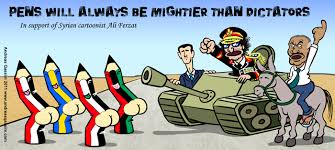
On Ali Ferzat by Andreas Qassim

In support of Ali Ferzat by Andreas Qassim, Swedish cartoonist

Ali Ferzat cartoon from 2009 re leaders staying in safe places while fighters die

Ali Ferzat cartoon from 2009 re leaders staying in safe places while fighters die


The singer Ibrahim al-Qashoush who wrote a popular anti-regime song was found in the river Orontes with his vocal chords cut out.

Ali Ferzat cartoon re torturer emotional re TV romance but not re victim

Ali Ferzat cartoon re torturer’s empathy with TV romance but not with his victim

Torturers inside Assad’s prisons were known to force detainees to pray to a picture of Bashar and recite: “There is no God but Bashar”.

Defending free speech is easy if you like what is being said. But many Muslims feel damaged by the Charlie Hedbo media circus, misunderstood and unfairly vilified by the West. Islam’s absence of a conventional hierarchy also makes it difficult for moderate Muslims, especially Sunnis who account for about 85% of Muslims worldwide, to have a unified voice. While the minority Shia, largely found in Iran and Iraq, look to a handful of Grand Ayatollahs to guide them, Sunnis have no Pope or head of the church equivalent. No one Sunni group can speak for another and there are at least four main Sunni schools of law, each with their own theologians.

The West fears what it does not understand. But it must not allow distorted views of Islam’s nature to take hold. In the past, in its foreign interventions in the Arab world, the West has been driven by self-interest, despite its rhetoric to the contrary. Its own economic ambitions have been paramount, leading it to exploit the Middle East’s strategic location and natural resources.

If Western countries could honestly declare that their actions will in future also consider the interests of local populations, it might be a first step towards healing the misunderstandings which have led to so many of the region’s seemingly intractable problems. Respect between the West and Islam is essential.

Cartoon of Ali Ferzat fighting with his pen against oppression, by Matt Wuerker

Cartoon of Ali Ferzat fighting with his pen against oppression, by Matt Wuerker

Schizophrenia in Damascus

Nothing in Damascus was as expected. Convinced there would be food shortages, I had vowed to eat very little during my stay. Yet while the besieged suburbs are starving, the central food markets are overflowing.

OLYMPUS DIGITAL CAMERA

The fruit stalls of Sharia al-Amin boast bananas from Somalia, the Bzouriye spice markets are buoyant with top-quality saffron from Iran and walnuts from Afghanistan. Lebanese wine and beer are freely available. Prices are higher than before, but still largely affordable for most people.

Sandwiched between the heavily-armed checkpoints, street stands selling thick hot Aleppan sakhlab, a sweet white drink, are everywhere.

Cafes and pastry shops are bursting with sticky delicacies, the famous Bakdash ice-cream parlour is buzzing with people as ever.

Bakdash ice cream parlour, October 2014

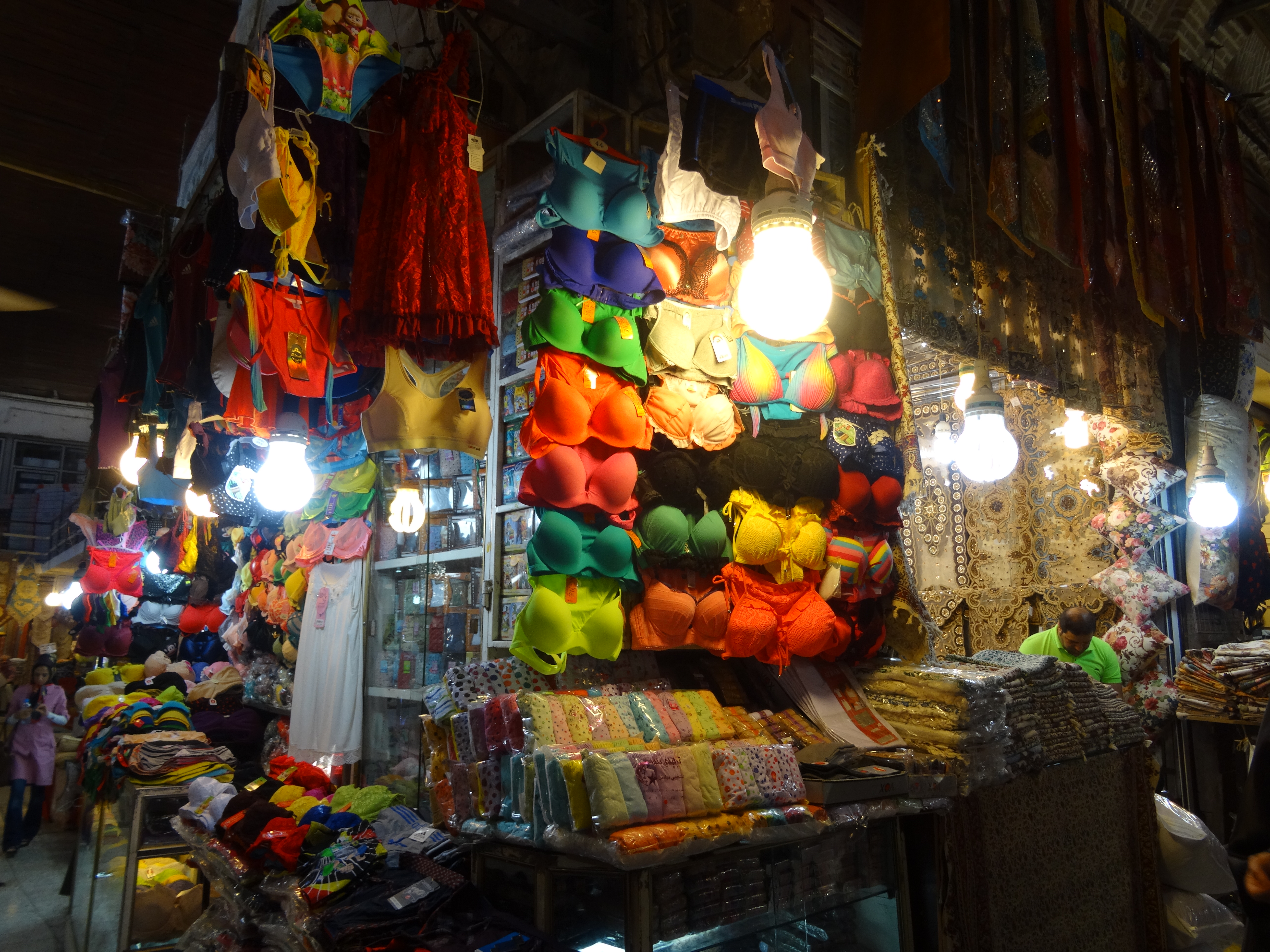
To judge from the carpets of cigarette butts on the pavements, smoking rates, always high, are higher than ever. In the main thoroughfare of Souq al-Hamidiya all the usual clothes and flamboyant underwear outlets are still thronging with customers – not a single boarded shopfront – quite a contrast to the average British high street.

Sporadically, in the days as well as the nights, shelling is disturbingly loud, but strangely offstage.

President Bashar al-Assad’s artillery is fired from Mount Qassioun, directly above the city, towards the eastern Ghouta region – the scene of last year’s chemical attack, whose pockets of resistance are still a thorn in the side of the government. Villages there have suffered a food blockade for the last 18 months.

But by all accounts there is much less noise than there was a year ago.

Mount Qassioun, seen from DamascusMount Qassioun, seen across the rooftops of Damascus

From that point of view, very gradually, life in central Damascus is getting better. Yet from other points of view, just as gradually, it is getting worse.

Beyond the 3.5 million who have fled the country as refugees, a further 7.5 million have been internally displaced – added together that accounts for half of Syria’s entire population. Homes which are left empty, if they have not been flattened, are vulnerable to immediate seizure by others – usually the owners have no idea who has moved in and it is too dangerous to go back and find out.

Almost as often, but rarely reported, Syrian homes are taken by profiteers, exploiting the weak or the absent.

My own house in the Muslim quarter of the Old City of Damascus, bought and restored in 2005, fell victim a few months ago.

It had been lived in for more than two years, from the summer of 2012 to the summer of 2014, with my consent by displaced friends whose homes had been destroyed in the suburbs. Now they had been evicted by my ex-lawyer and the previous owner conniving together to take it for themselves and split it 50:50.

Determined to get it back I recently returned to Damascus to throw them out and after 15 roller-coaster days, I succeeded. Things can happen surprisingly fast in Syria. You go to meet the judge one day, and he comes to inspect the house the next – without payment.

The old and the new doors to the houseA blacksmith made a new metal door to cover the smashed antique one.

Among the many moments of high drama were two break-ins, six changes of lock, the installation of two metal doors and the exposure of the bogus security reports which had led to my friends being evicted in the first place.

Bit parts were played by a fake general on a forged 25-year lease, and a Baathist single mother in the house with her newborn baby. It was with her that I felt most threatened by violence.

But in some ways life goes on almost as normal: dining with one friend in her 50s, whose car was lost in a random mortar attack, she explains how she now accompanies her 16-year-old nephew by taxi to play in the orchestra at the Opera House to make sure he is not picked up and enlisted into the army. At the checkpoints she clutches his cello between her legs so that the soldiers will not take it.

Checkpoints and road blocks in Yusuf al-Azma SquareCheckpoints and road blocks, such as this one in Yusuf al-Azma Square, are a common sight

Another friend works for the national electricity grid: his job is to repair electric cables damaged in the clashes. Over lunch at his home with his family, he tells me how one of his team stepped on a mine and was blasted to pieces in front of him – the man next to him had his eyes blown out.

He himself was lucky, escaping only with shrapnel in his intestine. He spent two weeks in hospital, two weeks at home recuperating, then went straight back to work. His attitude is simple: anyone who damages Syrian infrastructure is hurting the Syrian people.

The alleys of the Old City are full of children playing football. Many go to the school round the corner from my house.

Such is the overcrowding – some say Damascus’s population has risen from four to seven million because of internally displaced refugees – that their school-day is from 11:00 to 15:00, with one shift before them and another shift after them. They have 50 to 60 in their class but their enthusiasm to learn and to do their homework is undiminished.

The only other foreigners I saw on the streets were Iraqi Shia, men and women led round in groups to visit the shrines by a man wielding an orange lollipop sign.

When I met an old friend at the tourism ministry who still works at his office every day, he explained how this kind of religious tourism is now all they have left, some 200,000 pilgrims a year, after 8.2 million foreign visitors in 2010. He expresses no political views – he is just someone who has chosen to stay and do his job as best he can, like millions of others.

All over the country, even in ISIS-held Raqqa, I was reliably informed, government employees now draw their salaries direct from cash points on specific days, causing long queues outside the banks.

For the last two nights when I was finally able to sleep in my house in Old Damascus I experienced what everyone else has to suffer on a daily basis – scarcely four hours of electricity a day, no gas, no hot water, limited cold water.

It was tough, yet strangely invigorating, crossing the chilly courtyard to wash in a dribble of icy water, warmed by the knowledge I was surrounded by loyal neighbours who were looking out for me. Without them I could never have retaken my house: they protected me, helped me at every turn.

Bait Baroudi

A crisis brings out the worst and the best in people. What I found in Damascus was that a genuine kindness, a shared humanity and an extraordinary sense of humour are well and truly alive. Decent Syrian citizens are together doing their best to fight against immorality and corruption. Morale, in spite of everything, is high. Laughter keeps them sane.

Not once did anyone mention sectarianism. “DA’ESH” (the Arabic acronym for ISIS used across the Middle East) was universally condemned as beyond the pale.

How much longer, as the war approaches its fifth year and the number of greedy opportunists in society increases, such neighbourhood camaraderie can survive is an unanswerable question. But after this fortnight in Damascus I am more optimistic than before.

Diana Darke, Middle East cultural expert and Arabic speaker, is the author of My House in Damascus: An Inside View of the Syrian Revolution, new 2015 edition now available as paperback and e-book from:

http://www.bookhaus.co.uk/shopexd.asp?id=11301

My House in Damascus

Related post:

http://www.bbc.co.uk/news/magazine-30494989


The paradox of Iran and its links with Syria

Cameron and Rouhani

How fitting it is that Iranian President Hassan Rouhani  should have used his Twitter account to announce last month’s historic meeting with UK Prime Minister David Cameron: “1st meeting b/w UK & Iran heads of state in 35 years: 1 hour of constructive & pragmatic dialogue, new outlook #UNGA” the tweet boasted, attaching a photo to prove it, of the pair engaged in earnest dialogue. A week later the brief warming in relations was over, as Rouhani criticised Cameron for calling Iran ‘part of the problem in the Middle East’; Tehran headlines again referred to Britain as ‘the old fox.’

What is the Iranian leadership aiming for, in its apparent new accessibility, its seeming new willingness to talk and engage with western governments? How seriously should we take Iran’s ‘new outlook’, as the UK joins the US-led air strikes against ISIS in Iraq (and possibly Syria in future), a fight in which Iran’s help will, sooner or later, almost certainly be needed?

In Twitter-silent Iran, it was the silence of the ordinary Iranian people that struck me most. After the failed Green Revolution of 2009 in which around 100 protesters were killed and over 4,000 arrested, most Iranians learned to be silent – unlike the Syrians. Ordinary Iranians admire the courage of ordinary Syrians. “We gave up when we saw how the regime reacted, but they continued.”

The gulf between the Iranian people and their regime is striking. Rouhani’s smiling face and his carefully managed tweets project one image of Iran to the West, but conditions inside the country tell a very different story. Far from opening up, Iran is busily clamping down on its own people. Since Rouhani took office in August 2013 executions have been on the rise, more than 400 in the first half of 2014 alone according to the NGO Iran Human Rights (to give perspective, Saudi Arabia managed a mere 79 last year). Two gay men were publicly hanged in August for consensual sodomy; in recent weeks ’91 lashes’ were meted out to unveiled Iranians dancing in a YouTube video, and a British-Iranian woman was charged with ‘propaganda against the Iranian regime’ for attending a male volley-ball match. Iran’s hard-line ruling elite back home is determined to suppress any kind of resistance, fearful that, were they to allow greater freedoms in Iranian society, a wave of dissent might rise up and engulf them. Rouhani recently declared his view that internet controls and tight restrictions on women’s headscarves do not work – but will the anti-reformist clerics take any notice?

Iran is not a particularly religious country, given the power of the mullahs. The call to prayer is muted – it took three days till I heard the first one – and mosques are places more to sleep than pray.

Iran 4-18 September 2014 032

Shrines on the other hand are crowded, thanks to a superstition that throwing a few notes or coins through the grille of a holy man’s tomb will resolve life’s problems. “We never did Islam the way the Arabs wanted us to,” grinned a helpful bystander inside the segregated women’s area, confirming what my Syrian friends in Damascus had always told me about the Iranian pilgrims who thronged the city in their all-black chadors. “They are pretending. Underneath they are just on holiday.”

Painted high on random buildings within view of the main highways the faces of Ayatollah Khomeini and the current Supreme Leader Khamenei  smile down on their subjugated flock like a pair of benevolent dictators.

Iran 4-18 September 2014 738

Closer questioning reveals that maybe some 10-15% of the population is tied into supporting the regime for their own economic reasons. Iran is at heart a trading nation. Its entire history has been built on centuries of skilful bartering. Visit any Iranian city and the bazaar is the central nervous system, the driver of the economy. The bazaaris and the clergy were enabled by the 1979 Iranian Revolution to preserve the traditional positions of power threatened by the Shah and his corruption. They do not want to lose this power now through relaxing their grip and allowing Western influence and culture to take over. They rail against the evils of the Western model – drug abuse, family breakdown, immoral behaviour – yet the paradox is that these have all increased on their watch inside Iran anyway, thanks to unemployment, poverty and their own corruption.

Iran 4-18 September 2014 042

Iran is said to have one of the highest rates of drug addiction in the world at 5% of the population, the divorce rate is soaring in the cities where most people now live and prostitution is so rife that even the regime itself mentions it as a problem. And the solution of the hardline clerics? More floggings.

Iran’s demographic is suffering from a ‘Japanese curve’. After 1979 Khomeini encouraged everyone to have many children, resulting in a baby boomer generation. But the middle classes of that generation, now in their mid-30s, are the ones most excluded from influence, struggling with unemployment and deprivation. The average birth rate has plummeted to one child per family, partly because of women’s education, but also for affordability reasons. Worried that this is not enough to sustain the aging population, the regime is offering financial incentives for people to have more children, incentives which are not working: couples say it is still too expensive.

Most Iranians now live in cities, meaning that traditional barriers are breaking down as different groupings find themselves living side by side. Sunni-Shi’a intermarriage is becoming commoner, much to the horror of the mullahs. In schools the clergy controls the syllabus, with Islamic religious education forming a bigger element of the day’s lessons than any other country in the world, leaving less time for other subjects. Iran’s brightest and best are leaving the country.

For those who stay there are subtle ways of showing opposition and Iran has these in abundance. The BBC is banned, yet the BBC’s Farsi channel is the most watched, while Iranian state TV offerings on religion and wildlife languish. Facebook is blocked yet 58% of Iranians circumvent the ban, gmail accounts were till recently banned yet 63% of Iranians use gmail as their preferred email address. Women, for the last ten years or so accounting for more university graduates than men, show passive resistance through pushing the boundaries on Islamic dress, so that in Shiraz, Iran’s most liberal city, the mandatory headscarf is worn tantalisingly far back to reveal a full head of hair, with figure-hugging brightly coloured jackets leaving nothing to the imagination.

Iran 4-18 September 2014 414

So how, in the face of such contradictions, has the political clergy of the Islamic Republic managed to retain its power and control? The answer lies in its ever-increasing dependence on its various law enforcement forces, above all SEPAH and the Basij – another parallel with Syria. SEPAH is the Iranian Revolutionary Guard set up in 1979 to preserve the Islamic nature of the revolution and to pre-empt a military coup or foreign interference, while the Basij is the volunteer militia under its control, numbering up to one million. To cement the loyalty of SEPAH and the Basij, the clerical elite has permitted them to enrich themselves through mafia-style smuggling rackets operating across the Straits of Hormuz to the UAE – shades of Syria again where Assad’s shabiha control the contraband routes through the ports of Lattakia and Tartous. A multi-billion dollar empire has grown up, transparent to ordinary Iranians who follow world affairs closely. Banned from Twitter, most use SMS, sending each other jokes by text message based on the news of the day. SEPAH and the Basij are particular targets, with messages like:  ‘How much do you think SEPAH will charge the mullahs for smuggled fridges? Reply: About five prostitutes a day for a month should do it,’ and ‘How many Basij fighters do you reckon are now in Syria? Reply: I don’t know, but a lot more than in Iran,’ and ‘Who runs Syria these days? Reply: Iran of course!’

The highly experienced Iranian commander of the Quds Force (special operations division of the Iranian Revolutionary Guard), Major General Qassem Suleimani, has since early 2013 been masterminding the Assad regime’s fight against its rebels, sending advisers into Syria, helping bolster depleted ammunition/weapons supplies and re-train Syrian government troops. With consummate skill, he created the 60,000-strong National Defence Force (NDF) in Syria, modelled on the Basij, ostensibly to protect local neighbourhoods, in practice to exploit them and run smuggling rackets.

Prophetic 2007 poster of Bashar in Damascus' Hijaz Railway with the caption: 'We pledge allegiance to you with blood forever.' Blood drips from the words 'with blood'.[DD]

President Bashar al-Assad with the caption: ‘We pledge allegiance to you with blood forever.’ Blood drips from the words ‘with blood’.

Rouhani is an ace negotiator and will feign flexibility while holding tight to his position. He knows that time pressure is on his side: the West needs him now in its fight against ISIS and he has till 24 November to reach a nuclear deal. The conditions are perfect for extracting concessions from the West, and of one thing we may be sure: the Iranian governing elite will do nothing that rocks the status quo domestically, nothing that interferes with its ability to enrich itself. Embassies may open in London and Tehran, cooperation over ISIS in Iraq (though not in Syria) may be forthcoming when its own border region is threatened, but the Iranian regime, SEPAH and the Basij will remain umbilically connected, to each other and to the Syrian regime. Their collective survival is at stake and their loyalty to each other is not negotiable.

Looking back at Rouhani’s Twitter account, I am struck by the fact that, set against his 257K followers, he is only following six people, one of which is his own Iranian language account. The others are Iran’s Supreme Leader Ayatollah Khamenei, Ayatollah Rafsanjani, Ayatollah Khatami, his own Foreign Minister Javad Zarif and his own Vice President and Environment Minister the heavily headscarved Massoumeh Ebtekar – not exactly a broad range of opinion. All of which confirms that however much Rouhani smiles abroad, at home he is beholden to his hard-line masters.

Diana Darke, author of My House in Damascus: An Inside View of the Syrian Revolution (Haus, 2014),http://www.amazon.co.uk/My-House-Damascus-Inside-Revolution/dp/1908323647 has recently returned from an extensive tour of Iran arranged through Travel the Unknown www.traveltheunknown.com.


Shi'a prayer tablets made from the mud of Kerbala

Shi’a prayer tablets made from the mud of Kerbala

Related media:

http://gatesofnineveh.wordpress.com/

http://www.bbc.co.uk/podcasts/series/fooc/all (From Our Own Correspondent of 18 October 2014, starts at 17.25 mins)

Turkey’s dilemma over Kobane

It is a case of deja vu for Turkey’s President Erdogan.

Three years ago, as Turkey’s Prime Minister, he was urgently calling for a no-fly zone and the setting up of a safe haven on Syrian soil along its border with Turkey. No one listened. Now he is calling for it again. In late summer 2011 after many months of trying to reason with Syrian President Bashar al-Assad, when high-level delegations shuttled regularly between Ankara and Damascus, Erdogan finally lost patience with his former ally, a man he had even gone on holiday with, and began his support instead of the Syrian opposition rebels. It was a bold move, partly influenced by his thinking that support for Islamist rebel groups inside Syria would act as a counterbalance to the Kurds, who make up c20% of Turkey’s population.

What he did not foresee, was that Syria’s Kurds, taking advantage of the vacuum left by the Assad regime in the northeast, would seize control of the northeast areas round Al-Hasakah and Qamishli, even seizing some of the border crossings into the Kurdish parts of southeast Turkey like Ras al-Ayn and Ayn al-Arab (known to Kurds as ‘Kobane’).

The Syrian Kurds were more prescient. They had foreseen in the Syrian revolution a major opportunity to further their aspirations for their own homeland, or autonomy at the very least. The Kurdish street slogan was: ‘Democracy for Syria. Federalism for Syrian Kurdistan.’ Bashar finally gave them citizenship in 2012 after 50 years of state deprivation, in an attempt to deter them from joining the revolution, but by then it was too little too late.

Kurds have historically been bad at uniting, with seven dialects and seven political organisations to bring together, but over the course of the Syrian Revolution some of Syria’s Kurds linked up with their fellow Sunni Kurds in Iraqi Kurdistan, and have been openly receiving military training from them. Turkey’s government has been horrified, fearing the effects on their own restive Kurds, whose guerrilla activities under the Kurdistan Workers’ Party (PKK) recently flared up again after ten years of near stabilility. Some 45,000 were killed in that struggle inside Turkey since 1984.

Ankara is currently engaged in a delicate peace process with its Kurds, giving them greater freedoms and rights in return for them laying down their arms and withdrawing to Iraqi Kurdistan. Turkey knows how easily Kurdish ambitions could derail plans for the economic expansion of its southeast regions and how expensive that would be.

Pre-revolution, Bashar al-Assad was quoted as saying ‘Turkey is the model [for religious toleration in a secular state] because we have the same society and similar traditions.’ Over the last ten years under Erdoğan, Turkey opened up much faster than Syria under Bashar, liberalising its economy, embracing privatisation and free enterprise. As a result its economy has been booming, with growth peaking at about 12 per cent in 2010–11, though that figure has since slackened off considerably. It declared a ‘zero problems with neighbours’ foreign policy, trading with them all, and in 2009 opened its borders to Lebanese, Jordanians, Iraqis and Syrians, dropping all visa requirements. More and more Syrians started going to Turkey for their holidays.

At first Turkey welcomed Syrian refugees from the fighting, providing camps for them along the border. They began as a small trickle, building up to about 10,000 after the first year, then increasing exponentially to hundreds of thousands once the violence in Aleppo flared up. The flow then became such that they ran out of camp space, hurriedly building more, while backlogs of desperate refugees piled up on the Syrian side of the border. Now the numbers are close to a million and the strains are becoming unbearable.

Today once again Turkey is calling for a no-fly zone and a safe haven inside Syrian territory. Erdogan wants the US-led coalition to help him achieve this, knowing it means taking on the Assad regime, knowing it is too risky alone. Once again no one is listening. The reaction of the Syrian government is unpredictable. So far the US-led coalition air strikes and the focus on Kobane have enabled them to make gains on the ground around both Aleppo and Damascus. Even Iran is now talking of getting involved, to avert a humanitarian catastrophe, though it is far from clear how it would do this.

The longer the dilemma goes on, the harder Turkey’s decision will be. It has to juggle the pros and cons, knowing that its involvement in the Syrian conflict is deeply unpopular with its own Turkish population who have no appetite for war, yet also that its international reputation is at stake. Its ideal solution would be for Kobane to be saved by US-led airstrikes and Kurdish peshmerga battling ISIS on the ground, and for its peace process with its Kurds to be saved by securing a deal with the PKK similar to that which Ankara already has with Iraqi Kurdistan, whose oil Turkey badly needs. Erdogan knows he must save Turkey’s domestic stability at all costs, for the sake of the future and of investor confidence, for once broken, it will take years to put back together again.

Kurds on the Turkish borber, supporting their fellow Kurds battling for Kobane, Syria [October 2014]

Kurds on the Turkish border, supporting their fellow Kurds battling for Kobane, Syria [October 2014]

Related:

http://www.al-monitor.com/pulse/originals/2014/10/iranians-ask-soleimani-defend-kobani.html?utm_source=Al-Monitor+Newsletter+%5BEnglish%5D&utm_campaign=59e97cd3b2-October_8_2014&utm_medium=email&utm_term=0_28264b27a0-59e97cd3b2-93116701

http://www.theguardian.com/world/2014/oct/08/us-increasingly-frustrated-turkey-inaction-islamic-state

http://www.bbc.co.uk/programmes/p01gsjdw

http://www.chathamhouse.org/publication/postcard-nusaybin-turkey


Is Syria solvable?

Prophetic 2007 poster of Bashar in Damascus' Hijaz Railway with the caption: 'We pledge allegiance to you with blood forever.' Blood drips from the words 'with blood'.[DD]

Prophetic 2007 poster of Bashar in Damascus’s Hijaz Railway with the caption: ‘We pledge allegiance to you with blood forever.’ Blood drips from the words ‘with blood’.[DD]

At the funeral yesterday of a dear friend who died of natural causes in his own bed, I wept for Syria. Life coming to an end is hard to bear in any circumstances, but in Syria I cannot come to terms with why the lives of 200,000 people have ended, unnaturally, not in their beds, often with no funerals at all. What have they died for? Have their deaths achieved anything at all?

The mess that is Syria today scarcely resembles a country. Its identity has been shredded. After three and half years of a revolution that began peacefully but was met with violence, is it still even a revolution? So many opposing forces, so many countries are now involved that it has become impossible to see the way forward. Lawlessness has become the new norm. Inside Syria people are so confused about who is fighting whom and for what, that they have lost sight of what to strive for. Corruption is everywhere, the opportunism of war creating its own economy, with a ruthless few getting rich beyond their wildest dreams. Apart from the deaths, tens of thousands remain in prison. No one knows the numbers for sure. All across the country millions have been displaced and homes have been snatched – mine among them – sometimes just by needy people, but more often by immoral individuals taking advantage of the breakdown of law and order. Even in areas that used to be under tight regime control people are starting to realise that the government cannot protect them. Kidnappings purely for ransom money have become commonplace but no one is sure who the perpetrators are. More and more cases are being reported of the pro-government militia, the NDF (National Defence Force), tricking people into leaving their homes by warning them of imminent danger from DAESH (ISIS), then looting the contents and selling them on. As Lina Sinjab reports in her recent BBC piece about the NDF and its behaviour (see link below):

A few men with guns call themselves the ‘protectors of the neighbourhood’… They then set the rules and bypass the law, in a country that is already lawless.” (words of a Damascus resident)

As for the increasing cases of young people going out to Syria to fight, I cannot help but think of the scene in the film The Prime of Miss Jean Brodie where Mary Macgregor’s brother goes out to Spain to join in the Spanish Civil War, trying to do something noble with his life, only to join the opposite side to what he intended and be pointlessly killed. Seen from so far away, the idealism can seem so clear. From close up, all clarity vanishes, as it has done inside Syria. The Spanish Civil War lasted less than three years but killed around 500,000. The rebels finally prevailed and Franco went on to rule Spain for 36 years till his death in 1975. But the Syrian war has no precedent in history. We are in uncharted territory.

The international community has allowed the situation inside Syria to fester so long that it has become insoluble. The US air strikes are not helping ordinary Syrians. On the contrary the bombing of Jabhat al-Nusra targets is likely to turn Syrians against the West and its belated involvement which is not to save them, but to save itself from DAESH (the locally used acronym for ISIS/IS). Syrians have been sacrificed at the altar of world indifference and now, with the rise of DAESH, we will all have to pay the price. Only a change in Iranian policy towards Syria would shift the dynamics on the ground. Lured by the incentive of a US rapprochement, might they abandon the Assad regime and do a deal with Saudi Arabia and Turkey to remove Assad and his top layers, whilst keeping the military and security establishments largely intact? It is the obvious solution, but what are the chances of it happening?  As I wrote in My House in Damascus, “Pigs might fly…”

More than ever, I will have to remain a ‘hopeless dreamer’,  for the sake of all those lives lost unnaturally.

My Damascus House

My Damascus House


Related articles:

http://www.bbc.co.uk/news/world-middle-east-29429941

http://www.al-monitor.com/pulse/originals/2014/10/international-alliance-no-change-front-lines-syria-rebels.html?utm_source=Al-Monitor+Newsletter+%5BEnglish%5D&utm_campaign=15b8a0b861-October_2_2014&utm_medium=email&utm_term=0_28264b27a0-15b8a0b861-93116701

Syrian Literary Festivals

This October My House in Damascus: An Inside View of the Syrian Revolution will be featured in three literary festivals:  Cheltenham, Henley and Wimbledon. Full details below with booking via their websites.

First, on Saturday 4 October 2014 at Cheltenham:

In association with Waterstones

diana darke cover - Copy.jpg

PRESENT TENSE: SYRIA

QUICKFIND L066

SAT 4 OCT 2014 9:00PM – 10:00PM

THE STUDIO, IMPERIAL SQUARE

£8 – MEMBERS 10% OFF

If you are a member then login to book your tickets, if you’re not a member then find out how to become a member and get access to priority booking.
Public booking opens on Mon 01 Sep at 12:00pm

The-Times-Logo-March-2011.jpg

DETAILS

Anthony Loyd, The Times war correspondent who was recently injured reporting from Syria, evaluates the Syrian crisis with Diana Darke, author of My House in Damascus, and questions what might happen next.

All Literature events

MEDIA GALLERY

Syrian ‘World of Interiors’

My Damascus House (photo credit copyright Fiona Dunlop)

My Damascus House (photo credit copyright Fiona Dunlop)

In peaceful times World of Interiors might easily have been the sub-title for My House in Damascus. The Arabic concept of the baatin meaning the internal aspect that can only be sensed, as opposed to the zaahir  signifying the outward visible surface, is one of the leitmotivs of the book, re-awakened from my distant undergraduate days studying medieval Arabic literature at Oxford. From the outside the historic house I bought nine years ago in Old Damascus presented nothing but a plain facade, but on the inside it was a secret world. Even after a lifetime’s specialisation as an Arabist, I had never dreamt of buying property in the Arab world. But a chance encounter with an antiquities architect whilst researching a guidebook to Syria led me in an unexpected direction and together we spent four unforgettable years of restoration and discovery.

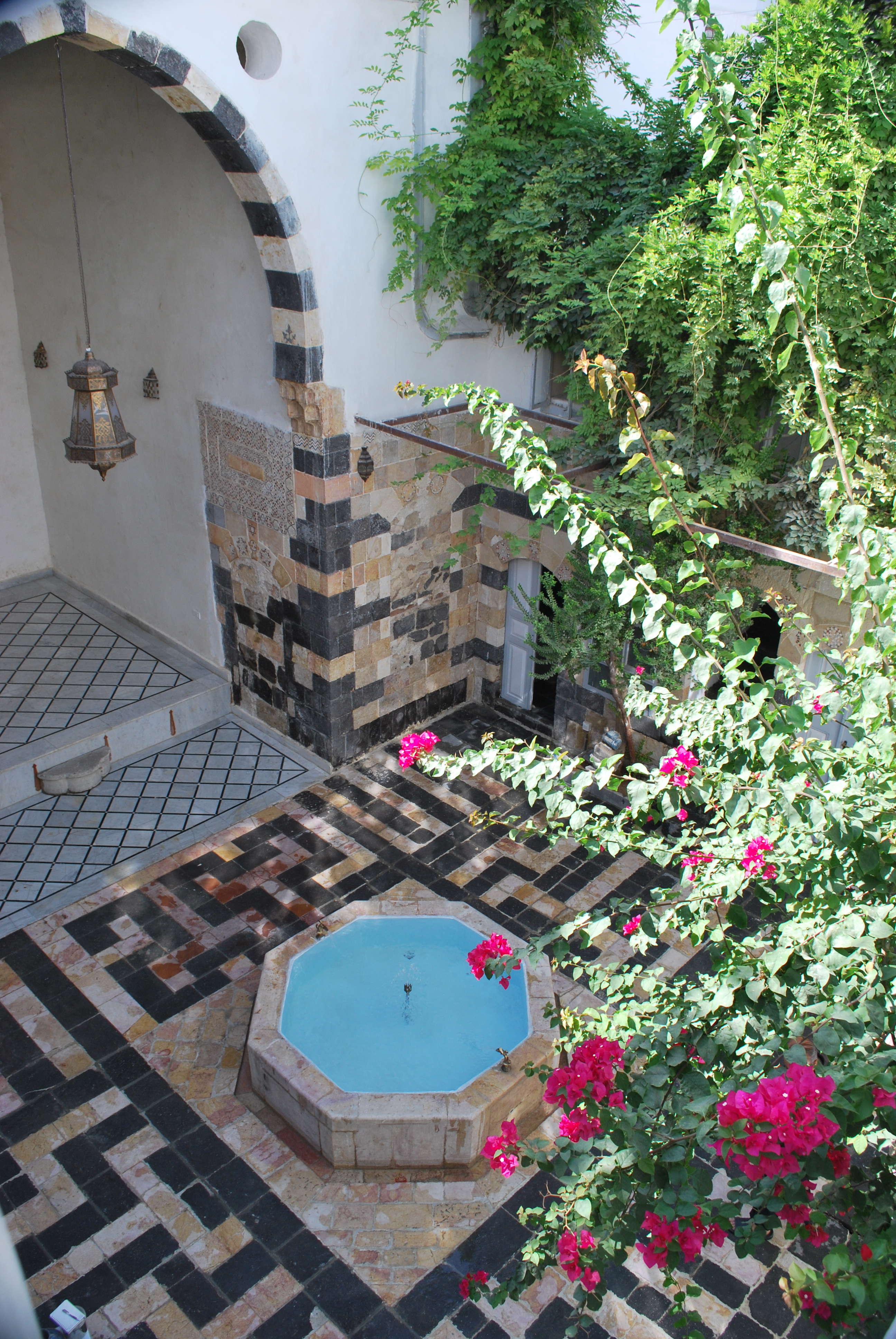
Inside that sanctuary I have experienced, more than anywhere else, a powerful sense of unity with nature and with my surroundings. The way the light stroked the ancient stones, the way the vibrant bougainvillea fell in a magenta trail, the way the palm doves swooped from their nests in the heavy foliage to peck at invisible delicacies, the way the tortoise meandered silently in and out of the shadows. The music of the call to prayer from the myriad mosques echoed round the walls and on Sundays the church bells chimed in melodiously.  Overwhelmed by the palimpsest of Syria’s complex past and present embodied in the multi-layered heritage of the house, I felt embraced as if by some archetypal womb.

To reach that point was hard. The path was strewn with near-impassable obstacles, blocked with bureaucratic nightmares beyond imagining.  But Syrian friends patiently helped me through the labyrinth. Only after painstaking deconstruction did I get there, a process which came to be symbolic of Syria’s own years of deconstruction, still alas ongoing.

First the breezeblock wall dividing the courtyard two-thirds one-third had to be pulled down to reunite the space as one, a move I identified as the reunification of Syria’s population, broadly two-thirds Sunni Muslim, and one third minorities like Kurds, Alawis, Christians and Druze. Next the uniform white-painted cladding had to be stripped off the walls revealing the centuries-old stonework of contrasting soft limestone and black basalt. This was a particularly lengthy stage, as we chipped away carefully with hand tools, struggling not to damage what lay beneath. The uniform cladding of the Ba’ath Party system and the tentacles of its omnipresent security system have been suffocating Syria’s identity for the last 50 years. Concrete is tough stuff.

Even so, the day will surely come when Syria too has its rotten infrastructure, its faulty wiring and its dodgy plumbing ripped out. Like the house, it will gradually emerge from the wreckage, as kaleidoscope colours begins to blend subtly with mellow shades from across the ages. The human quest for the perfect space – what I found in my magical courtyard – will never die.  Once ‘tasted’, as Islam’s greatest philosopher Al-Ghazali  wrote, the memory cannot be taken away. Today’s tragedy inside Syria leaves many wondering  how and when it will all end. How can a nation and its people endure such suffering?

Yet what I have learnt from my Damascus courtyard, is that despite the extremism and corruption currently ravaging the country, Syria’s core identity, firmly-rooted in centuries of moderation and tolerance, will survive. Its  zaahir looks hideously damaged, but its  baatin, its ‘World of Interior’ will remain intact.

The 'secret ceiling', an accidental discovery, that comes to represent the multi-coloured complexity of Syrian society [DD, 2013]

The ‘secret ceiling’, an accidental discovery, that comes to represent the multi-coloured complexity of Syrian society [DD, 2013]

As published in World of Interiors, August 2014, under Journal of an Arabist:

In renovating the house she bought in Damascus in 2005, Diana Darke has chipped away at the modern layers to find the harmonious structure beneath. A similar deconstruction is needed to recover the tolerant, pluralistic  Syria hidden by war.

‘My House in Damascus: An Inside View of the Syrian Revolution’ is published by Haus, Amazon price match paperback and ebook£10.49:

http://www.bookhaus.co.uk/shopexd.asp?id=727

My House in Damascus


Postcard from Nusaybin, southeast Turkey

POSTCARD from NUSAYBIN (as published in Chatham House’s The World Today magazine (Aug/Sept 2014 issue)

Mar Yakoub Church and university, Nusaybin [DD, 2012]

Syriac Mar Yakoub (St James’s) Church and university dating to the 4th century, Nusaybin [DD, 2012]

One glance at a modern map is enough to understand why Nusaybin is a hotspot in today’s world. Situated in southeast Turkey, it looks across the border at its southerly reflection, Qamishli in northeast Syria; its main east-west highway hosts an endless convoy of tankers with their precious cargo heading out from Erbil in oil-rich Iraqi Kurdistan into oil-poor Turkey;  and another highway leads southeast to Iraq’s Mosul. This volatile triangle of territory is delineated by watchtowers and fences along the Syrian-Turkish border, erected in the 1970s, and by the long Syrian-Iraqi desert frontier which became a physical barrier only after 2003.

All this talk of borders would have made no sense at all before World War One. Sykes-Picot had yet to draw their ‘lines in the sand’ creating the modern states of the Middle East. The maps in Baedeker’s 1906 Palestine et Syrie show only the loose provincial Ottoman boundaries and the journey from Nusaybin to the ruins of Nineveh, capital of the Assyrian Empire on the banks of the Tigris opposite Mosul, is described as ‘five days on horseback requiring a strong escort.’ Even in the 1930s under the French Mandate when Agatha Christie accompanied her archaeologist husband Max Mallowan to dig the famous tells of Mesopotamia, they would arrive by train at Nusaybin via the Berlin-Baghdad railway, then head south with no customs formalities, despite their trunkloads of luggage.

The defunct border crossing from Nusaybin to Qamishli [DD, 2014]

The defunct border crossing from Nusaybin to Qamishli [DD, 2014]

Nusaybin’s strategic location on east-west trade routes ensured a complex past. Beginning with the Assyrians, empires came and went, and as Roman Nisibis it formed a fortress-frontier against the Persian Sassanids. Forever caught in the power-play of outside forces, there are two indigenous peoples, the Kurds and the Syriacs, in and around Nusaybin who rarely get a mention, stateless peoples whose aspirations for nationhood were repeatedly thwarted. But an unintended consequence of recent events like the US invasion of Iraq, the ‘Arab Spring’ and the rise of ISIS militants has changed the dynamic.

The city’s residents today, like most in the area, are overwhelmingly Kurdish, with just a small Syriac community, but in the 4th century the population was mainly Syriac, and Nusaybin’s Syriac roots are still deep. St James’ Church in the centre is one of the world’s oldest functioning churches, dating back to 325. Alongside it sits the newly excavated university where famous scholars like St Ephrem the Syrian, ‘Harp of the Spirit’ (306-73), composed  hymns and trained all-female choirs. His language was Syriac, and his descendants, ancestors of the Assyrians, still speak a dialect of ancient Aramaic known locally as ‘Suryani’, using its classical form in their liturgy.

Successive persecutions at the hands of fellow Christians, Muslims and Kurds across the centuries caused most to escape to Europe and beyond, but to ensure the language does not die, each year dedicated members of the Syriac diaspora  send their children to Syriac summer schools run by monks at the nearby monasteries. Those who stayed scattered into small broken communities across the region within cities like Raqqa and Aleppo in Syria, Mosul and Baghdad in Iraq.  Qamishli was largely created by Christians fleeing the fighting of World War One.

Next summer  will be the centenary of their worst ever persecution, the 1915 Sayfo (The Sword), little known in the West, a massacre in which tens of thousands of Syriacs were slaughtered alongside Armenian Christians, mainly at the hands of Kurdish tribesmen.  Yet remarkably, today the highly educated and talented Syriac community is reviving, fed not only by families from abroad, but also by refugees from Syria,  returning to their ancient homeland. Most significantly of all, they are gradually healing historic rifts with their Kurdish neighbours, acknowledging that they were manipulated during the 1915 Sayfo by their Turkish masters.

Roman columns of Nisibis in the no-man's land between Nusaybin (Turkey) and Qamishli (Syria) [DD, 2013]

Roman columns of Nisibis in the no-man’s land between Nusaybin (Turkey) and Qamishli (Syria) [DD, 2014]

Looking across today’s barbed-wire border from Nusaybin, through the no-man’s-land where the last relics of Roman Nisibis still rise, the houses and grain silos of Syria’s Qamishli are clearly visible. Blessed with fertile wheat fields, Syria’s largest oilfield and three major rivers, this panhandle of northeast Syria  is quite a prize, and in January 2014 Syria’s Kurds, as the dominant population, declared Qamishli capital of ‘Rojavo’  or western Kurdistan. The 22 cabinet ministers are a Christian/Muslim/Kurdish mix, in line with their secular ideology. Kurdish identity is defined by ethnicity, language and culture not by religion, a fact reflected in Iraqi Kurdistan’s schools where all world religions are taught equally.

Today’s fragile balance is now threatened by new invaders, the Sunni militants of ISIS, who want to rid the region of imperialist borders, and impose an ultra-conservative Islamic state across Iraq and Greater Syria.  A year from now, at the centenary of the Sayfo, will Nusaybin still be in Turkey? What will the map look like? Only one prediction can safely be made – that it will still be a hotspot.


#Syriac Christians threatened with the ‘Sword’ again

Graves in the village of Anitli (Haho) [DD, May 2014]

Graves in the village of Anitli (Haho) [DD, May 2014]

The threat of  ‘the sword’ has special resonance for Syriac Christians. Syriac for ‘sword’ is Sayfo, the name they use to refer to the massacre they suffered in 1915, when tens of thousands of them were slaughtered. On Friday 19 July the Syriac Christians of Mosul, whose ancestors were the Assyrians with their capital at Nineveh on the bank of the Tigris opposite Mosul, were threatened with the sword, unless they converted to Islam or paid the jizya, a tax levied by early Islam on religious minorities. Beheading by the sword was the earliest form of capital punishment in Islam. This time, to escape such a fate, they are fleeing northwards in their thousands, mainly into Iraqi Kurdistan, whose Kurdish rulers do not define themselves or anyone else by religion. Islam is one among many religions and Kurdish schools there teach all religions equally. Nearly a hundred years ago,  the Syriacs fled southwards from Turkey. On that occasion their persecutors were mainly Kurdish tribesmen acting on the instructions of  Turkish masters seeking to purge the Turkish state of non-Turkish minorities, but today their tormentors are fanatical fighters of mixed nationalities from the State of the Islamic Caliphate (formerly ISIS), who took control of Mosul,  Iraq’s second city, on 10 June 2014.

As Europe remembers the outbreak of World War One a hundred years on, the oft-forgotten group of Aramaic-speaking Christians has been gearing up for its own centenary. Their original heartlands are the region known as the Tur Abdin (‘Mountain of the Servants of God’ in Syriac),  a remote corner of what is now southeast Turkey, where their churches and monasteries date back to the 4th century. As their anniversary approaches, this resilient community, helped by members of their increasingly active diaspora from Sydney to Stuttgart, has been resolutely fighting back.

Their expulsion from Mosul will definitely not be the end of them. The following text of my BBC From Our Own Correspondent piece with accompanying photos, describes their determination to survive:

http://www.bbc.co.uk/programmes/p022kkk3 (direct link to the BBC Radio 4 broadcast of 10 July 2014)

“No need for alarm clocks in Midyat. Every day in this ancient Syriac Christian town high on its plateau in southeast Turkey I am woken by goats bleating at my window and by cattle clattering past on cobbled streets. Kurdish children are herding them to nearby pastures from once elegant mansions that now serve as stabling.

Syriac stone mansion in Midyat [DD, May 2014]

Syriac stone mansion in Midyat [DD, May 2014]

For visitors like me the livestock lends a rustic charm, but not for members of the Syriac diaspora like Gabriel Khoury, whose ancestral home is one such pungent stable. Gabriel’s family emigrated to Australia when he was a boy, but now he has come back to claim his property. ‘I have six court cases to fight,’ he declares, his blue-eyes flashing angrily.  I encounter him at church where he leads the chanting in Aramaic, the language spoken by Christ. Then he takes me to the one-roomed hovel, his current home, which is all he has left of his heritage. His surname ‘Khoury’ reveals he comes from a line of priests.  ‘Long story short,’ he explains, ‘I will not give up till I have my family’s houses and shops back. Then, if God wills, I will rebuild them.’

Gabriel in his single room [DD, 2014]

Gabriel in his single room [DD, 2014]

Rebuilding is a constant refrain in this region known as the Tur Abdin,  where the Syriacs, one of the world’s earliest Christian communities, suffered heavily at the hands of the Kurds and Turks, especially in the 1915 massacres. At the village of Kafro I meet Niall, who has returned from 30 years in Stuttgart to help rebuild his community. An imposing row of large walled villas with a slightly fortified feel now flanks the single street. Alongside the ruins of the house where he was born, he has opened an al fresco pizzeria shaded by a nine-sided gazebo draped with vines. Multiples of three, representing the Trinity, are everywhere in the architecture here, and vines too hold deep spiritual significance, producing wine from the precious blood-stained soil. Traditionally each family planted just enough for its own modest consumption, but now some Syriacs have set up a wine factory imaginatively concealed in a mock mansion carved with friezes of grapes and wine glasses. Producing five reds and two whites to growing worldwide acclaim, its carefully chosen trademark  Shiluh means ‘peace’ in Syriac.

‘Two more families are coming back this year,’ smiles Niall, as he takes me to see the derelict shell of their original church. ‘When our community is bigger, we will restore this one. For now we are using a smaller one.’ He leads me past a well-tended cemetery where an open grave is awaiting the body of a 90-year-old returnee from Germany. This land reclaims its old, but reclaiming the young is more problematic. ‘Our teenagers,’ he explains, gesturing at a group just finishing their pizzas, ‘will leave soon for universities in Germany. A school bus takes the three of them from Kafro to Midyat where they are the only Christians in classes of over 40. How can we expect them to return here?’

Back in Midyat, Gabriel is on the case. The refugee camp established on a nearby hill was intended just for Syriac  Christians fleeing the fighting in neighbouring Syria, but so successful were they in being sponsored to leave, that only one family now remains.

The Syriac refugee camp on a hill outside Midyat [DD, May 2014]

The Syriac refugee camp on a hill outside Midyat [DD, May 2014]

 People like Gabriel took responsibility for the Christian refugees, many of whom have since moved west to Istanbul. Some have stayed in Midyat, like Maryam, a fair-haired beauty originally from Qamishli just across the border in northeast Syria. She now works as a waitress at one of Midyat’s magnificently restored Syriac mansions, converted to a 15-room hotel.

Midyat boutique hotel (Shmayaa) converted from a Syriac mansion [DD, May 2014]

Midyat boutique hotel (Shmayaa) converted from a Syriac mansion [DD, May 2014]

‘Long story short,’ says Gabriel, ‘we need more like this to bring our people back, more girls and more hotels.’ He even wonders if one of his sons might marry Maryam – his own wife was from Qamishli – and plans how young men might return from Europe as architects and managers to design and run hotels, as businessmen to create new enterprise, and above all  as lawyers to champion their cause. I dare to raise December’s controversial settlement of the land dispute with the biggest of the monasteries. ‘Don’t make me laugh,’ he retorts  tossing his head, ‘they gave us 20% only, the other 80% is still held back. Long story short,’ he continues, ‘we will fight on till we get back what is rightfully ours. ‘

Father Joaqim, Syriac monk at Mor Awgen, near Nusaybin [DD, May 2014]

Father Joaqim, Syriac monk  who has revived Mor Awgen Monastery, near Nusaybin [DD, May 2014]

As the centenary of their historic massacre, the Sayfo, approaches, long story short, maybe they will.

Related links:

http://www.bbc.co.uk/programmes/p022kkk3

http://www.independent.co.uk/voices/editorials/conversion-of-iraq-as-isis-drives-christians-out-of-their-homes-the-groups-genocidal-intentions-take-on-horrible-clarity-9617651.html

http://www.independent.co.uk/news/world/middle-east/time-runs-out-for-christian-iraq-isis-deadline-passes-with-mass-flight-9617606.html

http://www.al-monitor.com/pulse/originals/2014/07/jabhat-al-nusra-announce-islamic-emirate.html

Church of the Mother of God, Haho July 2013

Church of the Mother of God, Haho [DD, May 2014]

Saving #Syria’s Cultural Heritage – how to help

Bricking up the 13th century prayer niche of the Halawiye Madrasa, Aleppo

Bricking up the 13th century prayer niche of the Halawiye Madrasa, Aleppo

Little known and little recognised, groups of Syrians inside Syria are working together to try to save the destruction of their country’s cultural identity. Confronted with the inertia of the international community, the occasional statement and handwringing from UNESCO and the Syrian government’s own narrative presenting itself as the custodian of the country’s rich treasures, these groups are taking matters into their own hands. A mix of academics, archaeologists, students and ordinary citizens with a deep love for their country, they have almost no funding and most are volunteers.

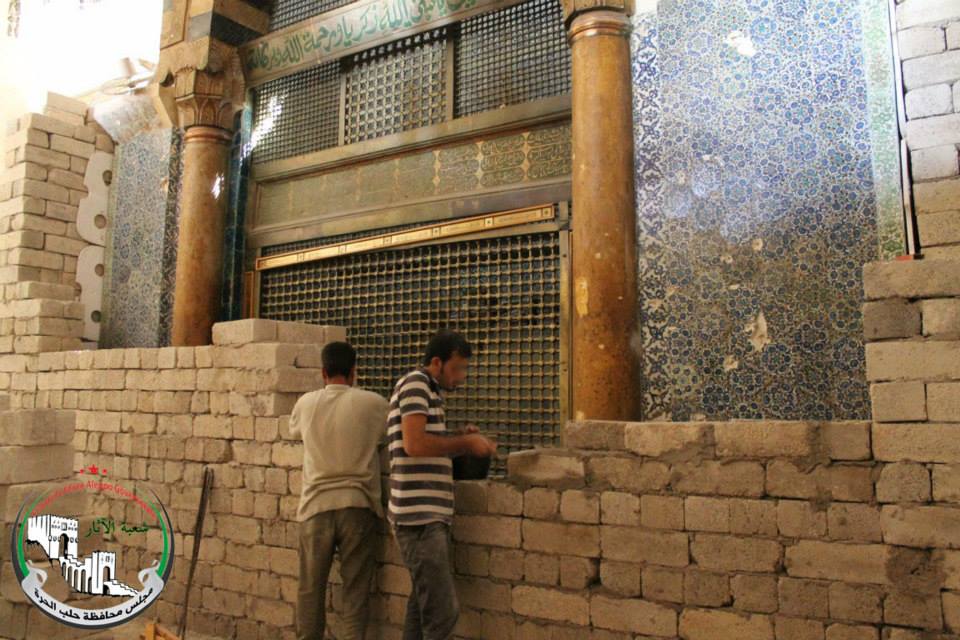
Protecting the tomb of the Prophet Zachariah, inside the Aleppo Great Mosque

Protecting the tomb of the Prophet Zachariah, inside the Aleppo Great Mosque

A recent study (by Heritage for Peace see link below) has shown that 38 organisations are involved worldwide in efforts to highlight the damage to Syria’s cultural heritage, including the big names like UNESCO, Blue Shield, the Global Heritage Fund, the World Monument Fund, ICCROM and ICOMOS. The overwhelming majority are talking shops, gathering data and posting it online. They are largely based outside Syria and function only through the official channel of the Syrian Directorate-General of Museums and Antiquities (DGAM) which in turn only functions in the regime-held areas of the country. Of these 38 organisations, 14 have been formed since 2011 specifically in response to the Syrian crisis, mainly from volunteer groups. Only six of the organisations are Syrian, working on the ground inside the country, and of these only three that we are aware of are taking pro-active, pre-emptive measures to protect ancient buildings. It is a chronic state of affairs, but such is their commitment to doing whatever they can that they are prepared sometimes even to risk their lives in order to protect and save their cultural identity.

Bricking up Zachariah's Tomb, Aleppo Great Mosque

Bricking up Zachariah’s Tomb, Aleppo Great Mosque

Aleppo, once Syria’s largest and richest city, is where such actions have been most prevalent. The Division of Antiquities of the Free Council of Aleppo was founded in 2013 and has sandbagged and walled up the precious sundial in the Aleppo Great Umayyad Mosque, and bricked up its shrine of the Prophet Zachariah. With the help of the Tawhid Brigade from the Free Syrian Army, they have dismantled its 12th century wooden mihrab for safe-keeping away from the front line.

The Syrian Association for Preserving Heritage and Ancient Landmarks was founded in Aleppo in 2013. Its members, many of them archaeology students from Aleppo University, at considerable risk to themselves, saved the stones from the fallen minaret of the Great Umayyad Mosque and have put them safely elsewhere awaiting reconstruction after the war. They also helped the Free Council of Aleppo with protecting the sundial and removing the mihrab.

Protecting the sundial in the courtyard of the Aleppo Great Mosque

Protecting the sundial in the courtyard of the Aleppo Great Mosque

The Association for the Protection of Syrian Archaeology (APSA) was founded in 2012 in Strasbourg by a group of Syrian archaeologists and journalists. Together with collaborators on the ground they have compiled an extensive website cataloguing the damage (www.apsa2011.com) and have also held short workshops in Turkey’s Gaziantep to train Syrians in techniques of how to record damage and how to carry out simple protection measures.

Syrian aircraft dropping barrel bombs to dislodge rebels from the Byzantine Dead City of Shanshara, Idlib Province

Syrian aircraft dropping barrel bombs to dislodge refugees sheltering in the Byzantine Dead City of Shanshara, near Al-Bara, Idlib Province

A team goes to document the damage at the Dead City of Shanshara, part of the UNESCO World Heritage site inscribed in June 2011, Idlib Province

An APSA team goes to document the damage at the Dead City of Shanshara, part of the UNESCO World Heritage site inscribed in June 2011, near Al-Bara and Kafaranbel, Idlib Province

All of this work goes unrewarded financially and unrecognised internationally. Syria’s concentration and range of cultural heritage sites far exceed that of neighbouring Iraq. Yet while Iraq benefited from a UN resolution in 2003 after the US invasion banning trade in its antiquities, the Syrian case has been largely ignored, complicated by politics. Stepping up to the challenge, the Global Heritage Fund UK has recently agreed to help by acting as a channel for funds for anyone who would like to help support this work. The sums involved are small by the standards of international organisations. But international organisations like UNESCO cannot operate inside Syria without the permission of the Syrian government – a permission which has not been forthcoming.

APSA is looking to raise £32,000. So far they have raised £6,400. If each of the 624,000 people who clicked to view the recent BBC feature highlighting the problem (see below) had been able to contribute just £1, the target could have been met 20 times over.

Anyone who would like to do something tangible to help can contact cgiangrande@globalheritage fund.org, or use the donation form below. Even small amounts will make a huge difference. Handwringing and nostalgia, alas, do not.

Global Heritage Fund – 2014DonationFormV2

Related links:

Click to access Towards-a-protection-of-the-Syrian-cultural-heritage.pdf

http://www.apsa2011.com/index.php/en/

http://www.bbc.co.uk/news/magazine-28191181

Presentation given on 30 June by Diana Darke and Zahed Tajeddin to the Global Heritage Fund UK on saving Syria's Cultural Heritage

Presentation given on 30 June by Diana Darke and Zahed Tajeddin to the Global Heritage Fund UK on saving Syria’s Cultural Heritage


Post Navigation