dianadarke

Syria and Turkey commentary

Archive for the tag “Damascus”

Cultural curiosities in #Syria

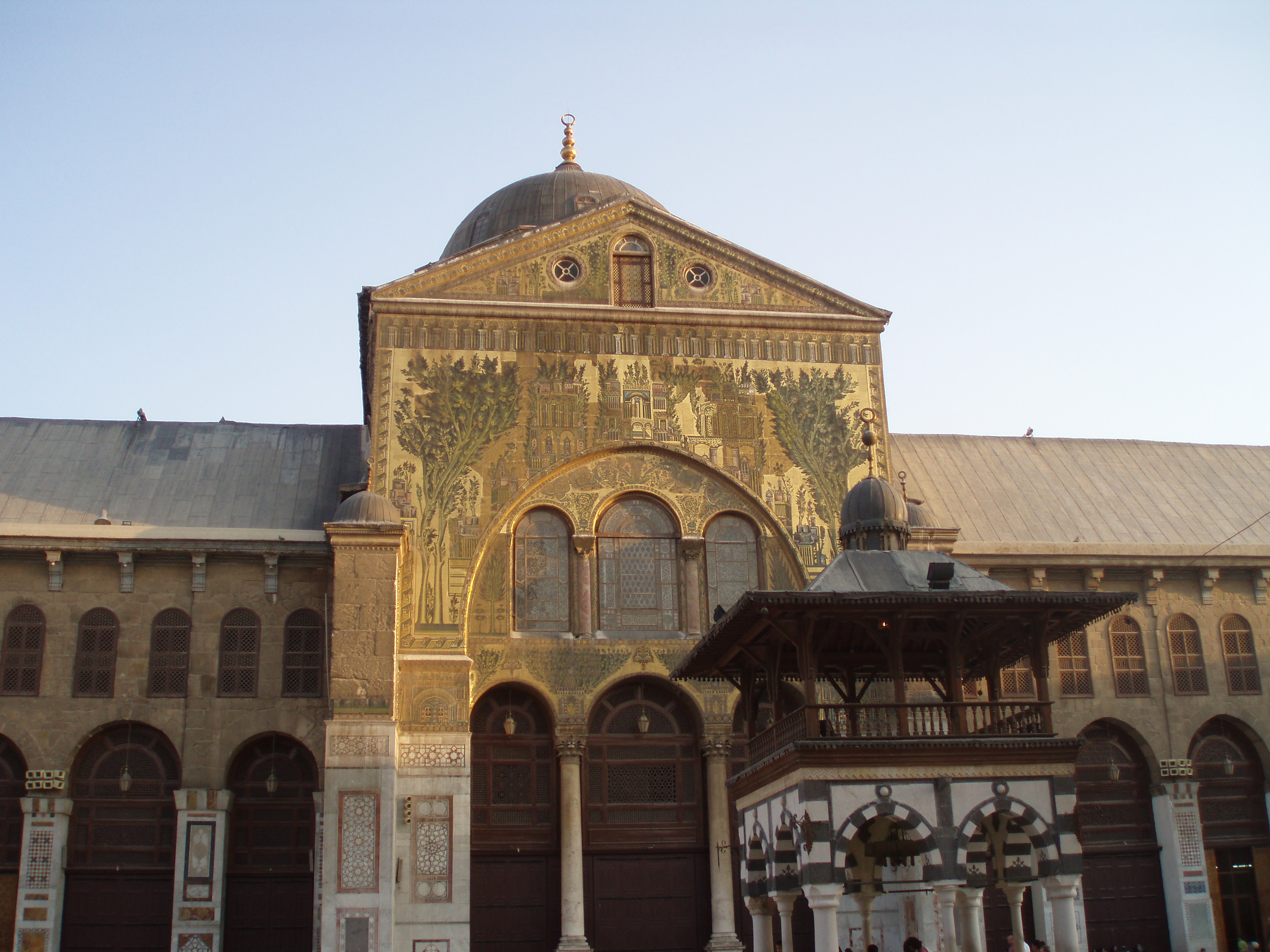
Images of Paradise in the mosaics of Damascus' Great Umayyad Mosque [DD]

Images of Paradise in the mosaics of Damascus’ Great Umayyad Mosque [DD]

1. Restoration of mosaic panel in the Great Umayyad Mosque of Damascus completed following damage from a “terrorist” shell, according to the official Syrian news agency. Damascus residents say it was so small, no one noticed:

http://sana.sy/eng/33/2014/02/03/526027.htm

2. Curious ironies of the Olympics-timed ceasefire in Homs:

http://www.ft.com/cms/s/0/19e29742-8f60-11e3-be85-00144feab7de.html?siteedition=uk#axzz2tCBcBUxZ

Ancient Phoenician stadium at Amrit, south of Tartous [DD]

Ancient Phoenician stadium at Amrit, south of Tartous [DD]

3. New tree-planting “forestation” campaign along Beirut-Damascus highway:

http://sana.sy/eng/27/2014/01/19/523248.htm


Roman road in Syria [DD]

Roman road in Syria [DD]

PR battle intensifies as Geneva II dates approaches

Prophetic 2007 poster of Bashar in Damascus' Hijaz Railway with the caption: 'We pledge allegiance to you with blood forever.' Blood drips from the words 'with blood'.[DD]

Prophetic 2007 poster of Bashar in Damascus’ Hijaz Railway with the caption: ‘We pledge allegiance to you with blood forever.’ Blood drips from the words ‘with blood’.[DD]

The BBC’s Chief International correspondent Lyse Doucet has posted a heart-rending news item this morning about Syria’s battle for bread:

http://www.bbc.co.uk/news/world-middle-east-25397140

Reporting from a government bakery in Damascus the footage shows queues of men (food shopping is traditionally the domain of men, not women across the Arab world) waiting to be issued with their packs of  round flat thin bread, far thinner than what is sold in the UK as pitta bread. The price, because this is heavily subsidised by the government, is the same as it has been for 20 years, 2 Syrian pounds per piece (1p in the current exchange rate,  2.5p in the exchange rate of before the revolution). In private bakeries, she is told, the price is ten times higher, and in war-torn parts of the country, there is no bread at all.

The sub-text here, though of course Lyse Doucet is far too professional to say so because she has been allowed into Damascus on a government-sponsored visa, is that in rebel-held areas there is no bread because the rebels cannot organise the production and because distribution networks have been disrupted. Cereal production is down by 40% and what wheat there is is mainly controlled and distributed by the government. She phrases her words very carefully to avoid any suggestion of attributing blame to either side.

Next the footage moves to a distribution centre where UN aid,  food parcels and blankets are being handed out to women and families queuing in the freezing cold. The snow has melted in central Damascus but the temperature range is still 1-7 degrees Celsius, quite normal for the winter months as Damascus lies at an altitude of 700m. She interviews a lady  who assures her that all aid channeled in via the UN agencies goes direct to the Syrian people who need it – a reassuring message to all who have generously donated to the UN Syria appeals.

Again the sub-text  is complex. UN aid has to proceed through government-approved channels and the process is tightly controlled. By definition rebel-held areas will not receive any such food parcels or blankets. Such areas  have to rely instead on aid channeled in ‘illegally’ across the borders, raised by Syrian charities funded by individuals. The British surgeon David Nott, who worked for 6 weeks in and around Aleppo conducting operations on victims of aerial bombardments and sniper attacks, and teaching Syrian doctors how to conduct them in his absence, was escorted into the country by exactly such a charity, Syria Relief http://www.syriarelief.org.uk/syriarelief/.

The Syrian government agenda here is clear, in allowing a senior BBC reporter into Damascus now, in the run-up to Christmas, and more significantly, in the run-up to 22 January, the date just 5 weeks away set for the crucial conference dubbed ‘Geneva II’, aimed at reaching a negotiated settlement to the Syrian crisis.  It wants to present its caring face to the world, to the international community who will be watching it at Geneva II. This government has learnt well the lessons taught it by the US and British PR firms it used to employ before the revolution to project its softer image across the world. Mindful of how this image has been damaged by the horrors of the country’s raging civil war, it is working hard on re-building it. As the date for Geneva II approaches, the government will almost certainly be intensifying its efforts to present itself as the only force in the country that can save Syria. And the biggest tragedy of all is that thanks to the vaccum left by western inertia, now increasingly filled by extremist Islamists funded by wealthy Gulf individuals, this assertion has probably become true.

Related articles

Revenge in Arab proverbs #Syria

Arab proverbs on revenge do not augur well for Syria’s future. There are many, but here are a few, to give a flavour:

Blood washes away blood

Vengeance erases shame

Break one jar of mine and I will break one hundred of yours

I looked for Arab proverbs on forgiveness and could only find one:

Only when the fault is forgotten is forgiveness complete

Reading Robert Fisk’s offering from Damascus today:

http://www.independent.co.uk/voices/comment/robert-fisk-in-damascus-assads-troops-may-be-winning-this-war-in-syrias-capital–untouched-by-obamas-threats-8825005.html

left me deeply troubled about where events are heading.

As the Turkish proverb says:

If you dig a grave for your neighbour, measure it for yourself


Related articles

Maa’loula Media War #Syria

Mar Serkis (St Sergius) Monastery dating to the 4th century, one of Syria's oldest still functioning churches [DD]

Mar Serkis (St Sergius) Monastery dating to the 4th century, one of Syria’s oldest still functioning churches [DD]

Why has Maa’loula, Syria’s most famous Christian village, suddenly found itself caught up in the Syrian war? Like most Christian villages, it has stayed neutral from the beginning, trying not to be drawn onto one side or the other. Why should it happen now?

Maa’loula is of no strategic interest to the rebels, set as it is in a cleft under a cliff with only one way in and out. Only the Qalamoun Mountains above the Christian town are of interest as strategic high ground from which to command surrounding areas. The regime has controlled a big and well-armed checkpoint at the entrance to Maa’loula for a long time, but last week it started firing up at rebel positions high above Maa’loula, provoking the rebel attack on the checkpoint. The regime then began shelling the town to displace the rebels, and the story hit the papers. Residents of Maa’loula were understandably frightened and distressed, feeling they had to leave and take shelter in Damascus. Conveniently, the BBC’s Jeremy Bowen had been given a regime-approved visa to be in Damascus, and was there to interview and film the fleeing Christians. Headlines across the world soon became ‘Christians in Maaloula forced to flee homes and houses looted by rebels.’ YouTube videos uploaded afterwards showed some damage to the Hotel Safir at the top of the cliff and to some residential buildings. The two famous monasteries were undamaged.

The facts here are strange for their timing. It is extremely lucky for the regime to have such headlines at present, to give weight to the anti-US intervention campaign, to make the rebels look as if they are targeting Christians. But why would the rebels do that? In the entire course of the Syrian civil war, the overwhelming majority of people killed have been Sunni Muslim. There have been no reciprocal massacres of Christians or Alawites by the rebels. If they had wanted to target Christians they could have done so months or even years ago, desecrating churches and knocking down crosses. Instead, many rebels have been actively helping Christians and protecting them wherever possible. In Qara, a little north of Maaloula the Christians are helping the rebels. In Homs the rebels are guarding the churches and the frescoes inside have not been damaged. Only the external fabric and the glass has been damaged by the regime shelling.

Church frescoes in Homs, Church of the Virgin's Belt [DD]

Church frescoes in Homs, Church of the Virgin’s Belt [DD]

They are even protecting the 35 or so Christian families who are still in Homs, too old or too poor to leave. But none of that makes headlines.

In Maaloula, beside the two famous monasteries of Mar Serkis and Mar Thekla, whose shrines are visited by Christians and Muslims alike in search of miraculous cures like a kind of ‘Lourdes’, there are 6 further churches and 2 mosques. The community is predominantly Christian but is also mixed. In Seydnayya, another famous monastery a little to the south just on the edge of the Qalamoun Mountains, the shrine is also visited by both Christians and Muslims, again seeking cures to illness and disease. In the town there are 13 further churches and 2 mosques. Two Christian women in the town are married to Muslim men. These communities have lived side by side for centuries.

Now however the regime is in a very tight spot, with the threat of an American-led attack. Bringing to the forefront of the world’s consciousness a strategically insignificant but historically significant place like Maa’loula, Syria’s most famous Christian village well known to tourists as the place where the nuns will sing ‘The Lord’s Prayer’ for you in Aramaic, ‘the language of Christ’,  is a very clever ploy. The regime has learnt well from the American and British PR firms it paid so handsomely to advise it on ‘image enhancement’ before the revolution broke out. Better trained and better funded, they are winning the PR war.

Related articles

Syria is not Iraq – 10 key differences

Images of Paradise in the mosaics of Damascus' Great Umayyad Mosque [DD]

Images of Paradise in the mosaics of Damascus’ Great Umayyad Mosque [DD]

Young and old arm in arm in Damascus

Young and old arm in arm in Damascus [DD]

Following on from ‘Syria’s Ghost’ (posted 31/08/2013) here are 10 key differences between the case for intervention in Syria as opposed to Iraq:

1. In 2003 Iraq was not in a civil war. It was simply another repressive authoritarian Arab state not much worse than Mubarak’s Egypt and Gaddafi’s Libya.

2. Syria in March 2011 witnessed a peaceful spontaneous uprising against its repressive authoritarian leader Bashar Al-Assad.

3. The Iraqi people were not asking the US-led coalition to intervene.

4. A large section of the Syrian people asked the international community to intervene after the Assad regime countered their peaceful demonstrations with extreme violence, arbitrary arrest and torture.

5. Iraq in 2003 did not present a threat to the international community. There were no Al-Qa’ida operatives or jihadis inside Iraq. They came in later to profit from the chaos we created.

6. Syria presents a serious threat to the security of the international community. The Al-Qa’ida-linked jihadi groups have thrived in the vacuum left by our non-intervention, and are growing. They are starting to dominate the moderate rebel groups like the Free Syrian Army.

7. Iraq was not a proxy war.

8. Syria has become a proxy war: America v Russia, Iran v Saudi Arabia, Hizbullah v Salafis. The interests of the Syrian people have been lost in the proxy war interests.

9. Iraq was not a humanitarian intervention. It was not in danger of collapse in 2003. It was not at war and was stable.

10. Syria would be a humanitarian intervention under the ‘Responsibility to Protect’ doctrine (Bosnia is the model). Syrians are dying of starvation and lack of medical attention as well as regime massacres and chemical weapons attacks. An entire generation is being lost.

For all those reasons, Syria is not Iraq, and for all those reasons, from the moment the regime made clear its intention to wipe out all opposition, I have supported intervention by the international community. Without it, Syria will disintegrate entirely over a period of years, and the fallout will come back to bite us big time.

Saladin's Castle in the mountains above Lattakia [DD]

Crusader Castle of Saone, later Saladin’s Castle in the mountains above Lattakia [DD]

Saladin's Tomb in Old Damascus. Saladin was a Kurd. [DD]

Saladin’s Tomb in Old Damascus. Saladin was a Kurd. [DD]

Looking at it objectively now 10 years on, the American-led invasion did inadvertently help one sector of the Iraqi people – the Kurds. Autonomous Iraqi Kurdistan could almost be seen as a model for the Middle East. Its schools since 2012 are teaching all world religions equally, and Islam is just one of them, no favouritism. It is booming economically thanks to its oil and its trade with Turkey. But all that was an unintended consequence.

Syria’s Kurds could also benefit from the current crisis in Syria, but that is happening anyway, and will continue irrespective of American strikes. More and more of them are pouring out of Syria’s northeast corner into Iraqi Kurdistan, where they are being warmly welcomed. Kurdistan may well turn out to a lasting beneficiary of the chaos inside Syria, along with the Syriac Christian community in eastern Turkey:

http://www.bbc.co.uk/news/magazine-23614968.

Related articles

Syria’s Ghost

Damascus' Great Umayyad Mosque with its Jesus Minaret

Damascus’ Great Umayyad Mosque with its Jesus Minaret

Nothing symbolises the cultural diversity and complexity of Syria more than Damascus’ Great Umayyad Mosque. Built on Aramean then Roman foundations, it was a cathedral, then a mosque, even serving as both simultaneously for nearly a century. But the colourful mosaic of Syria is becoming a broken jigsaw. Why is that?

In a word, Iraq. The spectre of Iraq hangs over the way everyone has viewed the Syria crisis for the last two and a half years. Syria is seen through Iraq-tinted spectacles. From the start the media has wanted to see everything in terms of what went wrong in Iraq, and never more so than now.

But Syria is not Iraq. It is so different from Iraq it is hard to know where to begin in listing the differences.

The spectre of Iraq and the US/UK-led destruction of Iraq has held back any meaningful involvement in helping the Syrian opposition. In time the vacuum started to be filled by extremist groups, all too keen to get meaningfully involved. In the first year of the Syrian uprising there were no extremist groups involved at all, in the second year they grew to 5% of the opposition forces, and in the third year they have grown to 15% and rising. Abandoned by the west, Syrian rebels had little choice but to accept the help of extremist Islamist groups in fighting the omnipresent Assad regime, in power for over 40 years and very deeply dug in. What else could they do?

The spectre of Iraq has held back western public opinion from supporting Syria in its quest for a fair new Syria, a Syria where arbitrary arrest and torture, routine under Assad’s Ba’athist system, is finally abolished and political prisoners are set free.

And now the spectre of Iraq has prevented British MPs voting to support military action. Britain has abdicated and sidelined itself, tied itself in tortuous knots made up of Iraqi string.

No one, it seems, can see past the spectre of Iraq, and the media must take its share of the blame in this. The media loves a good crisis, a good war. Suddenly Syria is all over the airwaves, when it was barely getting a mention before the chemical attack. It had become too boring, too routine, averaging about 200 deaths a day, not really worth mentioning, unless of course there was a nice cannibal to report on.

If America takes military action now, it will be doing so for all the wrong reasons and the consequences are by definition unknowable. Syrians are pawns, their fate is being decided by outside players who are now finally, when it is too late, becoming involved for their own reasons, with their own agendas, not for any genuine humanitarian reasons. The ‘Responsibility to Protect’ rule could have been invoked long ago if western powers had wanted. But the spectre of Iraq held them back.

According to Islamic popular tradition, Christ will descend from the Jesus Minaret of Damascus’ Great Umayyad Mosque before the Last Judgement to fight the Antichrist. Never has Syria needed a saviour more than now.

Syria is not Iraq. But it is cruelly haunted by the ghost of Iraq.

Maybe in the future we will all be haunted by the ghost of Syria, for our failure to help its deserving people.
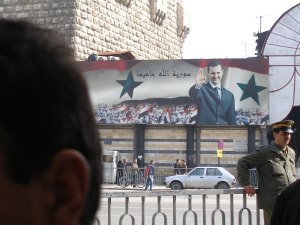
Unintended irony in the caption beside Bashar: 'God is Syria's Protector'

Unintended irony in the caption beside Bashar: ‘God is Syria’s Protector’

One year since Father Paolo’s abduction by ISIS

Father Paolo 2 download

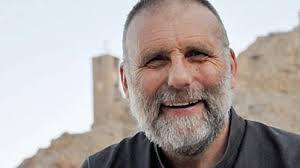
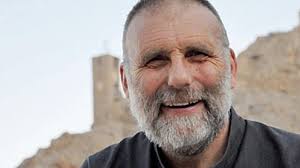
Father Paolo in front of his beloved Mar Mousa Monastery

On 29 July 2013 Father Paolo was abducted by ISIS in the Syrian city of Raqqa. There have been occasional rumours of his death at the hands of ISIS, most recently by an ISIS defector who said Paolo was shot 14 times and his body thrown into a well, but the Vatican so far has refused to confirm or deny such rumours. Until any news is definite, I will therefore keep this piece in the present tense, reissued in remembrance of a remarkable man.

Father Paolo does not fit the mould. He is not a man of conventions and has always pushed at the boundaries of what both Muslims and Christians consider acceptable. An Italian Jesuit priest, he went against the rules of his Jesuit community and set up an ecumenical monastery in the mountainous desert between Homs and Damascus.

OLYMPUS DIGITAL CAMERA

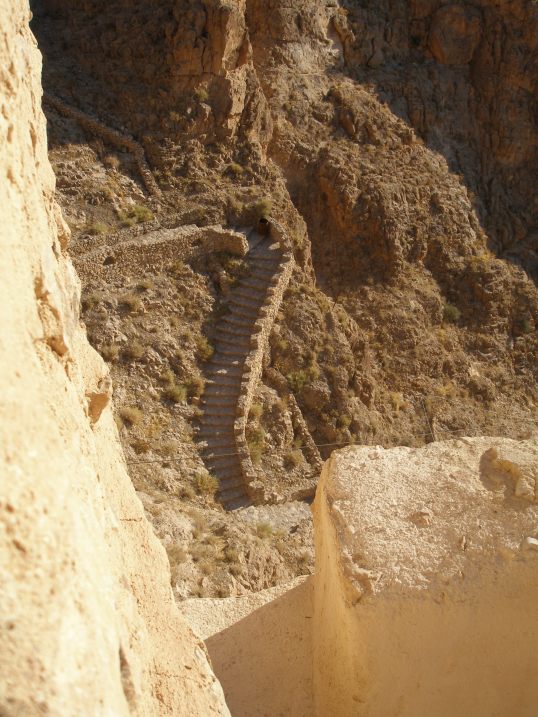
Steps leading up to the Monastery of Mar Mousa, steps which Father Paolo himself helped to build.

It represents his entire life and there is no doubt he would be prepared to die for it, for Syria and for his beliefs.

What are his beliefs? For him it does not matter whether you are Muslim or Christian, as long as you are close to God. He rejects the strict concept of ‘orders’ as very occidental: “Orders come from the West,” he always said. “In the east there are no orders.” He also felt it does not matter if you are a man or a woman, as long as your commitment to God is deep and sincere. He has always rejected what he sees as narrow-minded criticism of his allowing both monks and nuns at his community of Mar Musa. Most unusual of all though, is his conviction that he has been called to bring Islam and Christianity closer to each other. This is the whole purpose of his monastery, where masses were attended by Muslims and Christians alike. “We are here for the Muslims and for Islam”, he said. “We must not be against them. We are here for them.”

This is what he said to everyone who visited, and before the revolution up to 50,000 visitors a year came, mostly Muslims. He said it to Marius Kociejowski, who devoted a chapter to Father Paolo in The Street Philosopher and the Holy Fool, and he said it to me when I last visited him in November 2011, eight months into the Syrian Revolution when almost no foreigners came any more to Mar Musa.

On that occasion, six months before he was expelled from Syria for his outspoken criticism of the Assad regime and equally outspoken support of the Syrian Revolution, he spoke animatedly about his fears for the country. He foresaw the partition of the country and all the old divisions he was fighting so hard to dispel, resurfacing in ugly ways. He was disappointed in the position that some of his fellow Christian churchmen and women were taking in the struggle, trying to exclude themselves from the fight.

To imagine that he would stay out of Syria after his expulsion was always unrealistic. A man like Paolo could never be a bystander and watch from the sidelines. He knew the risks he took in going into Raqqa, in trying to speak to militarized extremists. The risks would not have mattered to him. What mattered was that he at least tried to negotiate, tried to reason with them not to fight against Kurdish groups. He believed in sacrificing personal happiness in pursuit of a greater goal.

“For me there is no East or West,” he said. He rejected the mould. May his philosophy never die.

Father Paolo 2 download

Related links:

http://english.al-akhbar.com/node/20110

http://www.ibtimes.co.uk/syria-jesuit-priest-paolo-dall-oglio-killed-498510

Jesuit Priest Father Paolo Dall’Oglio Shot 14 Times by Syrian Freedom Fighters (Video)


A House in Damascus

From Our Own Correspondent piece: http://www.bbc.co.uk/programmes/b0368kp4  Radio piece 4 minutes

From Our Own Correspondent full text – Syria’s Silent Majority

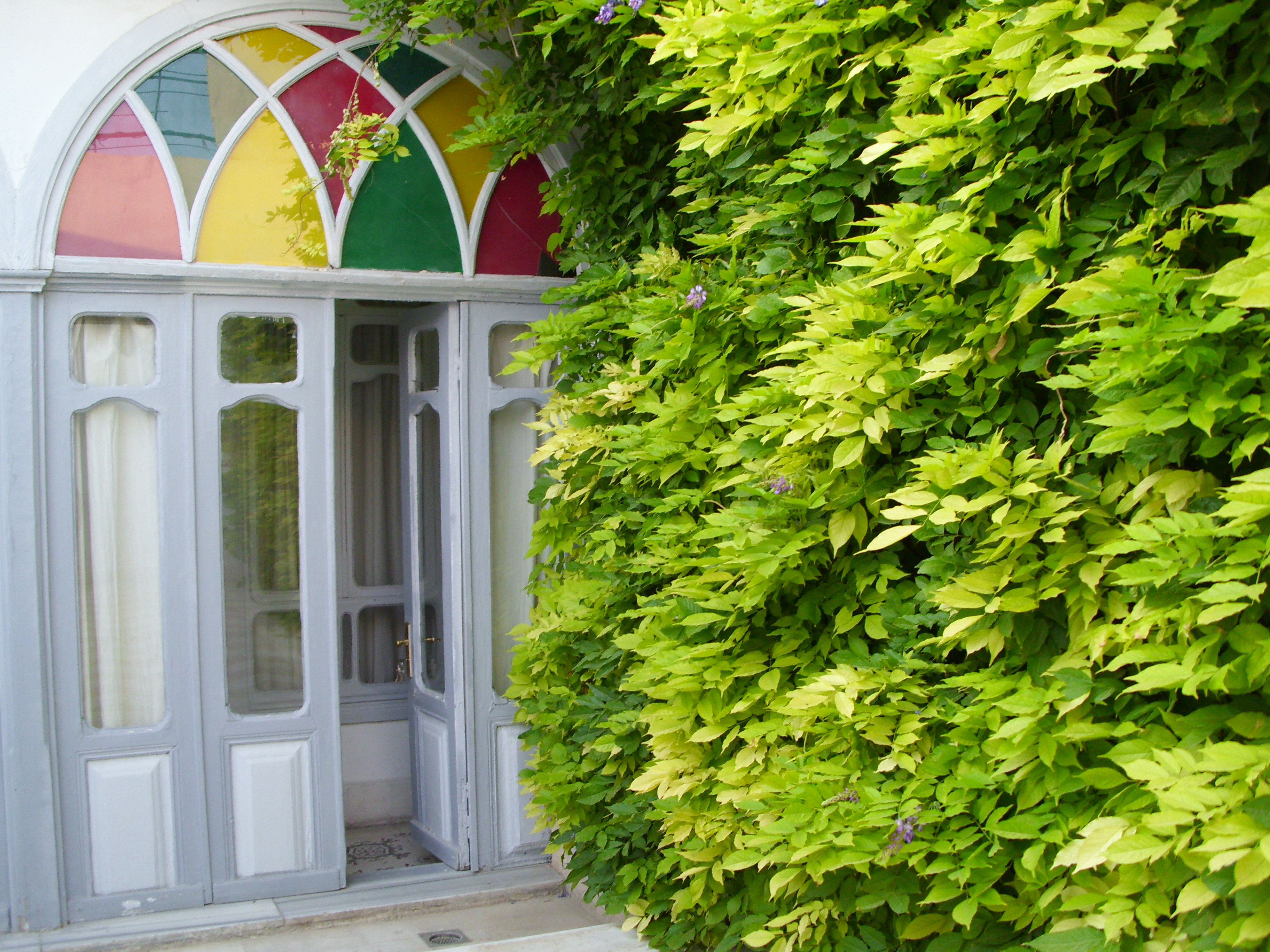
Restored Damascene courtyard houseDamascus June 2011 061Damascus June 2011 041Damascus June 2011 023Damascus June 2011 027Traditional Damascene tiles used decoratively in house restoration

Since writing this piece the ‘peoples’ committees’ (also called ‘reconciliation committees’ or more accurately ‘neighbourhood militias’) have grown in number within the Old City, raising tensions among the residents. They fear that these militias, often very young and always heavily armed, far from ‘protecting’ the Old City, will only bring the fight closer into the centre.

The radio piece begins at 6 minutes in from the programme start and lasts 4 minutes.

Damascus ‘neighbourhood militias’ being trained in Russia

Detail of an Ottoman painted ceiling in the Old City of Damascus

Detail of an Ottoman painted ceiling in the Old City of Damascus

Members of the ‘neighbourhood militias’ who now man the checkpoints in the Old City of Damascus have been receiving training in Russia, I am reliably informed. Training in what, you may ask? How to spy on your neighbours?

No, training in how to use weapons, how to fire guns, Many of the militia members are very young indeed, still teenagers. But if you are unemployed and your university/school education has been interrupted by war, the attractions of a stable job, paid for by the regime are obvious. The overwhelming majority are young men, but a few are women, some of whom – especially those stationed at the Bab Touma and Bab Sharqi checkpoints, are even wearing hijab headscarves, which is surprising.

The ordinary residents of the Old City have noticed the change, and the increase in armed patrols and checkpoints, but far from feeling safer, they are worried that these militias will increase the volatility of the Old City, hitherto a relatively safe bubble away from the fighting. What will happen next is anyone’s guess, but the residents feel highly manipulated by the presence of these militias whom they have had no say in choosing.

A rare insight into Damascus

The priceless mosaics with scenes of Paradise, Damascus Umayyad Mosque

The priceless mosaics with scenes of Paradise, Damascus Umayyad Mosque

It is rare in current reporting on Syria to find anything that goes beyond sensationalist headlines about Islamic extremists, massacres, battles won and lost. Horror stories about cannibals compete with more horror stories about rape as the international perception of Syria and its people spirals ever downwards.

But the New York Times’ recent reporting by Anne Barnard bucks the trend, showing the complexities of life in Damascus while at the same time exposing some of the regime’s ploys to control the Old City of Damascus. Barnard and her interpreter were taken by their government minder to attend one or two of the so-called ‘reconciliation’ committee meetings held in Maktab Anbar, the Ottoman palace which serves as the headquarters of the Old City’s municipal offices. But even though they were shown these meetings as examples of how the communities are cooperating to protect their neighbourhoods, they were able to see through the charade and identify many of the same attendees as members of the armed ‘neighbourhood militias’ and observe that ‘security’ was the main topic rather than ‘reconcilation’. If only more media reporting was as perceptive.

http://www.nytimes.com/2013/07/21/world/middleeast/enlisting-damascus-residents-to-answer-assads-call.html?pagewanted=all

http://www.nytimes.com/2013/07/29/world/middleeast/a-link-straight-to-syrias-ancient-past-endures-as-war-creeps-closer.html?_r=0

http://www.nytimes.com/slideshow/2013/07/29/world/middleeast/29damascus.html#1

Post Navigation