Alabaster sarcophagus of Hafez being stroked in reverence
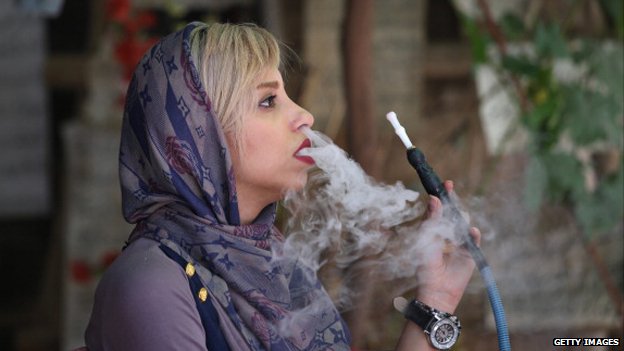
Far from being a homogenous grouping of devout Muslims, as the last 47 years of rule by the Islamic Republic would have us believe, Iran’s population of 93 million is a diverse multi-ethnic people. ‘We never did Islam the way they wanted us to,’ was the clear refrain I met from Iranians during my last tour of Iran. The empty mosques bore witness, serving largely as places for men to take a nap on the carpet during their lunch break. This was in September 2014, shortly after the UK and Iran announced their intention to resume diplomatic relations, broken off in 2011 following the storming of the British Embassy in Tehran by protesters chanting ‘Death to England.’ Decades of colonial interference in Iranian affairs, including the 1953 coup to install the Shah as absolute ruler (codenamed Operation Boot) to protect Britain’s oil interests, have left little love lost between the UK and Iran.
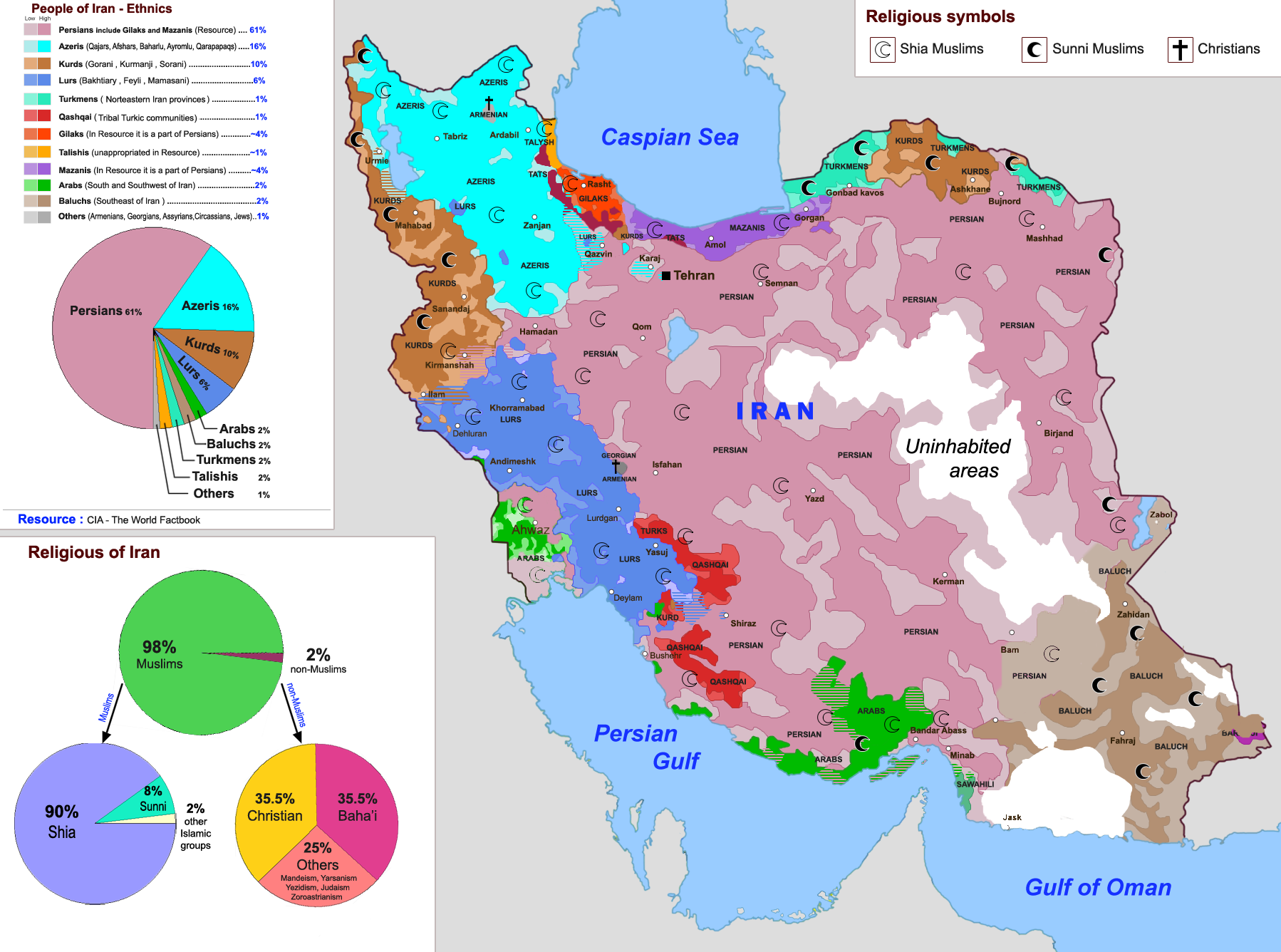
Today’s Iranian government officially registers all citizens born to Muslim parents as Muslim, an act which effectively masks the true personal beliefs of the younger generation. It does not, however, officially collect detailed ethnic data in its census, so figures are of necessity estimates, but the World Population Review 2026 gives a 51-61% core of Persians, 16-24% Azerbaijanis, 7-10% Kurds, 8% Gilaks and Mazandaranis, 2-6% Lurs, 2-3% Arabs, 2% Baluch and 2% Turkmen and other Turkic groups.
What these diverse multi-ethnic groups do, however, share, is a strong cultural identity. The joke runs that in every Iranian home there are two books, Hafez and the Qur’an. One is read and the other unread.
Hafez, the fourteenth century national poet, represents the rich complexities of Iran’s identity. His tomb in Shiraz, Iran’s most liberal city, is a place of pilgrimage day and night, with crowds of devotees stroking his alabaster sarcophagus. His poetry, besides lauding the joys of love and wine, also targets religious hypocrisy. “Preachers who display their piety in prayers and pulpit”, he wrote 600 years ago, “behave differently when they are alone. Why do those who decree repentance do so little of it?”
While the West remains obsessed with Iran’s nuclear enrichment, it is an open secret that well-connected clerics and businessmen enrich themselves through sanction busting. When I lacked the cash in Isfahan to buy a rug, the dealer simply rang a friend in Dubai and processed the supposedly banned credit card transaction. It duly appeared on my statement as a purchase made in Dubai.
Despite the mullahs’ best endeavours – or maybe because of them – there have been fundamental changes in Iranian society since the revolution in 1979. More women than men now graduate from university, leading to a well-educated female population that is refusing to breed, despite government incentives: ironically, a consequence of the mullahs’ own policy of spreading education.
Though the minorities are usually blended in the cities, many are concentrated in the border regions: the Kurds in the northwest, the Beluch in the southeast, the Turkmen in the northeast and the Arabs in the oil-rich southwest. If the central authority of the IRGC were to collapse, it could trigger a significant splintering in peripheral regions where historical grievances and armed movements are most deeply embedded. The Kurds in particular are the most potent ethnic opposition, and have a history of revolution against the Iranian regime, but also of disunity, frequently descending into infighting. The best organized are the PKK, Turkey’s nemesis, whom President Erdogan would be furious to see armed by the US, as Trump has hinted.
Given the lack of unified opposition to the IRGC, a power vacuum could see chaos, civil war and a resurgence of movements seeking independence. Deep divisions exist between the Persia-centric opposition royalists who would welcome the return of the Shah’s son, Reza Pahlavi, and the ethnic minorities.
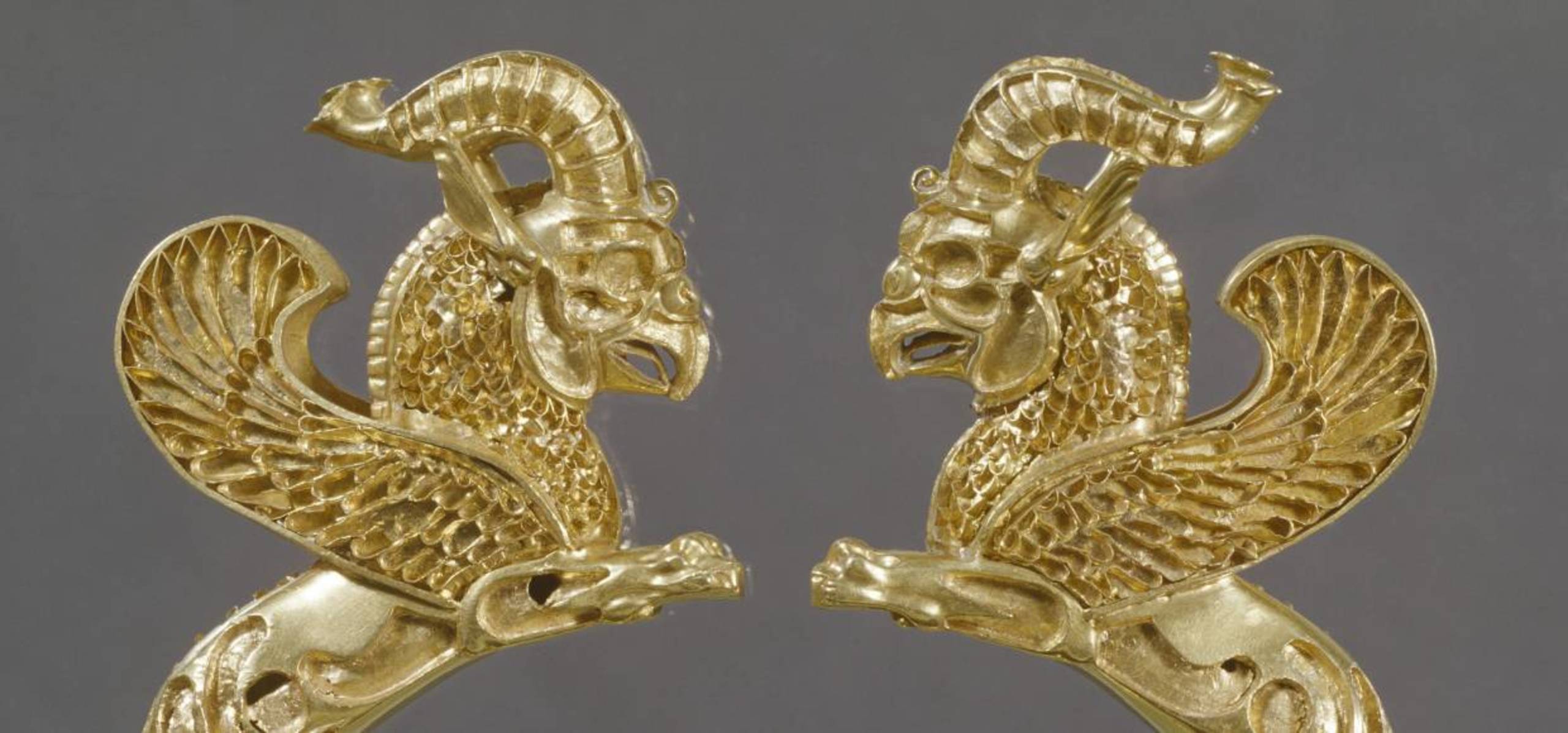
Recent independent surveys have found that Iranians are increasingly embracing their pre-Islamic heritage as another way of expressing anti-regime sentiment. There is immense pride in the unique Persian identity of their ancient Zoroastrian religion, almost as a kind of cultural nationalism. With origins to much earlier than 600BC, when Cyrus the Great adopted it as the state faith, it is one of the world’s first monotheistic religions, introducing the idea of a single supreme deity, Ahura Mazda, often represented as an eagle- winged disc with a human figure emerging from the centre. Scholars believe Zoroastrianism profoundly shaped the foundations of Judaism, Christianity and Islam, specifically its belief in the dualism of the eternal struggle between good and evil, the Final Judgement, angels and demons, the resurrection of the dead, and heaven and hell.
In 1979 the mullahs did a deal, allowing Zoroastrians one seat in Parliament if they did not oppose the regime. The fire temple in Yazd, spiritual heart of Zoroastrianism, has burned for over 1500 years, and the faith today is said to be experiencing a resurgence especially among young Iranians, among whom there is a marked trend away from traditional religious practice.
[Some elements of this article first appeared in a feature entitled ‘The ghosts of Iran’ published in The Tablet magazine, 12 March 2026, co-authored with John McHugo.]
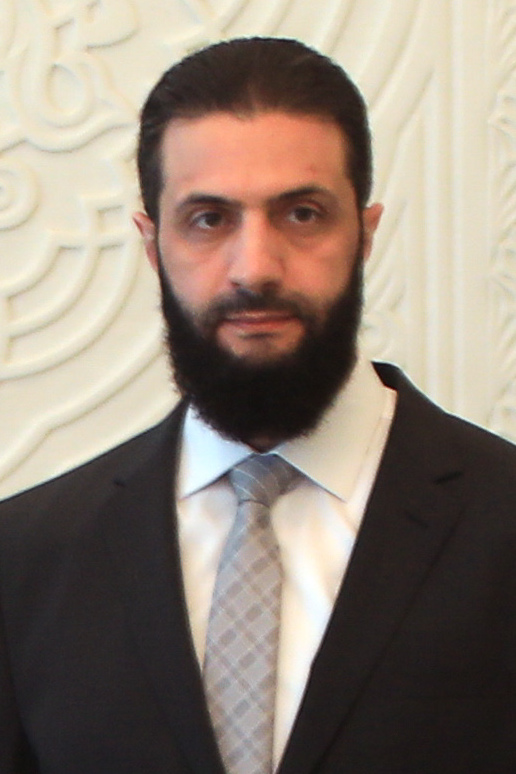
Tonight Donald Trump announced he will order the lifting of sanctions on Syria ‘to give them a chance at greatness’. It is a momentous declaration of confidence in the new man at the top, a man widely dismissed in the West as a religious militant, a jihadi extremist.
I am writing this post tonight because I profoundly disagree with the profiles put forward in recent months of Ahmad al-Sharaa, formerly Abu Muhammad al-Jolani, by The Economist, the Financial Times and The New York Times. They are all obsessed with his past, with his changes of direction and allegiance, with what they call his ‘chameleon’ nature. They are also convinced that he is driven by a lust for power, calling him ‘the great pretender.’
In my view, they are wrong. They misjudge and misunderstand the man, basing their analyses on the factual details they have been able to glean from various sources about al-Sharaa’s previous history and his background. They do not understand how his brain works, with some even confessing that they are puzzled by how he has managed to persuade other people to follow his directives and gain a following.
Here, I should reveal that I have an extra tool at my disposal – namely, a professional qualification in graphology earned over twenty years ago which enables me to analyse his handwriting and to see into his mind, to understand his motivations and his priorities. Handwriting is brainwriting and cannot lie. Through its subconscious elements like spacing, flow, direction, continuity, pressure and speed, it reveals the secrets of a person’s makeup, their character, their drive, their moral integrity, their strengths and weaknesses. These are elements that apply irrespective of the language or the script. I was trained on English and French handwriting, a two-year course of study with French external examiners in written and oral papers, but the same principles apply in Arabic, or indeed in any other language. Obviously when talking about a script direction being progressive, in English progressive is left to right, while in Arabic it is right to left. For regressive it is the other way round – in Arabic left to right, in English right to left.
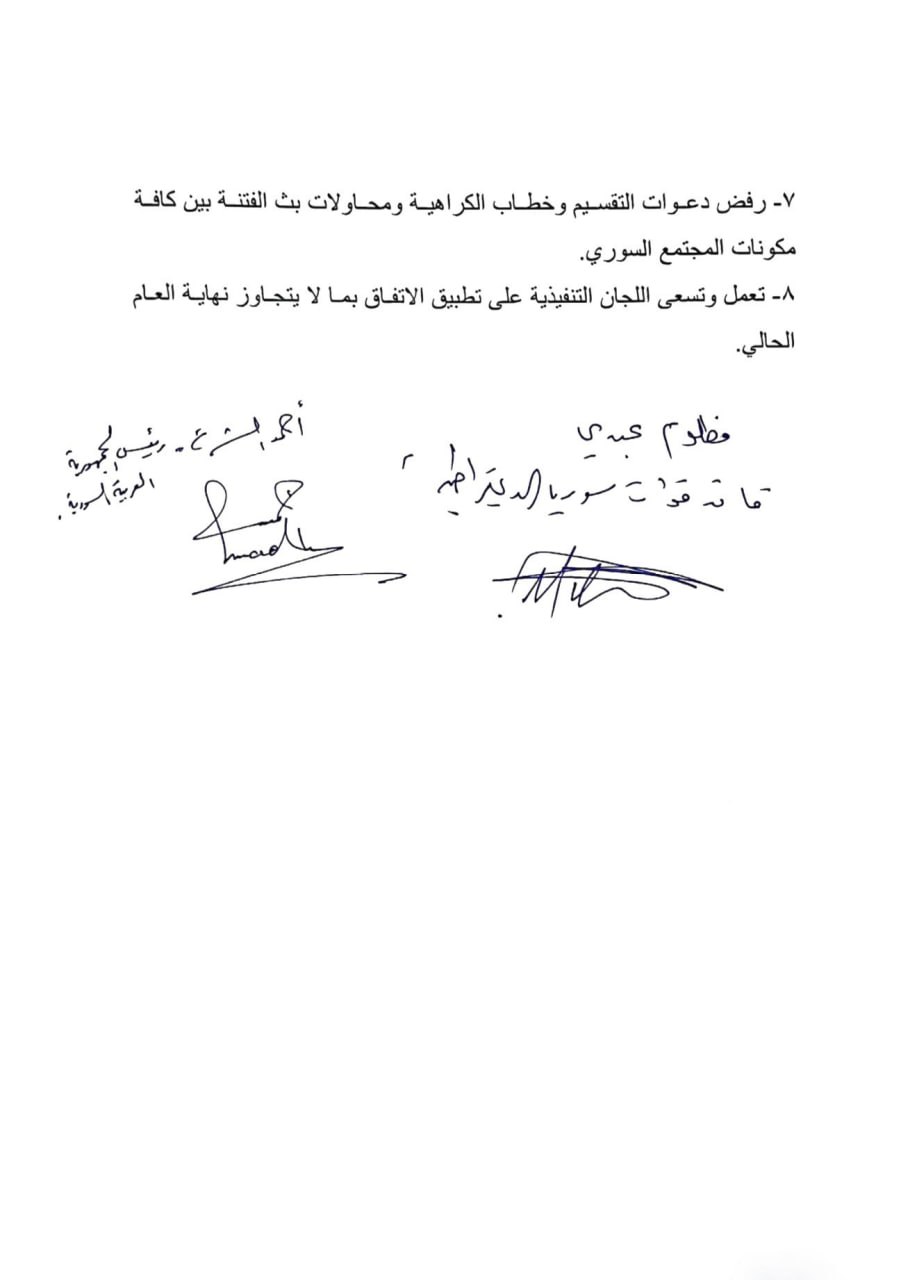
Let us look at the case of Ahmad al-Sharaa. I first saw his handwriting when it appeared online at the end of the 10 March 2025 agreement signed between him and Mazloum Abdi, commander of the SDF, the Kurdish-led Syrian Democratic Forces. The contrast between the two men’s handwriting and above all their signatures was striking.
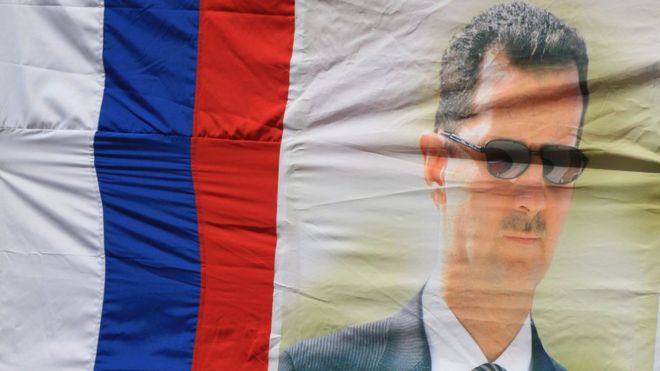
Looking at Mazloum Abdi, his signature is not progressive, but doubles back over itself, unsure of its direction, hesitant, and ends in an unnecessary and cautious dot. Bashar al-Assad, incidentally, had a cautious, self-cancelling signature that tried to big itself up in energy-wasting flourishes that lacked direction. Some years ago I wrote a comparative analysis of Assad father and son, concluding that while Bashar might have been the face of the Assad regime, he was certainly not its backbone.
Ahmad al-Sharaa on the other hand has the most remarkable signature I have ever seen, in English or in Arabic. The sheer ingenuity and agility in the way it is formed is astonishing. It begins in the top right corner with the four Arabic letters of Ahmad – alif, Ha, mim and dal, before moving back towards the right and seamlessly becoming the letters of Ahmad in English – A, h, m, a, d. The free-flowing movement at the end of the Arabic ‘dal’ cleverly doubles as the ‘A’ of the English Ahmad. The signature then reverts to the Arabic ‘al-‘ of the start of his family name, before ending in a final progressive flourish where the letters of Sharaa are not legible. There are four changes of direction, and the pen never leaves the paper. It is all one smooth stroke, carried out at speed. The movements throughout are highly progressive, never regressive. This is a man who only moves forwards, never backwards, and who is always open to all manner of solutions, approached from a variety of angles. He thinks outside the box and shows great adaptability and flexibility, whilst remaining true to his own vision. He is not driven by greed for power or money, but rather by a genuine belief that he has the ability to bring Syria forward into a new and progressive future. He is not dogmatic, stubborn or difficult.
His writing illustrates clearly the complex journey he has been on in his life to arrive at where he is now. His many changes of direction have been integral and necessary parts of his life. A signature of this complexity has taken many years to evolve, and certainly did not suddenly appear on 8 December 2024 with the fall of Assad. It is not just pragmatism, as western analysts like to describe it. It is far more than that. It is his ability to adapt quickly to changing situations and to move progressively with the flow of events as they unfold. This is a skill that requires deep intelligence, thoughtfulness and good judgement combined, all exercised simultaneously and at pace. On top of that there is also an element of playfulness and humour, making him likeable and popular. The New Syria would be hard pushed to find a better man to navigate the challenging road that lies ahead.
Anyone familiar with Islamic art will long have known how heavily William Morris drew his inspiration from the Islamic world. One glance at his patterns is enough – the repetition to infinity, the twisting foliage, the richly entangled fruit and birdlife, the stylised designs that are often botanically impossible yet speak to us at some deep primordial level – all are hallmarks of Islamic art. Curiously, ever since his patterns were popularised, appearing in every imaginable accessory in our kitchens and living rooms, from curtains to coasters, from tablecloths to mousemats, those same iconic Morris designs have been subsumed as ‘quintessentially English’, somehow deemed to be an intrinsic part of our British cultural identity. It is the same blind spot that exists with Gothic cathedrals like Notre-Dame, proclaimed to be ‘quintessentially French’, synonymous with the French national identity, by those oblivious to the Islamic origins of such rich architectural styles and ornamentation.
Until, that is, it is pointed out in exhibitions like ‘William Morris and Art From the Islamic World’, still running till 9 March 2025, where the eye can become trained. All credit is due to the William Morris Gallery, the fine Georgian family home in Walthamstow where Morris grew up, for staging this exhibition, and for highlighting to a British audience what has been hiding in plain sight all along. The gallery’s guiding mission has been to bring the communities of Walthamstow, where one in five of the population is Muslim, closer together, an outreach project to show how different cultures have intertwined and inspired creativity since time immemorial. Maybe a future exhibition at the V&A could do the same for Islamic architecture and European medieval styles like Romanesque and Gothic?
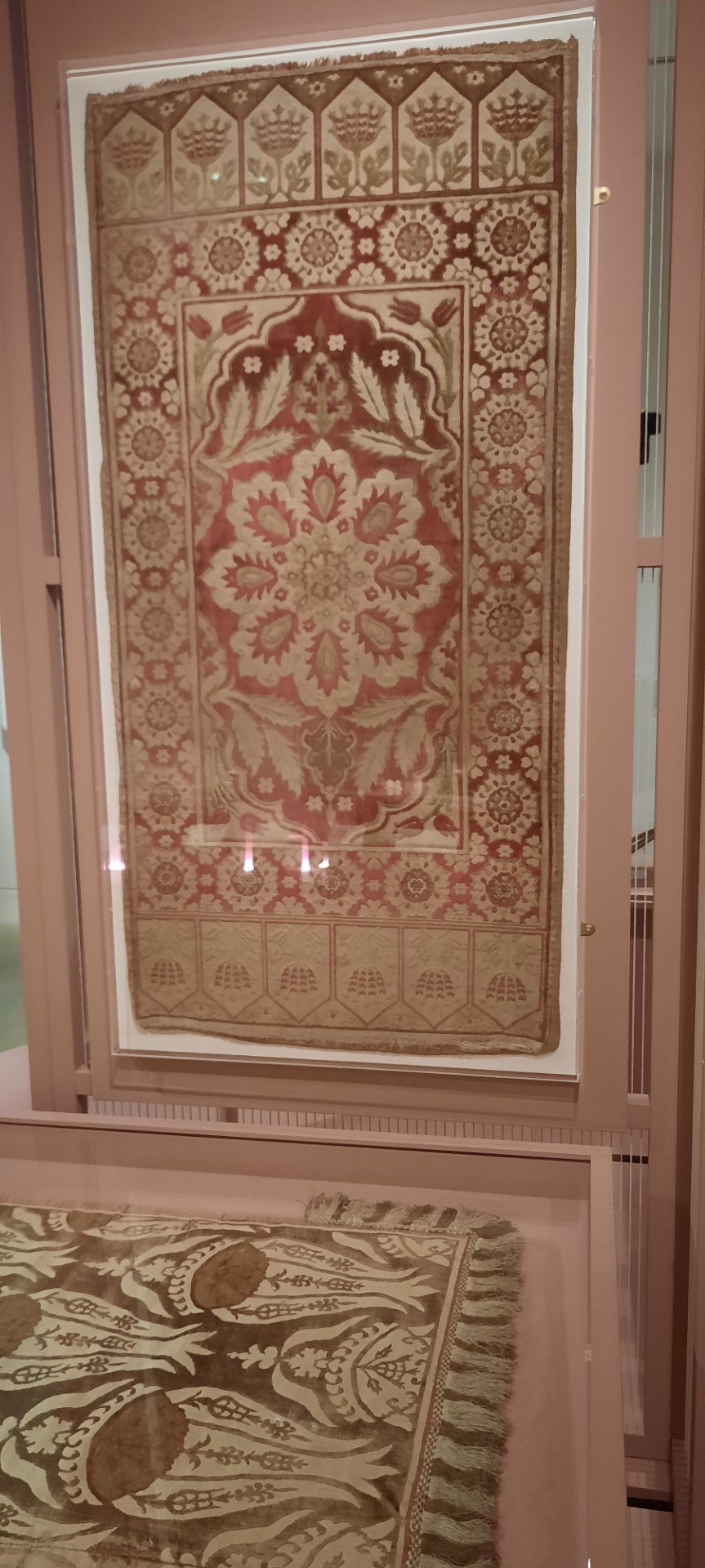
The starting point of the exhibition is a smallish room which brings together items from the Islamic world all of which, crucially, once belonged to Morris and his family. Though Morris himself never travelled further east than Italy, he acquired a range of carpets, textiles, metalwork and ceramics mainly from Iran, Syria and Turkey, which clearly served as his prototypes, using them to decorate his homes. This geographic range is very important to the curators’ careful and deliberate choice of phrasing in the title ‘Art from the Islamic world’, a much more accurate description than was common in Victorian times when all Islamic art was labelled ‘Persian’, considered the ultimate in Orientalist chic. Even today, museums like the Jackfield Tile Museum in the Ironbridge Gorge perpetuate such misnomers in their labelling, describing English tiles that are clearly copying Ottoman Turkish tile designs as ‘Iranian-influenced’.
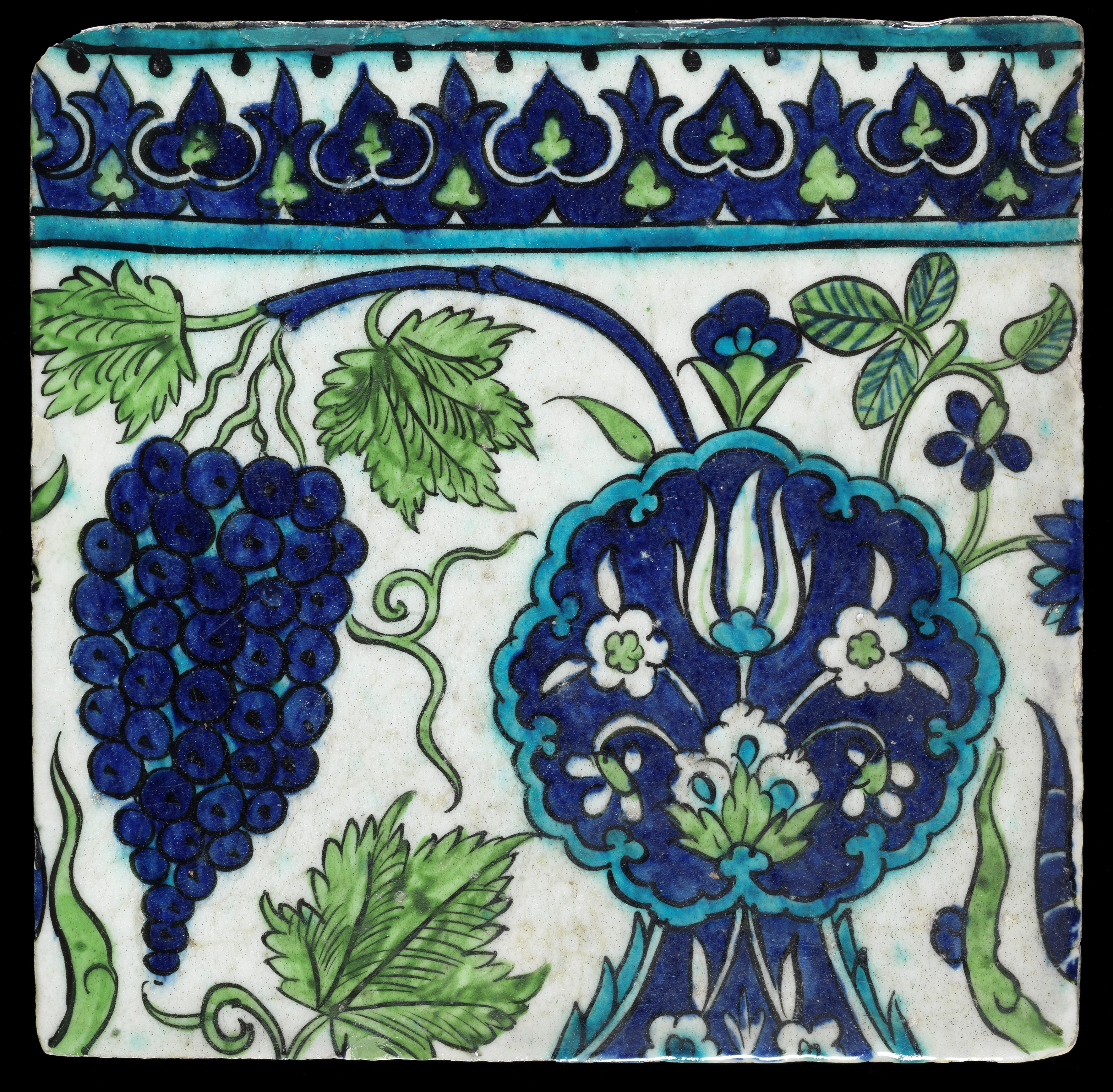
Fritware/Stonepaste Tile. Unknown. Fritware, mould made, painted in blue, green, turquoise and black under a colourless glaze, height 26.6 cm, width 27 cm, depth 2.8 cm, weight 2627 g, circa 1574-1599. Ottoman Period. Syria, Damascus. Forms part of a panel comprising twenty three tiles, C.4-1928. This tile probably formed the edge of the original panel.
When Morris, who often railed against the privileged society into which he was born, first launched his business in 1861, opening an interior design shop in Oxford Street, he was trying to bring his styles to the middle classes, well aware that most of his commissions were for wealthy clients with more money than aesthetic sense. ‘I spend my life ministering to the swinish luxury of the rich,’ he lamented. Some mocked his hand-made approach to design and craftsmanship as ‘thoroughly medieval’ and ‘useless’. At the time, his style of artist-led designs, using quality materials and hand-craftmanship was pushing against the tide of the Industrial Revolution. ‘I have never been in any rich man’s house,’ he declared, ‘which would not have been the better for having a bonfire made of nine-tenths of all that it held.’ It was part of his ‘Crusade against the age’, and in the end his persistence prevailed, for by the turn of the century, Morris & Co had become a by-word for good taste. He sold to important clients in Europe, America, Australia and Canada, exhibiting at international trade fairs in Paris, Boston and Philadelphia to raise the company’s profile. He learned to be a businessman, buying out his partners, and extending his product range to more affordable off-the-shelf items like wallpapers, fabrics and tiles. The Arts and Crafts movement, spearheaded by Morris, began in England and flourished in Europe and America between 1880 and 1920. On his death aged 62 in 1896 his coffin was draped in a magnificent 17th century Ottoman brocaded velvet from his own collection, made from silk and metal thread in Bursa, the first Ottoman capital.
Regret that his products were beyond the reach of the ordinary working class contributed to Morris’s growing political activism. Acutely conscious of his own privileged status in high society, he denounced the increasing industrialisation of the time, and became a socialist aged 50. He criticised the British government’s attempts to drag the country into a Russian-Turkish war in 1877, warning against ‘false patriotism’ and the dubious motives of the ruling classes who were led only by desire for profit.
Becoming a fervent environmentalist, he descried the despoliation of the landscape, and fought to stop pollution of the Thames and the destruction of Epping Forest. Although a nervous public speaker, his belief in his cause led him to give up to a hundred lectures a year, sometimes three a week, determined to make a difference. Driven by idealism, he wanted to imagine a world in which communities were equal, with no concept of private property, where craftsmanship and creativity could flourish. In 1877 he founded SPAB, the Society for the Protection of Ancient Buildings, and led the campaign to save the west front of St Mark’s in Venice. He was also outraged by the appalling restoration of St Albans, where the new pseudo-Gothic west front damaged much of the original fabric.
In south London at Merton Abbey, the Gothic ruins of which he restored, along with its water mill (another innovation introduced to Europe from Syria via Islamic Spain) on the River Wandle, he recreated an environment of medieval craftsmanship and techniques. He used natural dyes like indigo, disliking intensely the synthetic dyes of the times, even though it took him ten years of experimentation to achieve good results. So smitten was he with the beauty of Persian and Turkish carpets, hanging them on his walls or draping them over his tables as far too precious to walk on, that he decided to pioneer the production of hand-made rugs in Britain, recruiting experienced weavers from the declining Spitalfields silk industry, and using specially-built hand looms, hoping that eventually their skills would pass down to the next generation so that Britain might build its own hand-woven carpet tradition. One such example, called ‘Peacock and Bird’ is on display in the exhibition, so strikingly inferior in workmanship to the real thing that it serves as a clear marker that, even with the best will in the world, and the money, such traditions take centuries to accumulate and evolve.
All Islamic art ultimately seeks to recreate Paradise in the form of gardens and rivers, flowers and trees, where hierarchy is absent and where all live peacefully in mutual cooperation. The material and the spiritual world are connected through geometry, the unifying intermediary. This is precisely what Morris the idealist clearly felt drawn to in Islamic art, with its egalitarian traditions and deep respect for nature. As a child he had loved observing birds, flowers and plants in the Essex countryside. One of his most sophisticated patterns, which he named ‘Rivers’, after tributaries of the Thames, is based on meandering diagonal stems and natural growth, so that, as he put it, ‘even where a line ends, it should look as if it had plenty of capacity for more growth.’ This, together with his use of stylised birds and animals in pairs, to give underlying geometric structure to his patterns, are further borrowings from Islamic art. Other motifs he used, like flowers in vases, are also common in Islamic art.
Fritware/Stonepaste Tile Panel. Fritware, mould-made, painted in blue green and black under a clear glaze and framed in ebonised wood decorated with gilding, height, whole, 122 cm, width, whole, 92 cm, depth, whole, 8 cm, height, single tile, 26 cm, width, single tile, 27 cm, circa 1550-1650. Ottoman Period. Production Place: Damascus, Syria.
Granada, the most technically complicated textile Morris ever produced, so complex it never reached commercial production, was woven in 1884 at Merton Abbey. Featuring pomegranates and almond-shaped buds, connected by pointed arches and branches, the name tells us that his inspiration came from the patterns of the Alhambra Palace of the Nasrid kings. Though Morris himself never visited the Alhambra, he knew it through the lens of designer-architect Owen Jones (1809-74), who spent six months at the end of his Grand Tour, aged twenty-five, drawing detailed sketches of the stucco wall patterns of the palace, and acquiring a fascination with geometry, colour theory and the use of abstraction in decorative ornament. The result was his seminal work The Grammar of Ornament (1856), still used as a sourcebook in design schools internationally.
As the Gothic Revival got underway, the wealth generated from industry and trade, together with religious reform, resulted in a frenzy of churchbuilding, leading Morris to enter the market for church furnishings, like stained glass, embroidery, furniture and metalwork. Many of Morris’s contemporaries shared his interests and beliefs, like stained glass designer and tile-maker William de Morgan who also joined the Arts & Crafts movement. De Morgan moved his business to Merton Abbey, where he reproduced the fourteenth century ‘lustreware’ techniques of Muslim craftsmen, inspired by Islamic and medieval patterns. His tiles also decorate the walls of Leighton House in London’s Holland Park with its famous Arab Hall, a showcase of original sixteenth-century Damascus tiles procured on behalf of the painter Lord Frederic Leighton (1830-96).
A separate room in the exhibition is devoted to Morris’s daughter, May Morris, who travelled to the Islamic world after her father’s death. It displays the various items, especially textiles, she brought back and clearly valued highly, becoming a collector herself, as well as a donor.
A beautifully illustrated book, titled Tulips and Peacocks in a nod to the most prized flower of the Ottoman Turks, and the most loved bird of the Persians, has been published by Yale University Press specially for this exhibition, featuring a collection of ten essays by different specialists, including excellent contributions from the exhibition’s curators, Rowan Bain and Qaisra M. Khan, each exploring aspects of Morris’s connections to Islamic art. The front cover shows the distinctive 17th century Damascus tiles that Morris had acquired, in a pattern he called ‘Vine trellis’, purchased by Cambridge’s Fitzwilliam Museum after his death, and now reloaned by the Fitzwilliam for display at this exhibition. The book is on sale in the gallery’s shop, along with an impressive array of Morris-themed memorabilia for gifts or souvenirs.
Morris believed that through his work he could act as a bridge allowing craftspeople of the past to pass on their knowledge to contemporary artisans. The enduring popularity of his patterns suggests this may have been no idle dream, as people continue to respond to the same quasi-mystical, other-worldly qualities in his designs which echo those of Islamic art. Just below the surface, there is always the sense that something divine, something bigger than us mere mortals, unites us in our humanity. In this, perhaps, lies Morris’s universal appeal.
[A version of this article first appeared in The Times Literary Supplement (The TLS) on 17 January 2025]
With its future in the balance, a cultural historian looks past the corruption, violence and trauma of recent decades to the almost lost history of collaboration and shared traditions between Muslims in Syria and Christians in Europe. By DIANA DARKE [as first published 10 January 2025 in The Tablet]
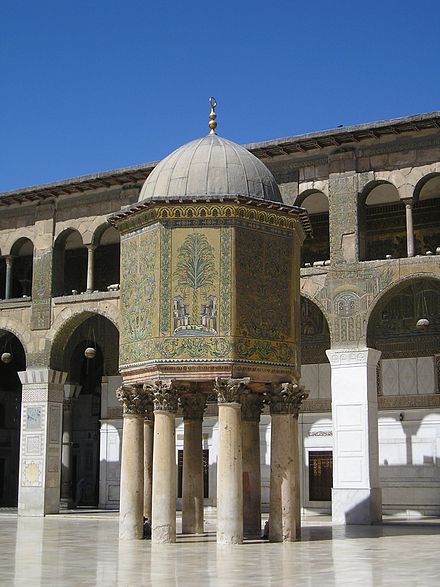
Buildings have stories to tell, in Syria none more perhaps than the magnificent Umayyad Mosque in the heart of the walled Old City of Damascus. It embodies the very soul of Syria, a sacred site where for over two millennia multiple civilisations and religions – Aramean, Greek, Roman, Byzantine and Islamic – have coalesced yet also survived in their own unique form. No surprise, therefore, that the new de facto ruler of Syria, Ahmad al-Shar’a, leader of Hay’at Tahrir al-Sham, the Organisation for the Liberation of Syria (HTS), chose to head straight there to pray after entering the city on 8 December.
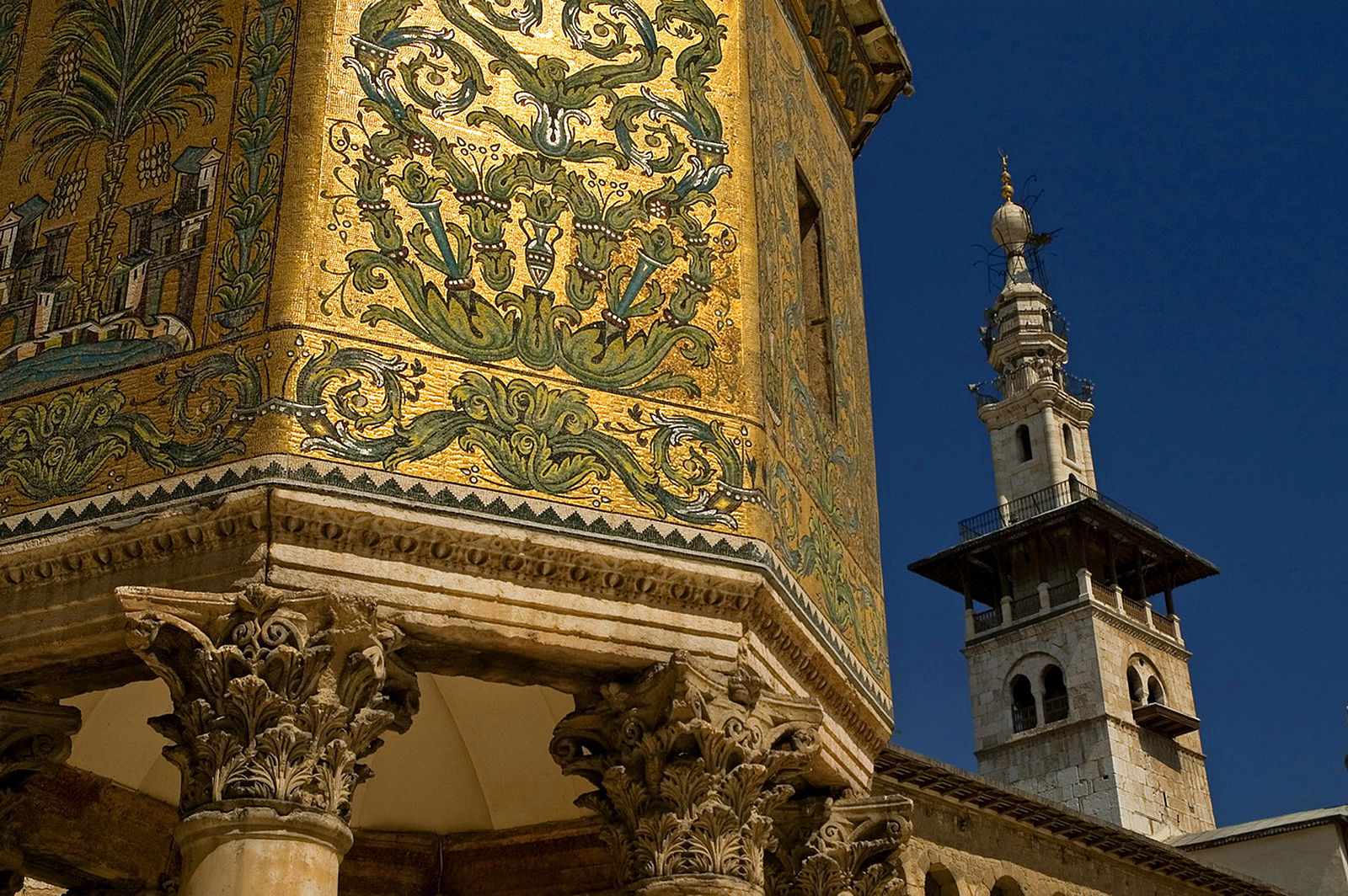
Syria has long been overwhelmingly Muslim but the Umayyad Mosque claims the heads of John the Baptist as well as Hussein, the Prophet Muhammad’s grandson. While still a cathedral, following the Muslim conquest of Damascus in 634, the building was shared by Christians and Muslims for close to a hundred years, as were the cathedrals of Homs and Hama. They were only converted to mosques once the Muslim population, small at first, gradually expanded. Top Byzantine Christian mosaicists then followed the brief of new Umayyad masters to cover the walls of the courtyard with breathtaking visions of the Islamic Paradise, timeless landscapes of fantasised trees, gardens, rivers and palaces in shimmering green and gold.
When rulers change, life for those uninvolved in the fighting tends to continue as before. The best architects and craftsmen are summoned to work on new prestige projects, irrespective of their religion, just as the most entrepreneurial businessmen find new opportunities. It was the same in Umayyad Spain when elite Muslim craftsmen were summoned by new Christian rulers during the Reconquista, to transfer their innovative engineering technologies like pointed arches and ribbed vaulting, as well as their decorative repertoires, to prestige abbeys and cathedrals. As late as 1492 the Catholic monarchs Ferdinand and Isabella appointed a Muslim master builder to look after all royal buildings in Aragon, a position that then passed to his son.
I bought a semi-derelict Ottoman courtyard house in Old Damascus in 2005. Full of wonder that I, as a foreigner, was able to buy a chunk of a UNESCO World Heritage site, I embarked on a three-year restoration project, guided by a Syrian architect and a team of fifteen craftsmen, experiencing first-hand the labyrinthine corruption of government and legal systems. To learn more about the house itself, I re-entered the academic world to study Islamic art and architecture. Deciphering the decorative styles of the house gave me the essential foundation for my subsequent work, connecting the almost lost history of collaboration and shared traditions between Muslims in Syria and Christians in Europe, traditions that formed the springboard for the architectural styles we know in Europe as “Romanesque” and “Gothic”.
In the new Syria of 2025 a Christian wheeler-dealer who made a fortune during the war in the transportation business is now raking it in as a high-end hotelier. Among Aleppo’s traditional soap-making family businesses, trade is up by 80%. My lawyer, who throughout the war bemoaned the fact that most of his caseload was divorce work, is now kept busy by clients asking questions he cannot answer. Many, like me, had their houses stolen during the war by profiteers writing fabricated intelligence reports against them. By a miracle, despite being labelled a British terrorist with links to armed groups, I went back in 2014 and retook possession, evicting my previous lawyer, his mistress and baby, along with a fake general on a forged lease.
The interim government faces huge challenges. Disentangling the different currencies, legal and education systems that operate in the different regions of Syria will take a long time. Add to that the complication of how to monitor the movements of returning refugees, as well as compiling a new electoral roll, and the three-year period Al-Shar’a suggested last week will be needed to draft a new constitution – four years for proper elections – in a unified Syria, becomes an ambitious target.
Al-Shar’a has promised to make Syria inclusive for all, including women. The country’s central bank has just appointed its first-ever female governor. Many commentators outside the country gnash their teeth, convinced that HTS, a Sunni Islamist group once aligned with Islamic State and al-Qaeda, remains a jihadi extremist outfit similar to the Taliban. Yet at least so far, its leaders appear ready, as are the majority of Syrians inside the country, to take Syria on a new trajectory, and seem prepared to engage pragmatically with the “international community” that failed it so badly, some elements of which even went so far as to rehabilitate Assad as if he were a fact of life, never understanding how hollowed-out his regime was, how unrepresentative of the overwhelming majority of Syrian people.
Syrian friends forced into exile during the war (along with nearly a third of the Syrian population) are scattered across Lebanon, Jordan, Turkey, Germany, Norway and Canada. From a range of professions – architect, lawyer, hotelier, tour guide, environmentalist – not one of them was able to continue their former work in their host countries. All struggled to make new lives for themselves and they feel they have lost thirteen years of their life. Even harder to bear is how in recent years refugees from Syria have been made to feel increasingly unwelcome, the mood turning against them in their host countries as right-wing populism has risen to heights where it is destabilising Europe as well as Syria’s neighbours. Most now plan to return, to rebuild their lives and their country, bringing with them new expertise and knowledge. After Germany’s 6000-plus Syrian doctors have left, they will be missed by its aging population, their worth only recognised once it is too late. Friends who stayed also feel the last thirteen years have been wasted, their country devastated by aerial bombardment from the Assad regime and Russia, sanctioned and isolated from the outside world.
Nothing screams “CHANGE” to me more loudly than the sudden arrival since 8 December of the world’s media, banned since 2011. During the 54 years of the Assad dynasty’s rule – 30 years under Hafez from 1970 till his death from leukemia in 2000 and 24 years under his second son Bashar – it was never easy for journalists to get visas into Syria. Control of the narrative was always an essential part of the Assad grip on power.
“Come in and report without restriction” was the message from al-Shar’a. In a country with so many secrets to uncover it is a journalist’s dream come true. Heartwarming scenes like a man exiled for 50 years reuniting with his 100-year-old mother have competed on our screens with tales of torture and abuse from the prisoners streaming out of the “slaughterhouse” in Seydnaya. Thank God the Assads’ filthy linen has been exposed for all to see.
Blacklisted for years, I was able to slip into Syria seven times since the uprising began in March 2011, most recently as part of the Crazy Club, hiding under the cassocks of the clergy. Now I can return openly. The situation inside Syria is complicated and varies considerably from region to region but prices for most things have got cheaper and the Syrian pound’s exchange rate has stabilised. Embassies are re-opening, schools and universities have reopened and civil servants are back at work. In Damascus the hotels and restaurants are brimming, not just with journalists but also with foreign delegations – even from the US – queuing to offer support and investment. But water and electricity remain in short supply. As the architect living in my house explains: “They told us, ‘You were silently patient for 54 years, be patient for a few more days and you will have bright times to come.’ But it turns out we have no infrastructure. We still have electricity for only one hour in the day and one hour in the night.”
Even so, he is happy, along with my other Syrian friends, that they are starting the New Year without Assad. Turkey has taken on responsibility for repairing the airports, roads and trains while Qatar will get priority in the energy sector. The White Helmets, trained to dig bodies out from under the rubble of Russian and regime air strikes, are now redeployed to clear that same rubble left untouched by Assad for years.
Much of Syria’s cultural heritage, damaged across the centuries by fires, earthquakes and wars, has later been rebuilt, each time more beautiful than before. The Umayyad Mosque’s Jesus Minaret, added in the eleventh century, resembles a campanile, and is named for the spot where, according to local folklore, Christ will descend on the Day of Final Judgement, a blending of Christian and Muslim beliefs typical of Syria. Mary receives more mentions in the Qu’ran than in the New Testament, and Old Testament stories like Abraham and the sacrifice of his son form key festivals in Islam. Syrian Muslims have historically attended church services at Christmas and Easter with Christian friends, while mosques have welcomed those of all faiths and none.
The pressures are great and the future is precarious, but the Syrian people have the skills, the ingenuity, the innovative mindset and instinct for survival, despite the obvious deep trauma and hurt, to create a new Syria, one that may ultimately serve as a model for the wider Middle East.
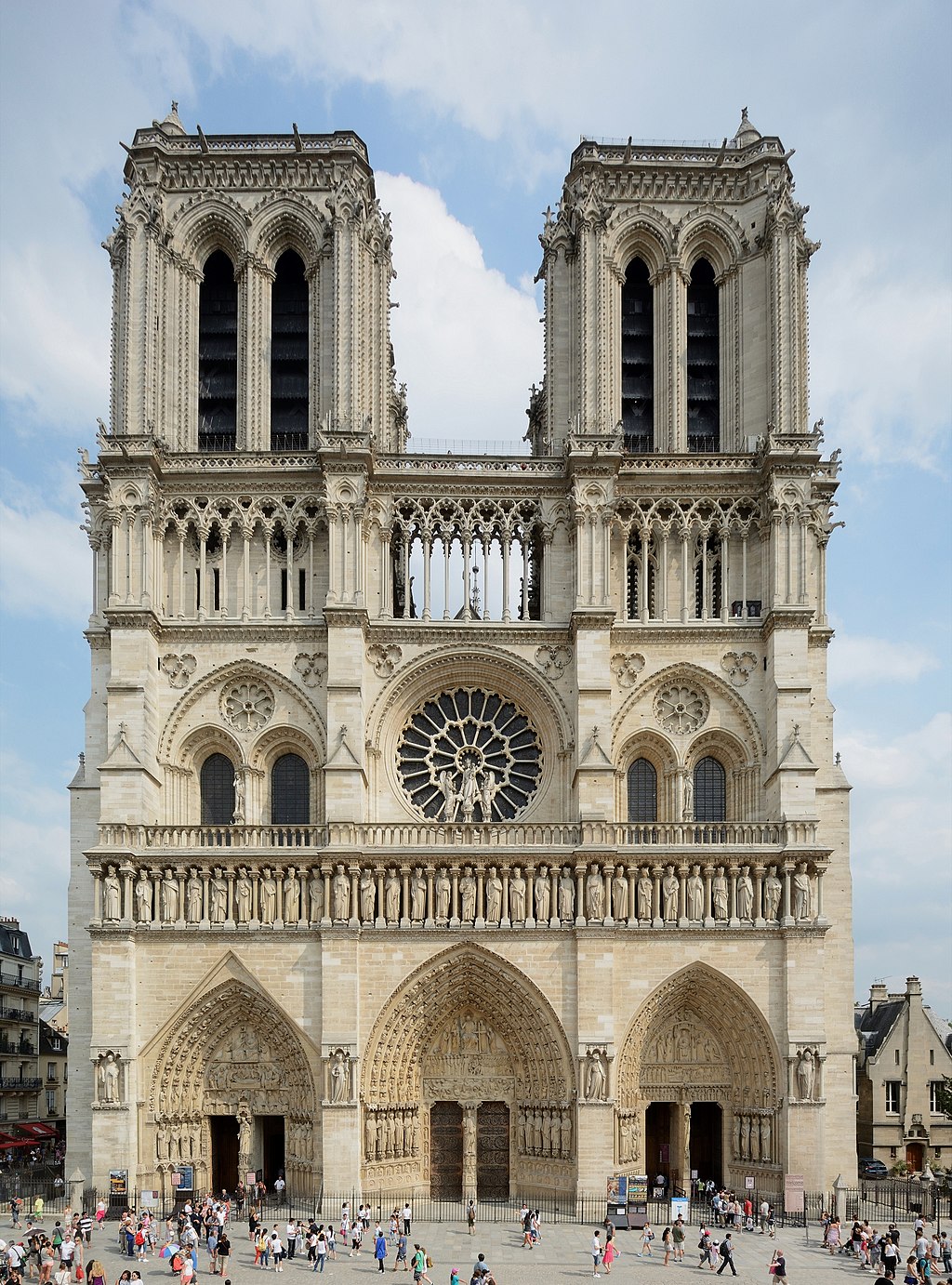
In a surreal twist of timing, President-elect Donald Trump was the guest of honour at Notre-Dame’s special reopening service on 7 December, at the very same time that the rebel offensive in Syria was reaching its whirlwind climax. Hours later, on Sunday 8 December, the world woke up to find that the Assad regime had vanished, following Bashar al-Assad’s night-time escape to Moscow, and that Notre-Dame was fully open to the public, following its intensive five-year restoration after the 19 April 2019 fire.
Syria too has been burning for the last 13 years. ‘Assad or we burn the country,’ was the message scrawled on walls across the country by his much-feared shabiha (secret police), along with slogans like ‘There is no god but Bashar’ and ‘Do not kneel for God, kneel for Bashar’.
Syria and Notre-Dame now both face a new future simultaneously. Restoring a fire-damaged medieval cathedral to a tight deadline was a huge challenge, one that many people thought impossible. Rebuilding an entire country, restoring its social fabric, regenerating its decimated economy after so many years of war is, of course, a challenge of an entirely different order, one that is almost beyond conceiving, a challenge that will involve many difficult steps and take many decades to achieve. But it is doable, with the right backing.
Did Trump give a single thought to Syria as he sat through the cathedral service? Probably not. Arriving in Paris that morning, he had dismissed the country, posting on his Truth Social network: “Syria is a mess, but is not our friend,” then adding “THE UNITED STATES SHOULD HAVE NOTHING TO DO WITH IT. THIS IS NOT OUR FIGHT. LET IT PLAY OUT. DO NOT GET INVOLVED!”
The very next day, however, the dynamics on the ground inside Syria had suddenly changed in a way no one had thought possible. In less than a fortnight the Islamist rebels from Idlib had swept out from the north, taking charge of Aleppo, Hama and Homs, while Druze rebels from Suweida in the south surged up to take the capital Damascus just in advance of them.
Despite his determination not to get involved, Trump may yet find himself, once in office on 23 January 2025, wrestling with decisions about the new Syria that will affect America directly – what to do about the US troops still stationed there, whether or not to support the Kurdish-led SDF (Syrian Democratic Forces) in Syria’s oil-rich northeast, whether to use them to clamp down on a resurgent ISIS and above all, whether to lift the sanctions and the rebels’ terrorist designation in order to allow the country to rebuild. Speed is of the essence, as with Notre-Dame’s rebuilding, so that everyone believes in the project and its feasibility.
Notre-Dame’sConnections to ‘Stealing from the Saracens’ and ‘Islamesque’
‘Islamesque’ is a revolutionary piece of research, challenging the European art history world and its use of the architectural term ‘Romanesque’. The book has garnered a starred review in Publishers Weekly, an honour awarded to books ‘of exceptional quality and distinction’. Yet while my attention would ordinarily have been focused on ‘Islamesque’, I have found myself instead consumed by the new developments inside Syria, following every twist and turn, even asked to give media interviews by outlets like the BBC. My Syrian friends, both inside and outside the country, are ecstatic about the demise of the Assad regime. The ones inside said it felt unreal, as if they were watching a movie, with events all around them unfolding so quickly. After 54 years of milking the country like their own private farm, the old regime, its posters of Bashar so omnipresent, just melted away overnight. Their illusion of strength and invincibility was, in my view, always hollow, held in place by little more than fear and by the terrible tentacles of the Assad security and intelligence branches, all seventeen of them, modelled on East Germany’s monstrous STASI, a network that reached into all corners of society, leading people to believe that even the walls had ears. Such fear does not breed loyalty – it used to annoy me when commentators said that Assad still had a lot of support among Syrians inside the country.
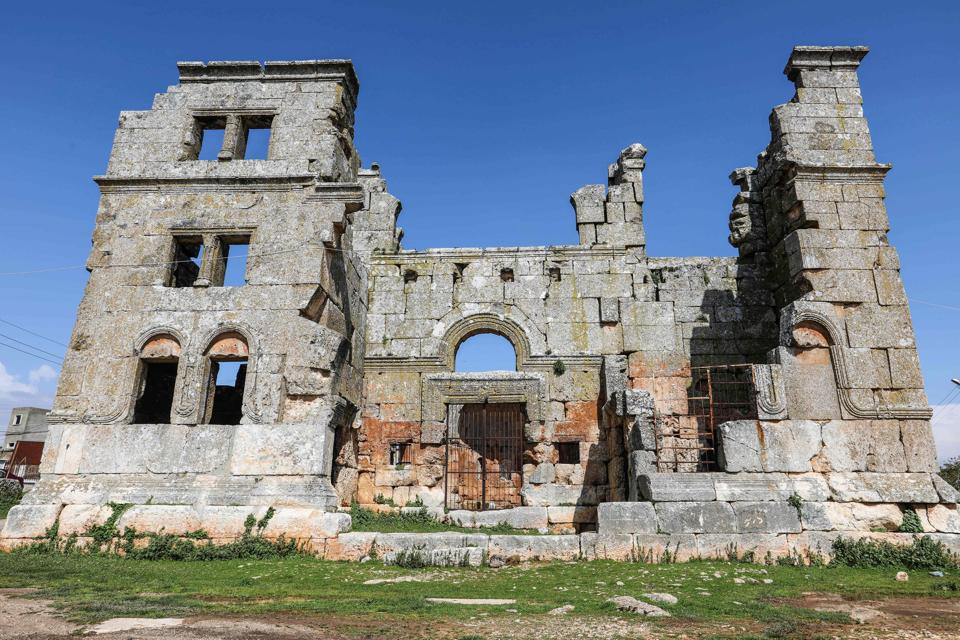
Syria and Notre-Dame also share many connections. For example – and you will find no mention of this in any of the overwhelmingly Europe-focused documentaries, books and articles written about the cathedral’s restoration – the structure’s sturdiness can be traced back to early fifth, sixth and seventh century archetypes of the twin tower model still extant in Syria’s northwest, where stonemasonry skills are literally as old as the hills. The three limestone massifs of Jebel Zawiya, Jebel Barisha and Jebel Ala formed the local building material for all Syria’s early churches. Close to two thousand such structures remain scattered among the ruins of some eight hundred settlements in the rebel-held Idlib Province, despite the Assad regime’s and Russia’s aerial bombardment of the last decade and despite the heavy earthquakes that have afflicted this region of northwest Syria since time immemorial, . These Byzantine settlements, known as the Forgotten Cities, were designated a UNESCO World Heritage Site in June 2011, just three months after the start of the Syrian war.
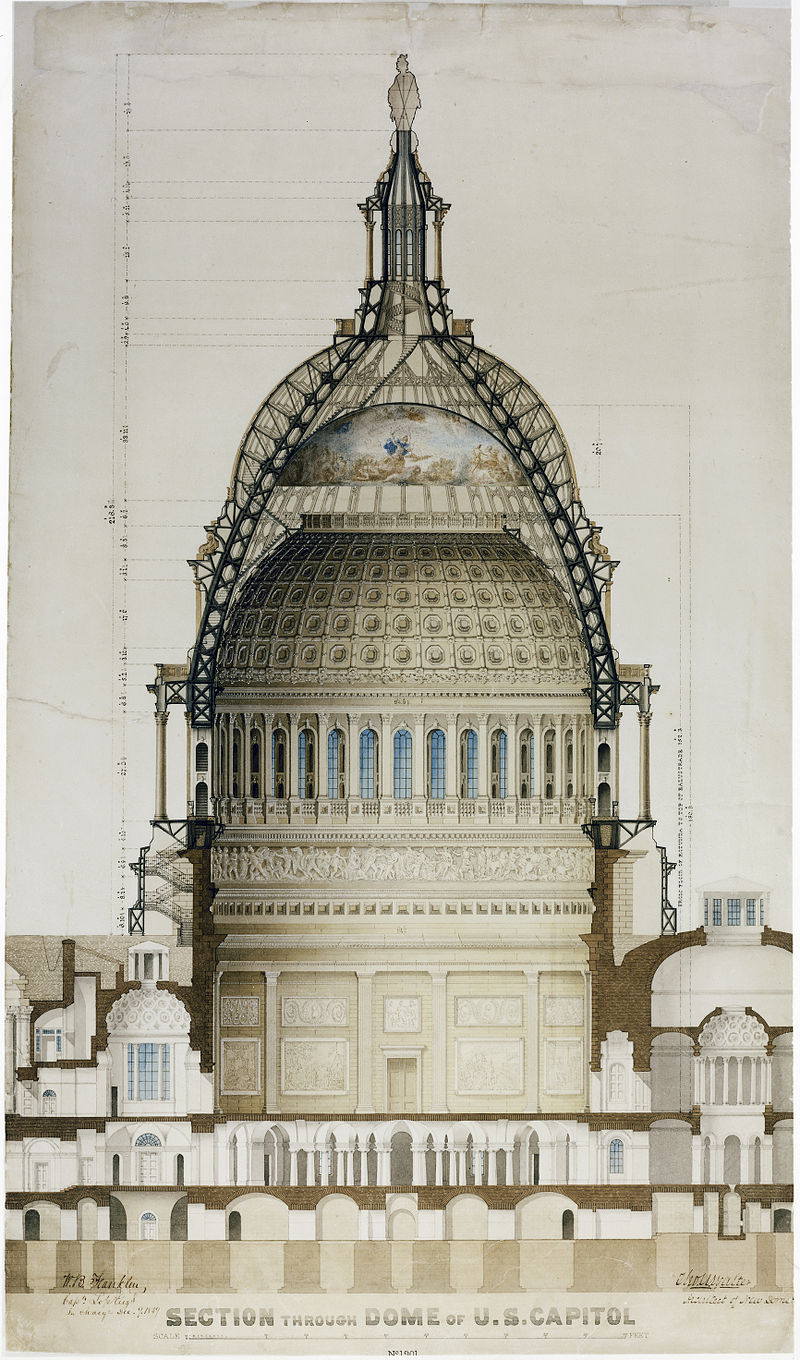
Trump is almost certainly unaware of these and the many other cultural connections between Notre-Dame and Syria, let alone how the Gothic or ‘Saracen’ elements in Notre-Dame cathedral then found their way across the Atlantic, into cathedrals like Washington DC’s National Cathedral, the spiritual home of America, into Gothic campuses like Yale University and even into the heart of American democracy, Washington DC’s Capitol Dome, with its ‘Saracen’ Islamic double dome.
Whether or not he knows or cares about this architectural backstory of so many American monuments, Trump has the power to transform the new Syria. He could, in an act of faith and leadership similar to that which enabled Notre-Dame to be rebuilt in five years, have the vision to do a deal with Turkey’s President Erdogan on the Kurdish PKK elements within the Kurdish-led Syrian Democratic Forces (SDF) that also allowed the 2000 US troops to go home to America, and to then lift the US sanctions that were imposed against the old Syria in recognition that the new Syria deserves a chance to rebuild itself from the inside. In my dreams, this would enable the country to rise from the ashes and shine like a beacon in the region surprisingly speedily. It could even be a vital part of Trump’s legacy – to help create a new Syria – and as a by-product, even to eradicate Islamic terrorism from the globe forever. Once peace and stability are restored in the Middle East, extremist outfits like ISIS would find no more drivers for recruitment. Their base support gone, they would simply melt away, as surely as the Assad regime melted away once its ideological hollowness was apparent to all.
Cross-section of the Washington DC Capitol Dome, showing the Islamic double dome vaulting technique
England’s greatest architect, Sir Christopher Wren, wrote that what we call “the Gothic style should more rightly be called the Saracen style.” Americans, it seems, are especially fond of Gothic. Across the continent are spectacular Gothic Revival structures, many modelled on the medieval cathedrals of England and France, such as St. John the Divine and St. Patrick’s in New York City, Washington National Cathedral, and the Cathedral of St. John the Baptist in Savannah, GA. On top of that, America boasts the world’s biggest collection of neo-Gothic architecture in its universities, colleges, and schools. What accounts for that popularity?
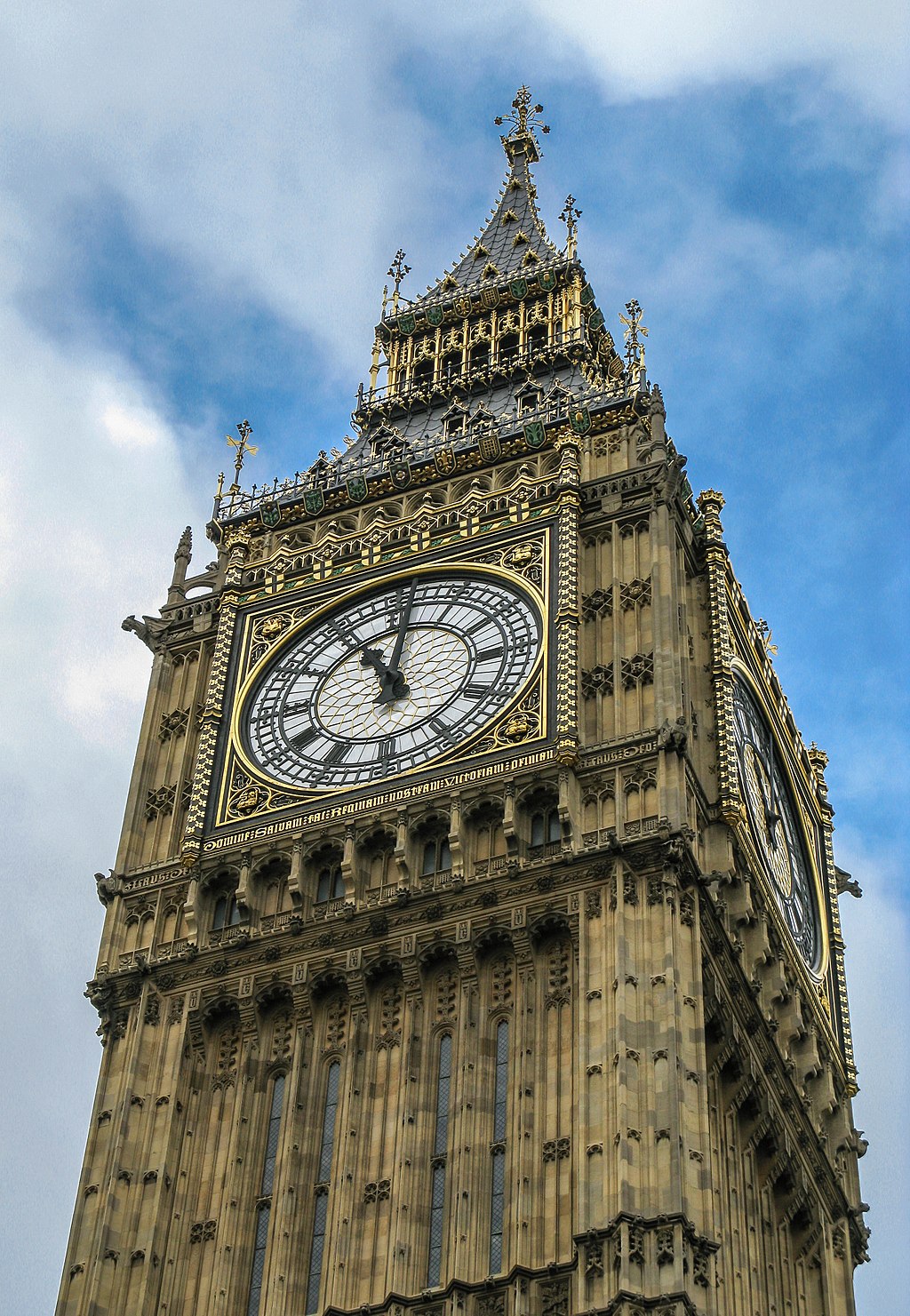
America’s leading neo-Gothic architect, Ralph Adams Cram, wrote in his book Gothic Quest about the power of architecture “to bend men and sway them.” Like the fervent European Gothic Revival architects before him, such as Augustus Pugin, designer of the clock tower commonly known as Big Ben for the Houses of Parliament in London, Cram believed that Gothic was the “purest” form.
While studying classical architecture in Rome, he had an epiphany during a Christmas Eve mass, thereafter becoming an Anglo-Catholic. Like his fellow neo-Gothic enthusiasts in Europe, and indeed like many Europeans today, for him Gothic architecture epitomized the Catholic faith. The commonly held view of Gothic’s provenance was that it represented Europe’s shared heritage. Although such Eurocentrism remains deeply rooted, serious scholarship has questioned just how “European” the Greek, Roman, and Byzantine civilizations that preceded the era of Gothic actually were, since all three empires were multicultural and multiethnic. Few of the later Roman emperors were ethnically Italian and even fewer Byzantine rulers were ethnically Greek.
The Islamic roots of Gothic architecture
The time has come to examine Gothic in the same way, since Cram never realized, along with Americans and Europeans in general, that key elements of Gothic architecture — the pointed arch, the trefoil arch, ribbed vaulting, and many other features — were born, not in Europe, but further east, often evolving from styles that were associated with a completely different religion.
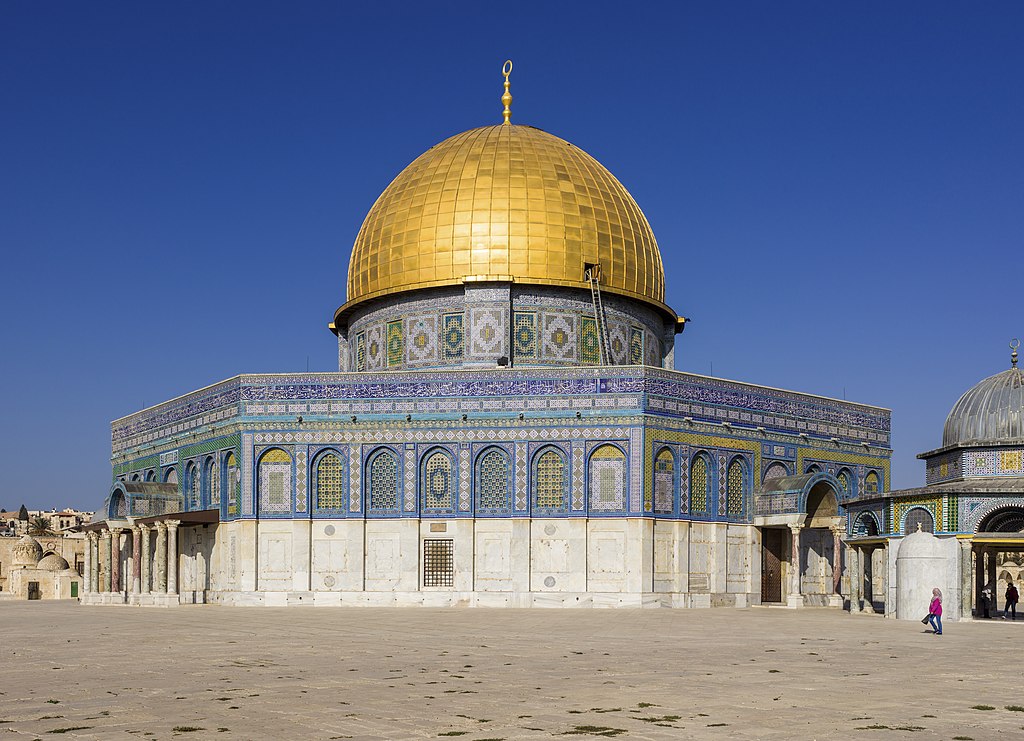
Even Eurocentric architects cannot deny that the pointed arch had its origins in Islamic architecture. It appeared in the 7th century Dome of the Rock in Jerusalem, built as the first Muslim shrine by the Umayyad caliph Abd al-Malik, and was then further developed under the Abbasids in Baghdad.
The Dome of the Rock in Jerusalem was built as a Muslim shrine in the late 7th century. Its design features were widely copied by the medieval Crusaders and brought back to Europe in the 12th century. (Andrew Shiva / Wikipedia / CC BY-SA 4.0)
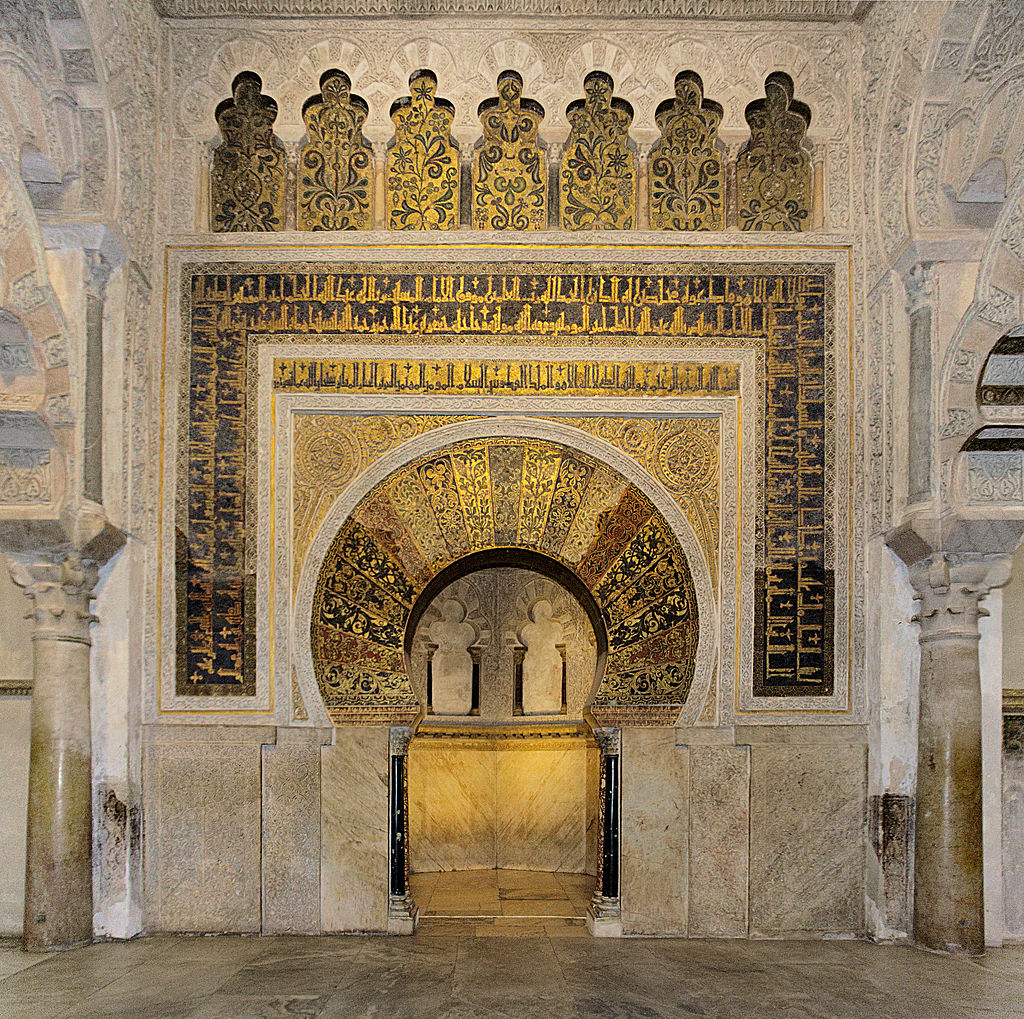
It went on to become the defining feature of Islamic religious buildings. The trefoil arch, so enthusiastically adopted by Gothic architecture as a symbol of the Holy Trinity, first appeared as a carved decorative feature in Umayyad shrines and desert palaces. Byzantine church architecture, which the Umayyad caliphate inherited, had round Roman arches and single domes, like Constantinople’s Hagia Sophia. There was not a pointed or trefoil arch in sight, let alone ribbed vaulting.
Trefoil arches above the mihrab in the Cordoba Mezquita, predating their use in Gothic cathedrals by over a hundred years. (Ingo Mehling, CC BY-SA 4.0, via Wikimedia Commons)
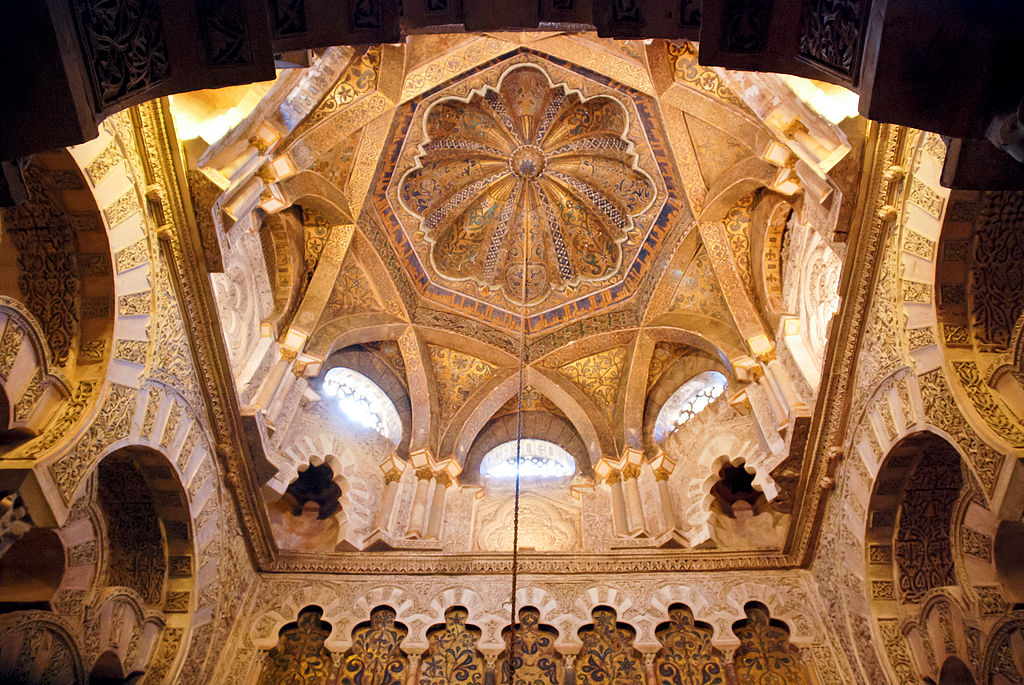
From Syria and their capital Damascus, the Umayyads brought these elements to Spain in the 8th century, re-using them in their main mosque of Cordoba, still known today as the Mezquita, Spanish for “mosque,” even though it was converted to a Catholic cathedral at the Reconquista. The 10th century ribbed vaulting of the Mezquita’s main dome was analyzed in 2017 by Spanish architectural engineers and pronounced the most perfect example of geometry, never once needing structural repair in its thousand-year existence.
The masons’ marks displayed on the rear wall show the names to be overwhelmingly Muslim, unsurprisingly, since their grasp of geometry and their stonemasonry was recognized as far superior to that of their European counterparts. It was no coincidence that Spanish Christian kings like Alfonso XI and Pedro the Cruel insisted on Mudéjar (Muslim) craftsmen for their building projects.
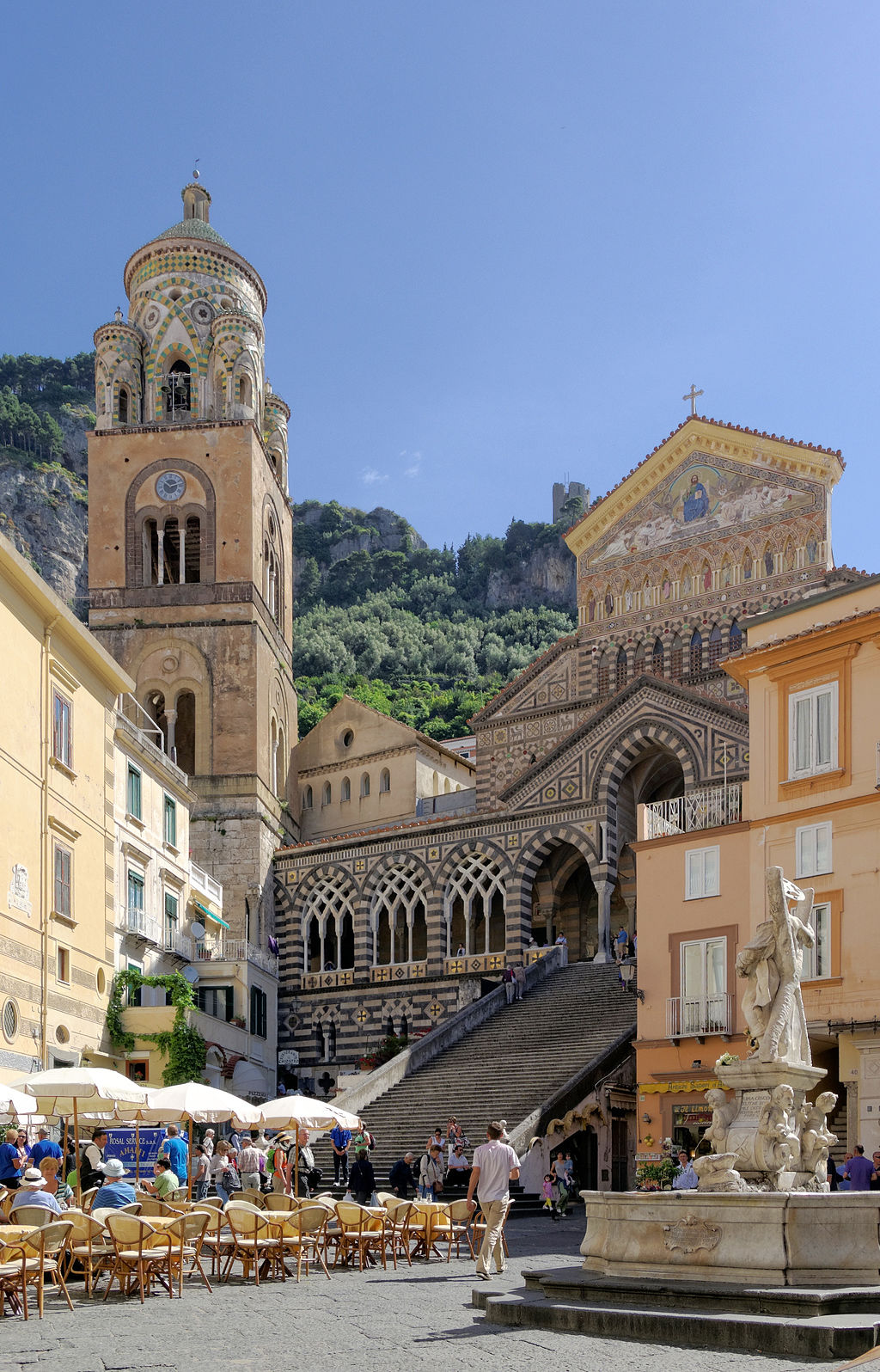
From Spain, these skills and styles passed into southern France where they were gradually incorporated into Benedictine abbeys and Cluniac shrines on the pilgrim route to Santiago de Compostela. The same styles also found their way into Europe from vibrant Islamic cities like Cairo, Damascus, and Aleppo, passing first via Italian trading ports like Amalfi, then via the Norman, Arab-influenced architecture of Sicily.
Amalfi cathedral, showing the pointed arches first copied from the Ibn Tulun Mosque in Cairo. The cathedral was financed by Amalfi merchants trading with Cairo. (Berthold Werner, CC BY-SA 3.0, via Wikimedia Commons)
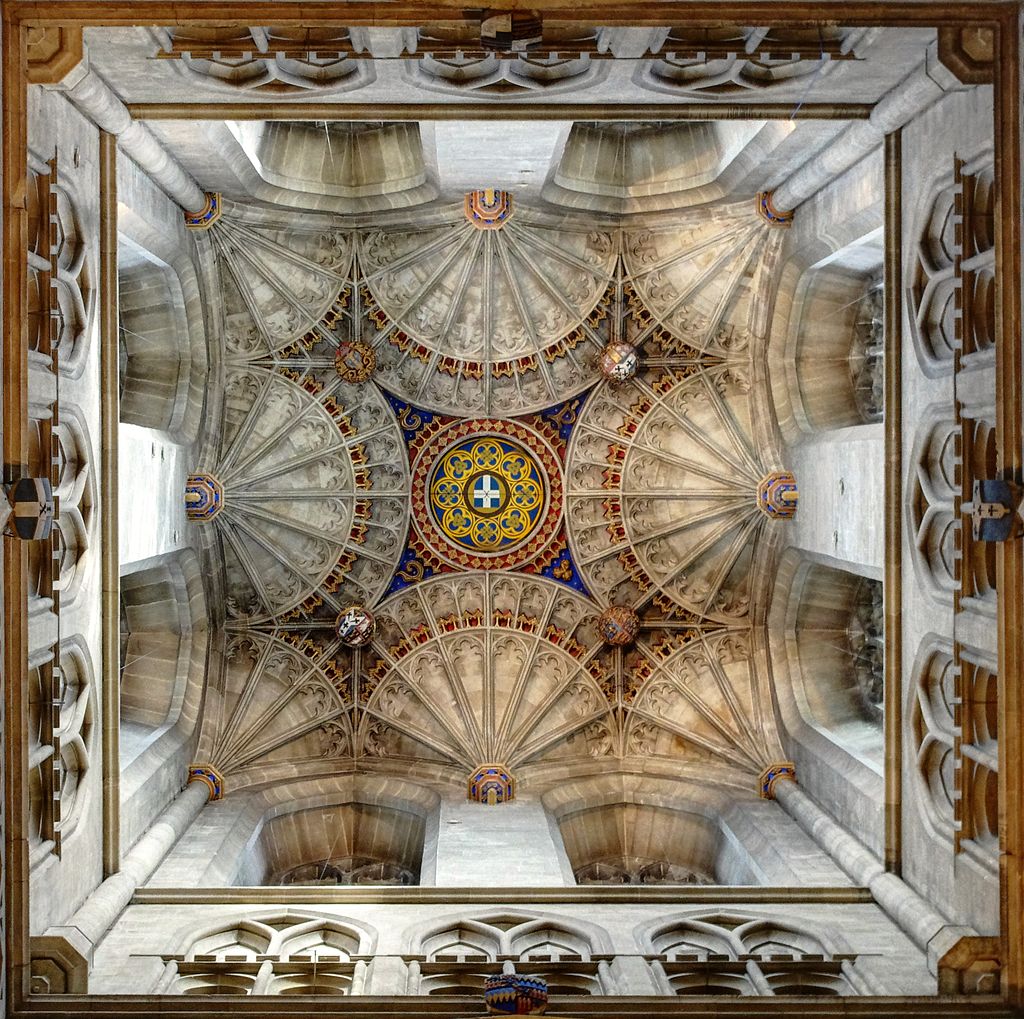
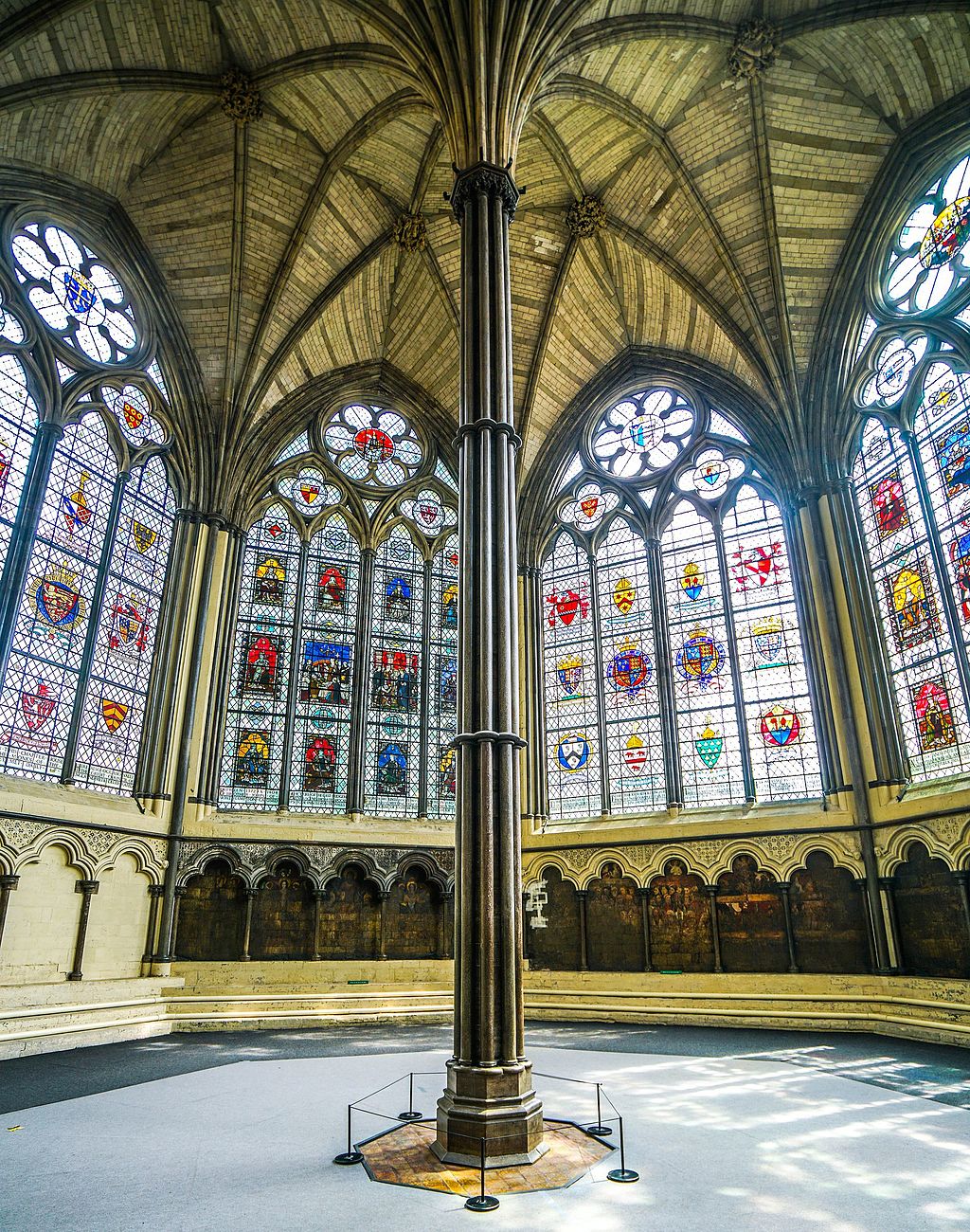
The returning Crusaders, ironically, set up new kingdoms in the 12th century, mimicking the styles of their conquered enemies, whom they called the Saracens, meaning “people who steal.” The Norman French brought the styles back to Normandy, where they synthesized them into what was originally just called “French work” in cathedrals like Notre-Dame and Chartres, before importing the style into England, under Norman rule at the time, in buildings like Canterbury Cathedral and Westminster Abbey.
Fan vaulting of the crossing inside Canterbury Cathedral. (Tobiasvonderhaar, CC BY-SA 3.0, via Wikimedia Commons)Pointed arches, trefoil arches and ribbed vaulting in the Chapter House, Westminster Abbey. (ChrisVTG Photography, CC BY-SA 4.0, via Wikimedia Commons)
Only centuries later was it misleadingly dubbed “Gothic” by an Italian art historian, the same person who coined the term “Renaissance.” In Spain, it was called the “Gothic of the Catholic Kings.” Eurocentrism at work again.
From Spain to North America
In North America, it is easy to forget that when the Spanish arrived in Mexico in 1492, they came from a world in which Christians and Muslims had shared rule for nearly 800 years. The Spanish colonizers did not build in the style of the native Americans whose lands they took, but imported the styles of their homeland, just as the Umayyads had recreated the Syrian styles of their homeland in Spain, modelling the Cordoba Mezquita on the Damascus Umayyad Mosque. The influence of “the Moors,” as the Muslims were known, can be found in practically every style of Spain from the 8th century onwards, with its unmistakable tinge of Orientalism.
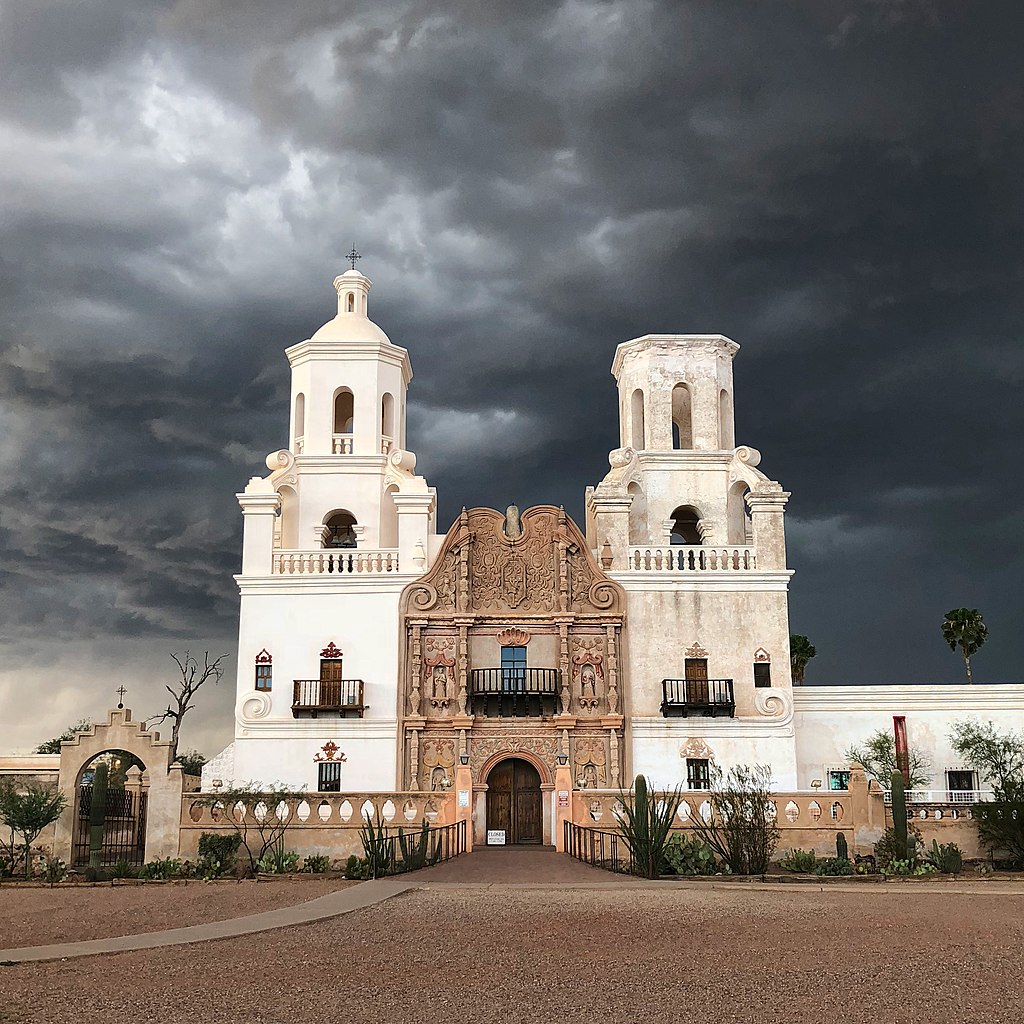
The Spanish missions in California and Arizona, founded by Catholic priests of the Franciscan order in the 18th and 19th centuries, also imported the styles of their homeland, and Moorish designs are evident in San Xavier del Bac and San Luis Rey de Francia.
Mission San Xavier del Bac, near Tucson, Arizona, with its Moorish-inspired exterior. (Keyany, CC BY-SA 4.0, via Wikimedia Commons)
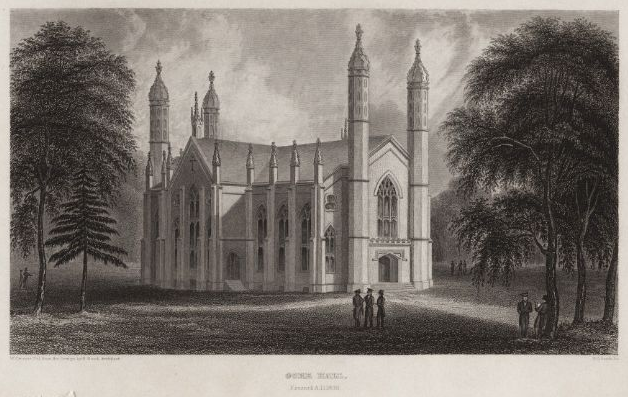
Taking inspiration from English Oxford and Cambridge colleges, “Collegiate Gothic,” as it is known, began in 19th century America with church-like libraries at prestigious universities such as Harvard’s Gore Hall.
Harvard’s Gore Hall. (G.G. Smith, engraver, Public domain, via Wikimedia Commons)
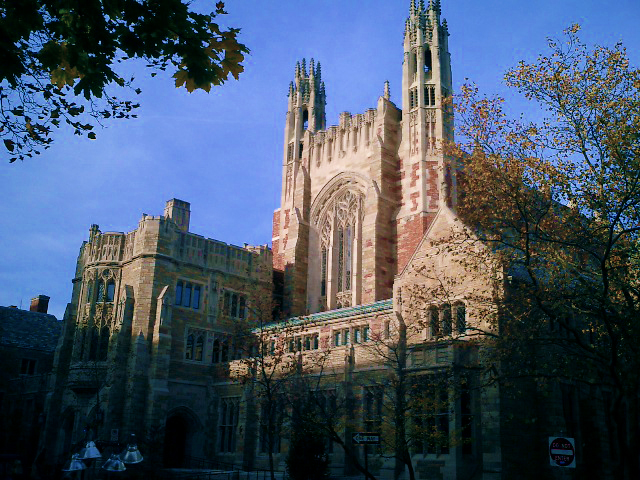
The popularity of Collegiate Gothic endures into the 21st century, with prominent “new” buildings still seen as representing the pinnacle of sophistication, such as Yale’s Benjamin Franklin College and Princeton’s Whitman College. Much of Yale’s campus can be considered “Gothic,” including Yale Law School.
Yale’s Sterling Law Building, home to the Yale Law School. (Shmitra, CC BY-SA 3.0, via Wikimedia Commons)
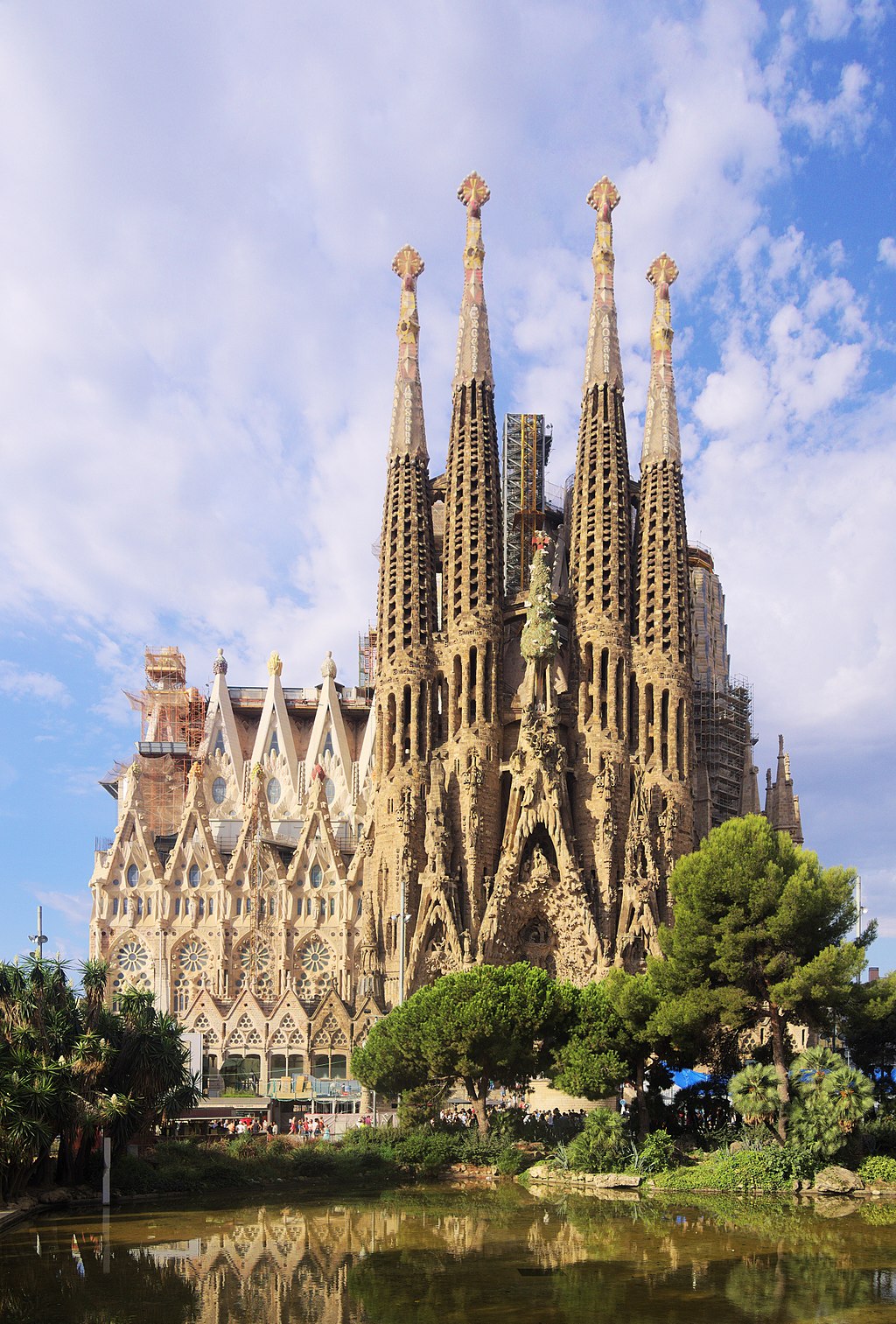
In Europe too there is still one famous neo-Gothic church under construction. Its Spanish architect, Antoni Gaudí, another devout Catholic, openly acknowledged the influence of Islamic architecture in his masterpiece, the Sagrada Família in Barcelona. It is a style we might call Hispano-Saracenic-Gothic, representing the ultimate fusion of nature, geometry, and religion. A multinational team is collaborating to complete it in time for the 2026 centenary of Gaudí’s death, using materials from all over the world.
The still unfinished Hispano-Saracenic-Gothic cathedral of La Sagrada Família, Barcelona. (C messier, CC BY-SA 4.0, via Wikimedia Commons)
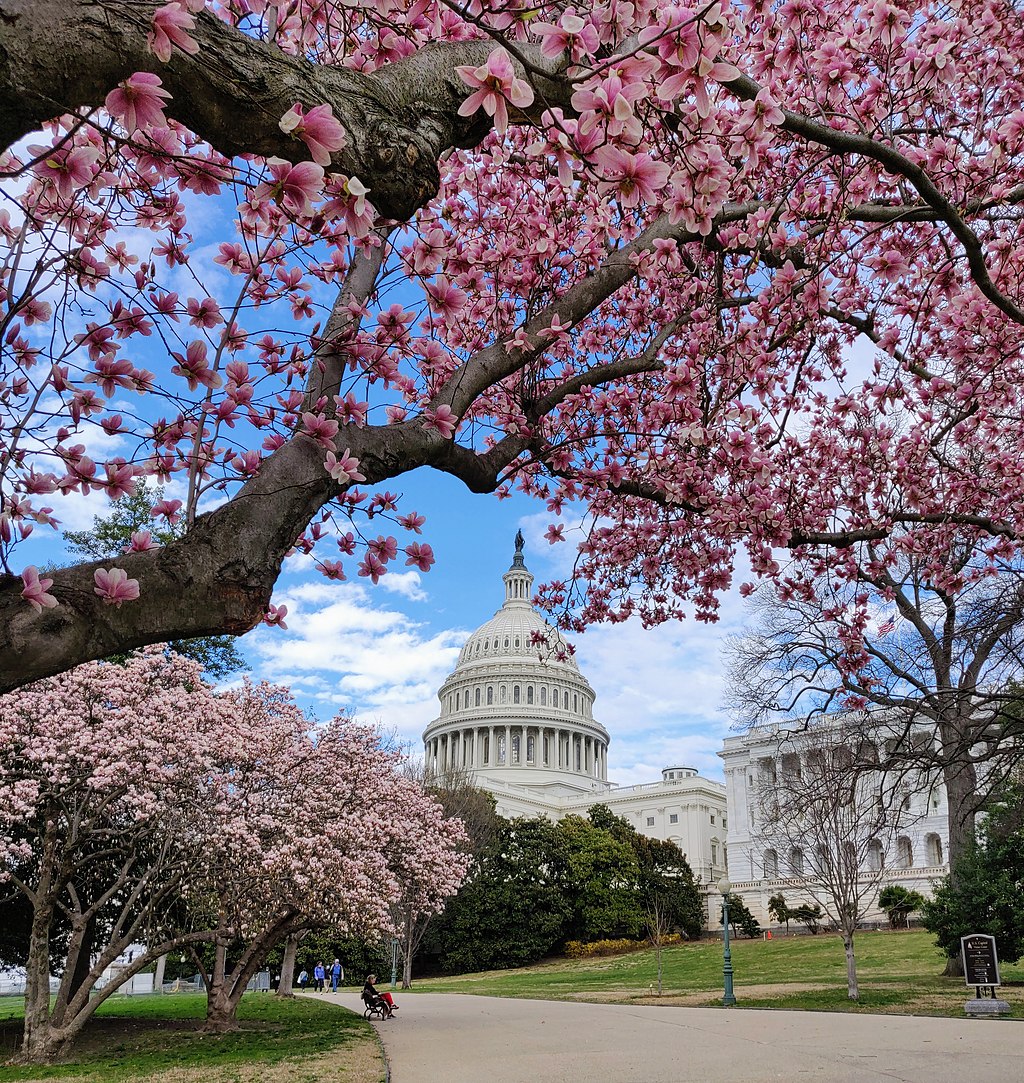
On top of all the “Saracen,” “Moorish” elements we have identified in so-called “Gothic” buildings, there is still one more surprising thing to take in: The Capitol building in Washington, DC owes a debt to Islamic architecture, through its double dome.
The United States Capitol, with its double dome, a “Saracen” technique where the interior and exterior have different profiles, leaving a hollow in between. (Sdkb, CC BY-SA 4.0, via Wikimedia Commons)
This is the technique, first used in Seljuk tombs and later Ottoman mosques by the great court architect Sinan, where the exterior profile is taller, in order to make a bold silhouette on the skyline, than the interior dome, which is lower, with a hollow space in between. The clever device was copied across Europe, notably by Wren in his iconic dome of St. Paul’s Cathedral in London where he openly admitted use of what he called “Saracen vaulting.” That is why the cover my new book, Stealing from the Saracens: How Islamic Architecture Shaped Europe shows the interior dome of St. Paul’s Cathedral.
Surely if there is a lesson in all of this, it is that no one “owns” architecture, just as no one “owns” science. Everything builds on everything else.
How wonderful it would be, in this current age of Islamophobia and nationalism, if we could acknowledge the ties that bind us, often in mysterious and unseen ways, rather than seeking to airbrush them out of our history. My hope is that an enhanced understanding of the shared elements of Christian and Islamic architecture might encourage us toward a broader inter-religious dialogue, even with those we may sometimes have seen as “the enemy.”
A version of this article first appeared on the website of the Washington-based thinktank The Middle East Institute:
The Roman aqueduct system is still visible in the cliffs of the Wadi Barada gorge (2011, DD)
The flashpoint for Syria’s war, six years old this March, took the form in recent weeks of an elemental struggle over water. Drinking water to some 5 million residents in the Syrian capital Damascus was cut on 23 December by the Damascus Water Authority, blaming diesel contamination of the supply by the rebels.
The historic water source of Ain al-Fijeh lies in a valley 18km northwest of the capital in Wadi Barada, where a cluster of 13 villages has been under rebel control since 2012. Local people joined the revolution early in protest against government neglect, corruption and land grabs made legal under new state land measures, where whole hillsides were requisitioned for sports clubs and luxury hotels.
The hillsides of Wadi Barada, with a Roman quarry in the bottom left (2011, DD)
On 22 December the Assad government, using barrel bombs dropped from helicopters and supported on the ground by Lebanese Shi’a militia fighters of Hezbollah, began a campaign to take control of the strategic valley and springs. The timing was significant, just days before the announcement of the countrywide ceasefire brokered by Russia and Turkey on 29 December.
The Barada Gorge was cut through the Anti-Lebanon Mountains geological eons ago by the Barada river, which still runs through the centre of Damascus. Today it is just a shadow of its former self, diminished for most of the year by drought and pollution to a dirty trickle by the time it reaches the city-centre. But in earlier times it was the source of the city’s legendary fertility, and the reason for its location in an oasis of gardens and orchards known as the Ghouta. The river was and still is fed by the melt waters of Mount Hermon, Syria’s highest peak. Mentioned no less than 15 times in the Bible, it retains its snow-capped summit till early June. The amount of snowfall in winter is a direct indication of how much water Damascus will have throughout the year.
The distant snows of Mt Hermon, seen from Damascus rooftops (2011, DD)
The Barada, the ancient Abana, was supplemented through seven further rivers whose course was diverted by means of elaborate channels as far back as Roman times. Guided by aqueducts into the centre of Damascus, the city was fed by a complex network of waterways and channels that allowed water to flow in and out of every house. Sophisticated Ottoman water distribution points throughout the city also allocated water in agreed quantities to the public bathhouses, mosque ablution areas and public drinking fountains. Even today most houses have a special drinking tap in their kitchen directly connected to the spring.
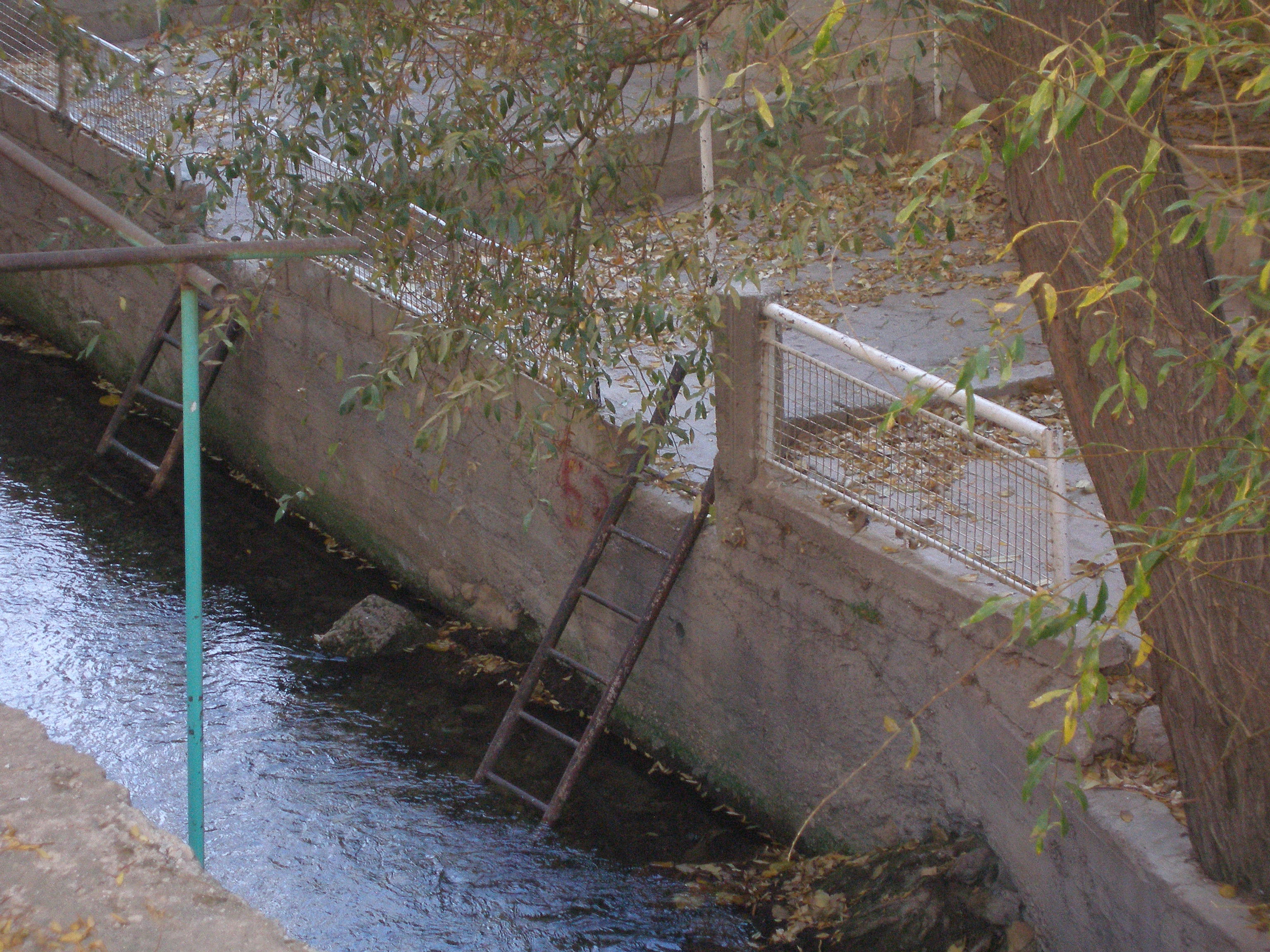
In high summer families would come to Wadi Barada on Fridays and holidays, often renting a riverside platform for the day. Rigged up as tent awnings open only onto the river side, they formed an idyllic private arbour where families could relax, enjoying the coolness of the fast-flowing river. Little iron ladders were fixed onto the platforms, so that children could climb down and swim.
A swimming platform and ladder used by picnicing families along the river (2011, DD)
In the 16th century it was along the banks of the Barada river on the outskirts of Damascus that the first coffee houses grew up. Pilgrims would be assembling, waiting for the annual Hajj or pilgrimage to Mecca to set off in one huge joint caravan, protection in numbers from raiding desert tribesmen. Many engravings from the 19th century show scenes of coffee houses on the banks of the brimming Barada.
Near the village of Souq Wadi Barada, huge gaping holes in the cliff above can be still be scrambled into. They are part of the original Roman water system, elaborate tunnels cut into the rock conducting the melt-waters into the aqueducts of Damascus.
Wadi Barada’s ancient Roman aqueduct system, cut into the cliff, to guide water from Ain Fijeh to Damascus (2011, DD)
Sections of the old Roman road between Baalbek and Damascus, inscriptions in Greek, the official language, and in Latin, the language of the soldiers, can still be seen, describing how the road was rebuilt higher up to avoid destruction by flooding.
A Latin inscription above the Roman road in Wadi Barada connecting Damascus to Baalbek (2011, DD)
For Hezbollah too the battle is a geographical one. They regard this area as their backyard, connected to their Baalbek stronghold in Lebanon. They have been determined to take it, along with the Qalamoun Mountains a little further north, to ensure total control of this area which they see as vital to their and their sponsor Iran’s strategic interests, part of their Shi’a Crescent linking Tehran to the Mediterranean.
The Syrian government claimed there were fighters from the Al-Qaeda-linked Jabhat Fatah al-Sham (formerly Jabhat al-Nusra) present in Wadi Barada, to justify its ongoing campaign, since that group was excluded from the countrywide ceasefire. Local residents have always insisted there were only ever Free Syrian Army moderates present in the valley.
After two attempts at local ceasefires failed and the key mediator was killed in a targeted assassination, the battle continued for a month, till the Syrian regime and its Hezbollah ally shelled the valley into submission. Under a deal, some fighters were permitted to leave for rebel-held Idlib province in the north. Others were permitted to stay if they agreed to join Assad’s army. Russian media says the repairs to the Ain Fijeh water source are nearly complete and Damascus’s drinking water will soon be restored after nearly eight weeks of shortages where the residents had to use wells or bottled water.
Syrian soldiers reclaiming the source of the spring at Ain Fijeh, Wadi Barada 29 January 2017 (Sputnik News)
Each side continues to blame the other.
Since both UN monitors and Russian officials were denied access to the area by Hezbollah checkpoints, the truth remains hidden – as so often in Syria – behind the fog of war, or in this case, beneath the waters of the Barada.
Recent days have seen increasing evidence of both Russia and Iran, the key supporters of President Bashar al-Assad’s Damascus-based regime, consolidating their military occupation of Syria. Their clear intention is to make it impossible for their interests to be displaced from those parts of the country that matter to them, namely Damascus and the two corridors that connect first west to Lebanon and Hezbollah and then northwest via Homs to the Tartous and Lattakia provinces on the Mediterranean.
Russia has its naval base at Tartous and its airbase at Hmeimim south of Lattakia, converted from the former Basil al-Assad airport, from which it flies all its sorties Aleppo and the rest of the country.
New infrastructure is being built around the airbase to accommodate Russian servicemen. Now it has been announced that Russian companies will be investing in Syria’s electricity and tourism industries in Tartous and Lattakia provinces, by setting up electrical generators and supplying houses and factories direct according to their needs. Syrian contractors had sought to do the same in the past but were turned down. Russian-financed hotels and chalets are being built along the coast near Jableh and Lattakia and in the summer hill resorts of Slunfeh and Kasab, as well as Qardaha, Assad’s home village, as part of the tourism drive which is seeking to draw visitors under the slogan “Syria Always Beautiful”. Exact locations are decided based on recommendations from Assad’s security services and the presidential palace. Bit by bit Syria is being sold off to Putin’s Russian mafia friends, while Syrian investors are being frozen out.
Meanwhile in Damascus Iran is making sure its interests are secured, the latest announcement being a new “coordination office” ostensibly to bring together the Sunni and Shia ideologies, but financed by Iran and located in the dominantly Shi’a quarter of Al-Amin in the walled Old City. Under Bashar al-Assad’s presidency an unprecedented 15 Iranian seminaries have been set up inside Syria, now with over 5,000 Shi’a students mainly from Iran, Iraq and Lebanon. The first public Shi’a rituals took place in Damascus in 2005 with the “Kerbala March” along the main Old City artery of Medhat Basha, the biblical Street Called Straight. The spread of Shi’ism in Syria however goes back to Bashar’s father Hafez al-Assad when the first Shi’a seminary was set up in 1976 near the Sayyida Zainab shrine in Midan, south Damascus, still the most important Shi’a shrine in the country. Its founder, one Hassan Mehdi al-Shirazi who had fled Saddam Hussein’s Iraq in 1975, made himself useful to Hafez al-Assad by issuing a fatwa that “every Shi’ite is an Alawite doctrinally and every Alawite is a Shi’ite in ideology.”
With every week that passes, Syria is being sold off to the regime’s supporters. Russia and Iran are digging their tentacles deeper and deeper into Syrian soil, even altering the local demographic in their favour by resettling their own people in areas evacuated under “starve or surrender” sieges, as in Homs and Darayya.
Cushioned by Russian and Iranian support, Assad sleeps well in his bed while the West, the UN and the international community express righteous “outrage” at the bombing of aid convoys but little else. They are powerless to change the dynamic on the ground, leaving ordinary Syrians in despair that their country can ever return to the single entity that it was pre-2011.
Syria’s civil war came late to Aleppo. It was July 2012. But after four years of bitter bloodshed between its regime-held west and rebel east, the beating heart of Syria’s commercial and industrial capital has entered cardiac arrest. The Castello Road, last rebel artery north towards the Turkish border, has been choked off by President Assad’s forces backed by Russian air support, Lebanese Hezbollah and Iranian government militia. Hezbollah chief Hassan Nasrallah last month declared Syria’s “real, strategic, greatest battle is in Aleppo and the surrounding area.”
Aleppo is no stranger to sieges – there have been at least eight recorded across its turbulent history. But this one promises to last longer than all the others put together.
Many of the 400,000 unfortunates trapped inside expect to suffocate and slowly starve as extortionately-priced food, medicine and fuel supplies are systematically blocked. Some will die before then from the Syrian and Russian government barrel-bombing. Latterly supplemented by incendiary cluster munitions burning to 2,500 Centigrade, the bombers are steadily eradicating schools, hospitals and markets from above with impunity. Months of such punishment lie ahead for Aleppo, as the stage is prepared for the Syrian endgame, a game the rebels look doomed to lose, along with their entire anti-Assad revolution.
Aleppo’s dramas have gone largely unnoticed by Europe and the West, preoccupied with their own dramas closer to home – the Nice attacks, the US shootings, the Turkish coup attempt, the Brexit fallout. Last week’s OPCW report accused the Syrian government of failing to declare its stocks of sarin and other illegal warfare agents for the Russian-brokered 2013 chemical weapons deal: it raised barely a murmur in the western media.
Broken promises
Syria’s moderate opposition groups have suffered years of broken promises of support from the international community. Myriad proclamations of “Assad must go” were followed by handwringing from the sidelines. But even the rebels were not prepared for the latest twist that took place in Moscow a few days ago when John Kerry agreed with Sergei Lavrov to coordinate US-Russian military strikes on ISIS and Syria’s Al-Qaeda-affiliate Jabhat al-Nusra.
Nusra’s aim has always been to set up Islamic emirates inside Syria, an ideology at odds with Syria’s FSA-linked moderate opposition, yet the two have often found themselves allies of convenience in the fight against Assad. The dynamics of the battlefield are such that, were Nusra to withdraw their military support or be targeted, the FSA rebels would be left even more vulnerable to attack. North of Aleppo they are already battling on three fronts – against ISIS, the Kurds and the Syrian regime. In Aleppo itself there is no ISIS presence and very little Nusra either – yet civilians on the ground do not trust the bombs will stop simply because of the new US-Russian deal.
Destabilising factors
In Turkey the climate is also changing. Heavily destabilised by a series of ISIS and Kurdish PKK attacks, the subsequent collapse of its tourist industry, the absorption since 2011 of two million Syrian refugees and then by last week’s coup attempt, even Turkey, once solidly pro-rebel, is talking of future ‘normalising’ of relations. Like Europe and the US, it has too many problems at home to worry about Syria.
But therein lies the biggest danger. The international community is forgetting that all these destabilising factors – the surge of refugees, the exporting of ISIS terrorism and Jabhat al-Nusra extremism – have been incubating undisturbed inside Syria for the last five years. The link between our inertia and their rise was denied, leaving Syrian civilians little option but to flee. Thousands more will follow once the new US-Russian deal ‘legitimises’ the bombing.
Aleppo is no stranger to refugees. Across the centuries it welcomed many, as has Syria. Some were Christians escaping persecution from fellow Christians in Europe. Aleppo has long been multi-cultural, a complex mix of Kurds, Iranians, Turkmens, Armenians and Circassians overlaid on an Arab base in which multi-denominational churches and mosques still share the space.
OLYMPUS DIGITAL CAMERA
OLYMPUS DIGITAL CAMERA
While the West obsesses about fighting ISIS and Nusra, this colourful tapestry of Aleppo’s innately tolerant population is being shredded. Despair will inevitably drive some to copy the extremists. If we help stop the fighting, extremism will become impotent and disappear. But if we turn away and leave Aleppo’s wounds to fester, the infection will spread back to us in an even more virulent form.
This article was published on the BBC website 22 July 2016 in the following format:
In the complex world of Middle Eastern boundary disputes, spare a thought for Banias, ancient City of Pan. Its location in the Golan Heights beside a water source on a strategic crossroads has condemned it to a history of tug and war for over 2000 years.
The settlement was based on the spring at the foot of Mt Hermon on whose summit, according to an Arab proverb, it is winter, on whose shoulders it is autumn, on whose flanks spring blossoms and at whose feet eternal summer reigns. The spring forms the Banias Stream, key tributary of the Jordan River, which then flows into the Sea of Galilee, Israel’s largest reservoir.
First to settle here and worship the divinity of the springs were the Canaanites (Joshua XI, 16-17). Then in 198BC it was the scene of the Battle of Panium between the Macedonian armies of Ptolemaic Egypt and the Seleucid Greeks of Syria whose elephants won the day. To commemorate their victory they built a temple to Pan, goat-footed god of nature and wild things, creator of panic in the enemy. The local name became Paneas, the origin of modern Banias – Arabic has no ‘p’, so uses ‘b’ as the closest sound.
The Romans renamed it Caesarea Philippi (4BC – 43AD), after the son of Herod the Great, and the city was rich in biblical associations. Here it was that Jesus told Peter he would be the Rock of the Church and be given the keys of the kingdom of Heaven (Matthew XVI, 13-18).
Conflicts continued here between the pagan tradition and Christianity, then between Christians and Muslims. Under the Crusaders the site was known as Belinas and on the hills above, an hour’s walk away, they built the imposing Subeiba Castle, today called Nimrod, which still dominates the pass leading up towards Damascus. A Christian sanctuary dedicated to St George was built above the grotto, whom the Muslims called Al-Khidr (the’green one’) and later converted into a mosque. Today it is maintained by the local Syrian Druze of the Golan.
After World War I Banias found itself contested by both the British Mandate over Palestine and the French Mandate over Syria. Britain wanted to retain control of the whole Jordan water system, while France wanted total control of the route linking Damascus and the Golan to Tyre on the Lebanese coast. The case of Banias was among the compromises reached, where Britain agreed for the line to be drawn 750 metres south of the springs so that it fell to the French. The French Mandate came to an end in 1946 and Syria gained its independence as a state within the same borders.
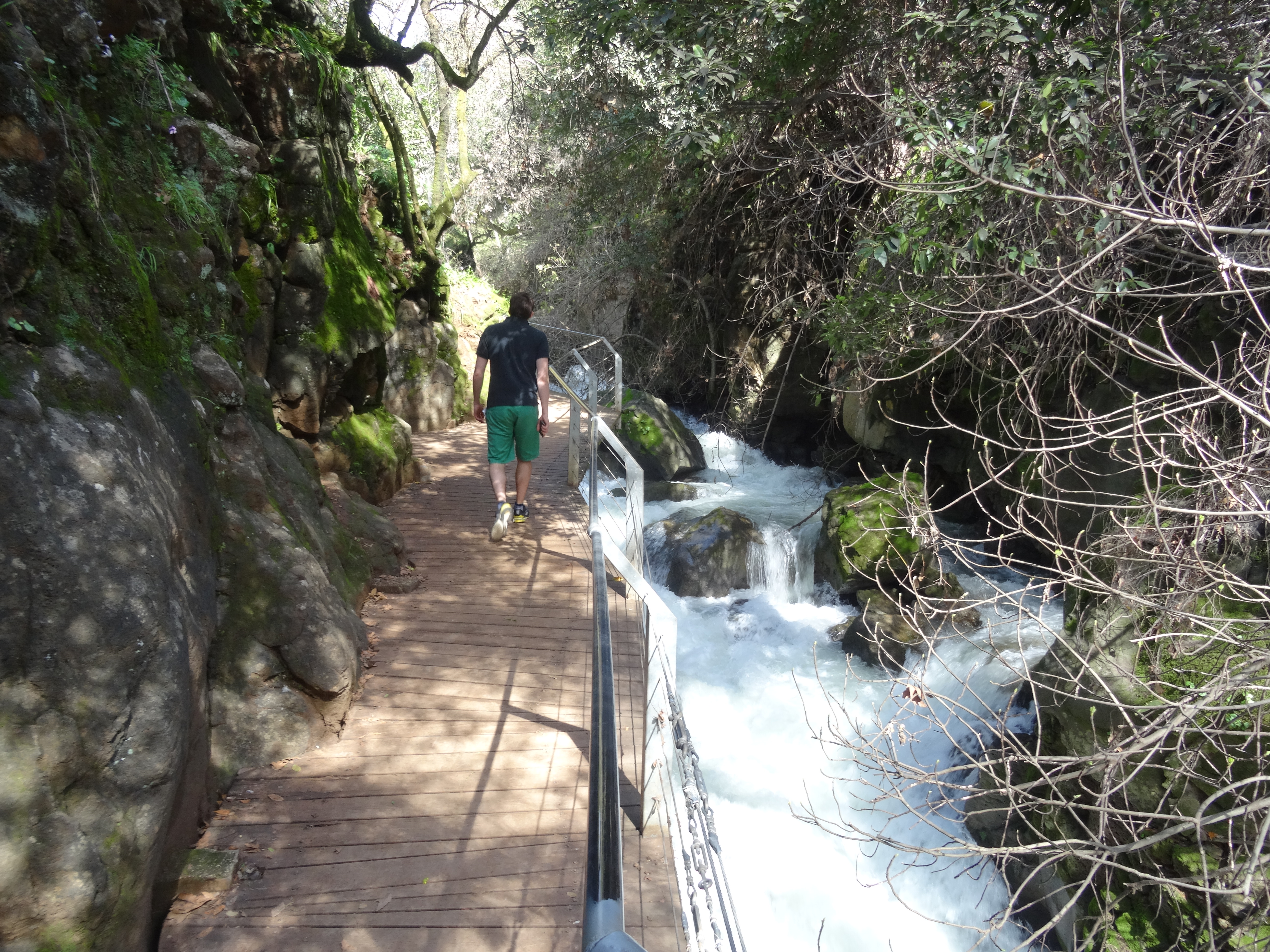
When the state of Israel was created in 1948 without the agreement of its Arab neighbours, the stage was once again set for conflict. Israel insisted on control of the Jordan headwaters, but Syrian troops refused to withdraw from Banias. Israel began work in 1951 on a channel to drain the nearby Huleh swamps, bulldozing Arab villages that lay in the way, so Syria reinforced its military presence. A swimming area on the stream is still called the ‘Syrian Officers’ Pool.’
Throughout the 1950s and 60s Syrian and Israeli units attacked and counter-attacked, each determined to take control of the vital snowmelt from Mt Hermon. Israel announced a plan to divert the water from the Banias stream into its National Water Carrier, and Syria countered with a plan to build a canal from Banias to Yarmouk. When the heavy machinery moved in to start on the project, Israeli guns destroyed them.
In June 1967 the penultimate day of the Six Day War saw Israeli tanks storm into Banias in breach of a UN ceasefire accepted by Syria hours earlier. Israeli general Moshe Dayan had decided to act unilaterally and take the Golan. The Arab villagers fled to the Syrian Druze village of Majdal Shams higher up the mountain, where they waited. After seven weeks, abandoning hope of return, the villagers dispersed east into Syria.
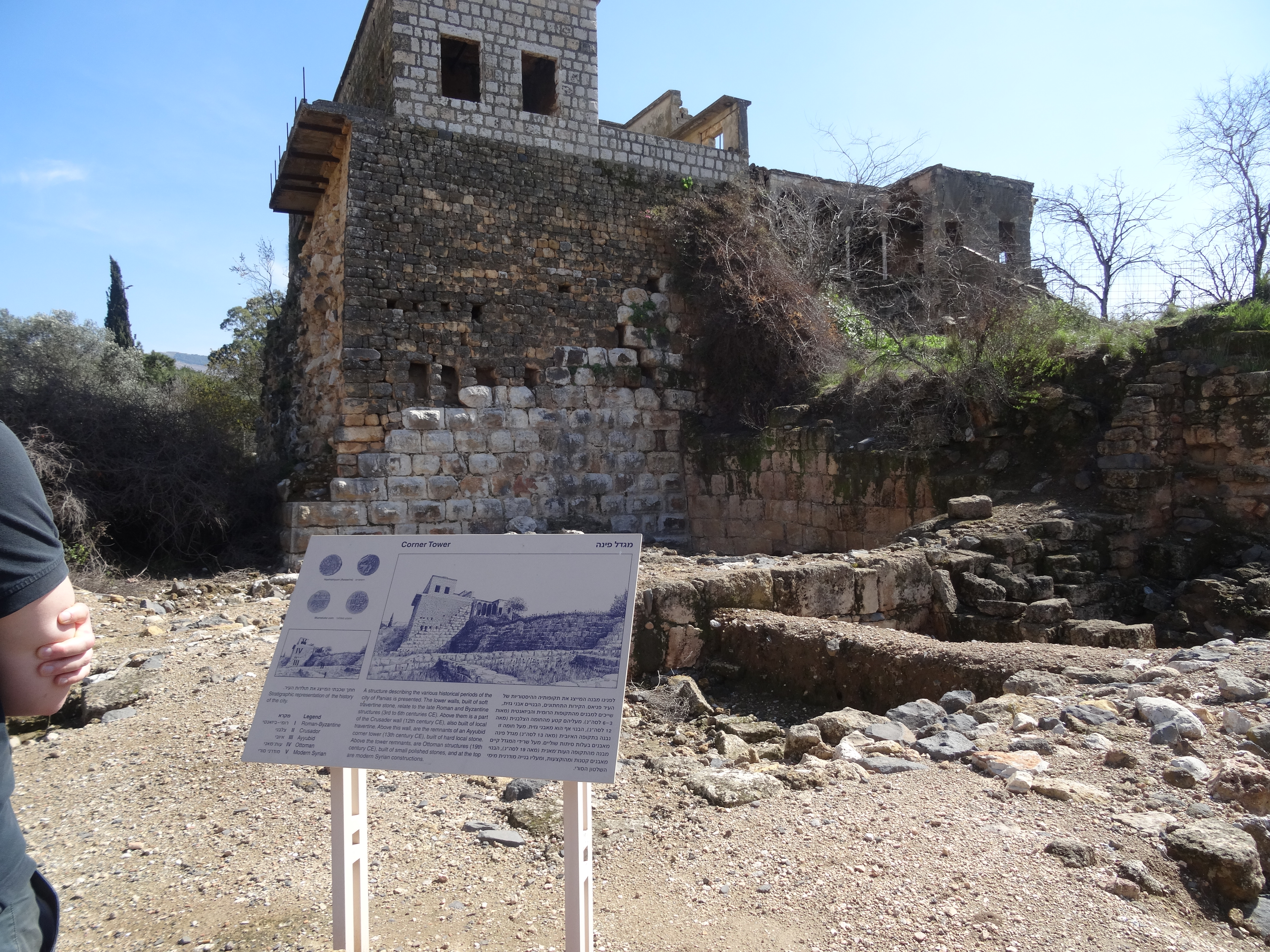
Israeli bulldozers raised their homes to the ground a few months later, bringing to an end two millenia of life in Banias. Only the mosque, the church and the shrines were spared, along with the Ottoman house of the shaykh perched high atop its Roman foundations. Within days Israeli volunteers began building on the banks of the river, creating Kibbutz Snir, the first Israeli settlement on the Golan. In 1981 Israel annexed the Golan Heights in an illegal move unrecognised by any state but international law remained impotent. No foreign power dared intervene.
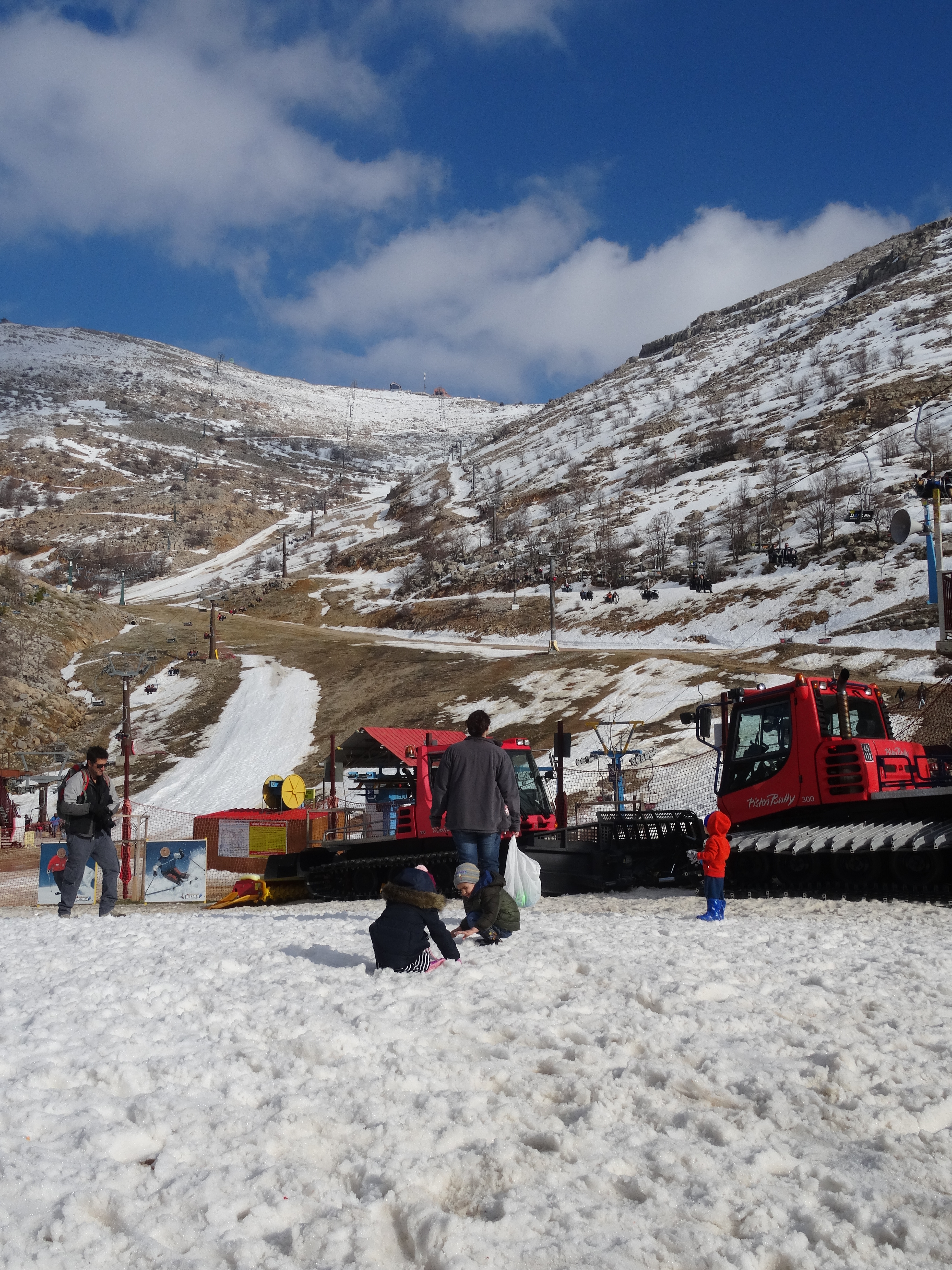
Since 2003 Israel’s confidence has increased and the Golan is now covered in scores of settlements, while dozens of hotels offering settler-made ‘Chateau Golan’ serve as weekend getaways for Israeli city elites. A ski resort has been built on Mt Hermon. Tourist websites refer to ‘Israel’s Golan Heights’ and all local maps show it as part of Israel.
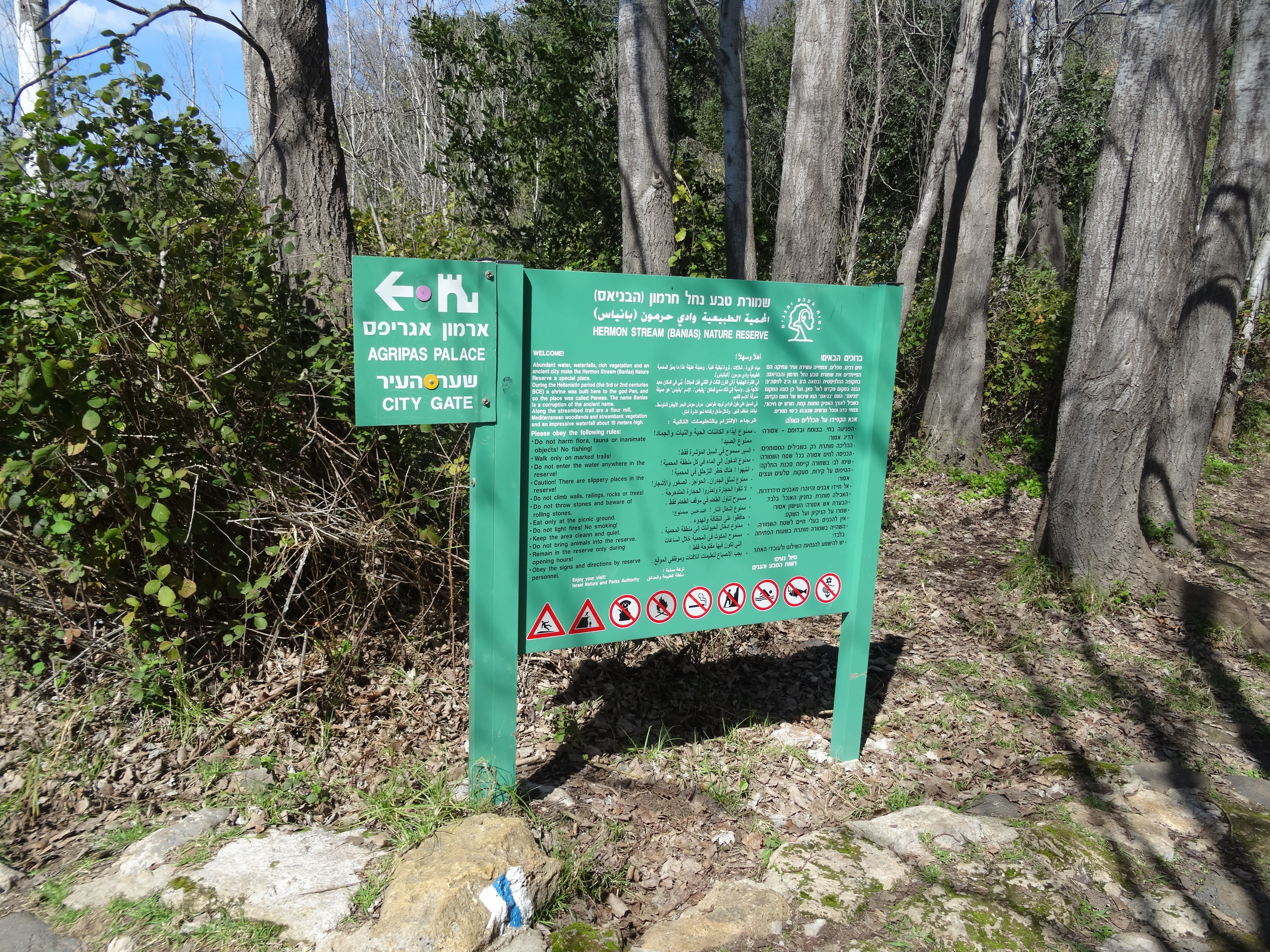
As for Banias, now emptied of residents, the site has been incorporated into one of Israel’s many ‘nature reserves’ on the Golan. Four walking trails have been neatly laid out in loops around the ancient city, its springs and its waterfalls. The souvenir shop sells T-shirts emblazoned with ‘Israeli Air Force’ and ‘Mossad’.
Explanatory signs give the Israeli version of history.
The free leaflet that accompanies the entry ticket explains Banias is now ‘a perfect place to understand the pagan world of the Land of Israel and Phoenicia’. On the map, the basilica has become a synagogue, the Ottoman shaykh’s house has become ‘Corner Tower’ and the Syrian Officers’ Pool is simply ‘Officers’ Pool.’
History in Banias has been rewritten once more. But is this the final version or are there more chapters to come?
(This piece also appeared in Aeon digital magazine as below):




















 dianadarke
,_Elizabeth_Tower,_-Big_Ben-_--_2010_--_1979.jpg)