dianadarke

Syria and Turkey commentary

Archive for the tag “Kurds”

A Dangerous Chemistry – the Kurds and water

Flooded Rumkale in Eastern Turkey, following the damming of the Euphrates upstream

Flooded Rumkale in Eastern Turkey, following the damming of the Euphrates upstream

 http://www.bbc.co.uk/iplayer/episode/p01gsjdw/From_Our_Own_Correspondent_Turkey_and_France_What_Lies_Beneath/

The southeast of Turkey is being transformed by the ambitious and controversial water scheme known as GAP. Since the 1980s 22 dams and 19 power plants have been built on the Tigris and Euphrates rivers, and GAP – or the Southeast Anatolia Project to give it its full title – is now nearing completion.  By 2015 the Turkish government hopes that GAP will double Turkey’s irrigated farmland, produce over a quarter of its electricity and bring social benefits to the impoverished population in the nine provinces affected, 90% of whom are Kurdish.

For decades Turkey has been wrestling with its Kurdish problem in the southeast of the country. Since 1984 over 45,000 lives have been lost in the skirmishes between the Kurdish separatist group known as the PKK and the Turkish army. In April this year however, after months of negotiations, Turkish Prime Minister Erdogan and jailed Kurdish leader Abdullah Ocalan reached an agreement that, if fully implemented, will end the 30 year old conflict. In exchange for greater recognition of Kurdish rights, the PKK agreed to withdraw to Iraqi Kurdistan. The withdrawal is ongoing, but slow, with only 20% so far having left. The peace process is fragile, and downstream in the Kurdish parts of Syria, unpredictable forces have been unleashed by the ongoing civil war. Will the GAP project help or hinder?

***

Soreyya, a mature stylish teacher from Istanbul, is one of a steady trickle of cosmopolitan Turks now venturing cautiously eastwards. She wants to explore the other half of her own country.

‘I had no idea it was so civilised!’ she tells me, as we sample an exotic lakeside breakfast at the half-submerged village of Halfeti. ‘My friends thought I was crazy to come this far east. They said I would hate it, but I love it,’ she says, putting her bare bejewelled arm maternally round young Zafer, our beaming Kurdish host.

‘Yes, we are learning to understand each other,’ he affirms.

We have just enjoyed an early morning boat ride to Rumkale, a mighty Byzantine fortress on the Euphrates, now stranded on an island by flooding.  Drowned in the valleys all around, lie hundreds of other sites, their archaeological treasures lost, stolen or transferred hastily to local museums.

Flooding is a not a new phenomenon in Eastern Turkey. It began with the epic deluges described in the stories of Gilgamesh and Noah, though unlike those cataclysms of nature, today’s version, the equally epic GAP project, has been decades in the planning. The Turkish government hopes it will redress the balance in living standards between the poverty-stricken Kurdish southeast provinces and the wealthier western parts of the country, by bringing employment and prosperity.

‘You must be so pleased,’ I say to Zafer, ‘with all this development helping your restaurant business.’

‘I am one of the lucky ones,’ he tells me, ‘Land values have tripled since 2000 and I own this place. But many do not own the land they farm. Aghas, wealthy  landlords, own it. They get big government payouts when their land is flooded.’

‘You mean the Kurdish farmers get nothing?’ I ask.

‘Nothing,’ he repeats. ‘Some have lost everything. The government must sort out property rights and compensation for us as well. And this boom has made bride prices shoot up!’

‘Don’t worry,’ laughs Soreyya, ‘Next year I’m coming back to get a job at one of the private schools. Maybe I’ll bring my teenage daughter with me!’

Further east in the Tigris gorge at the ancient city of Hasankeyf,  I sit with Kobe, a gloomy Kurdish cafe owner  whose livelihood will shortly disappear under 70m of water when the controversial Ilisu Dam is completed.

‘They tell us there will be underwater tourism,’ he grumbles, ‘so people can still see the historic bridge and monuments. But why do we need all these dams? This is just Ankara’s way of blocking the valleys where the PKK used to infiltrate and displacing us from our land. We have too much water already.’

Perversely, while some have too much water, others have too little. Downstream in the broken jigsaws of Iraq and Syria  – whose Kurds are also striving for autonomy – GAP, according to UN sources, has already led to a 40% reduction in water flow. The recent exodus of Syrian Kurds into Iraqi Kurdistan was driven not just by fighting, but by lack of water. Turkey, controller of the headwaters of the Tigris and Euphrates, can turn the tap off – or on.

More difficult to control are its Kurds, some 10-12 million of them and growing. Kurdish birth rates are legendary.

‘When Erdogan says he wants every Turk to have three children,’ Kobe continues, ‘his message is really more subtle than that. For western Turks who are frightened to have even one or two, he wants them to raise it to three. But for us Kurds, who often have 8 or more, he wants us to bring it down to 3 – otherwise, he thinks, what can they all do when they grow up except join the PKK?’

‘If Erdogan isn’t careful,’ he goes on, ‘he may accidentally help us to unite with our Syrian and Iraqi brothers. If he ignores our grievances, he will regret it. Have you looked at a map? Most of the oil wells in Turkey, Syria and Iraq are in our Kurdish territories.’

‘And most of the water,’ I add softly.

His troubled face breaks into a smile.

‘You know, we could be a model for the Middle East,’ he goes on, ‘we are not fanatics like those crazy jihadis trying to take over in Syria. Kurdish Islam is not the Islam of Saudi Arabia or Iran. In Iraqi Kurdistan our schools teach all world religions equally.’

As I wave goodbye to Kobe –  and to Hasankeyf before it vanishes forever –  I can’t help thinking that  a whole flood of western Turks like Soreyya  will need to come quickly to the east, to understand their Kurdish countrymen better  and to save Turkey’s fragile peace process with the Kurds.       Otherwise not just the landscape, but the entire regional map may be reshaped  –  by the most powerful weapon of all , water.

Hasankeyf on the Tigris, due for flooding [DD]

Hasankeyf on the Tigris, due for flooding
[DD]

Syria is not Iraq – 10 key differences

Images of Paradise in the mosaics of Damascus' Great Umayyad Mosque [DD]

Images of Paradise in the mosaics of Damascus’ Great Umayyad Mosque [DD]

Young and old arm in arm in Damascus

Young and old arm in arm in Damascus [DD]

Following on from ‘Syria’s Ghost’ (posted 31/08/2013) here are 10 key differences between the case for intervention in Syria as opposed to Iraq:

1. In 2003 Iraq was not in a civil war. It was simply another repressive authoritarian Arab state not much worse than Mubarak’s Egypt and Gaddafi’s Libya.

2. Syria in March 2011 witnessed a peaceful spontaneous uprising against its repressive authoritarian leader Bashar Al-Assad.

3. The Iraqi people were not asking the US-led coalition to intervene.

4. A large section of the Syrian people asked the international community to intervene after the Assad regime countered their peaceful demonstrations with extreme violence, arbitrary arrest and torture.

5. Iraq in 2003 did not present a threat to the international community. There were no Al-Qa’ida operatives or jihadis inside Iraq. They came in later to profit from the chaos we created.

6. Syria presents a serious threat to the security of the international community. The Al-Qa’ida-linked jihadi groups have thrived in the vacuum left by our non-intervention, and are growing. They are starting to dominate the moderate rebel groups like the Free Syrian Army.

7. Iraq was not a proxy war.

8. Syria has become a proxy war: America v Russia, Iran v Saudi Arabia, Hizbullah v Salafis. The interests of the Syrian people have been lost in the proxy war interests.

9. Iraq was not a humanitarian intervention. It was not in danger of collapse in 2003. It was not at war and was stable.

10. Syria would be a humanitarian intervention under the ‘Responsibility to Protect’ doctrine (Bosnia is the model). Syrians are dying of starvation and lack of medical attention as well as regime massacres and chemical weapons attacks. An entire generation is being lost.

For all those reasons, Syria is not Iraq, and for all those reasons, from the moment the regime made clear its intention to wipe out all opposition, I have supported intervention by the international community. Without it, Syria will disintegrate entirely over a period of years, and the fallout will come back to bite us big time.

Saladin's Castle in the mountains above Lattakia [DD]

Crusader Castle of Saone, later Saladin’s Castle in the mountains above Lattakia [DD]

Saladin's Tomb in Old Damascus. Saladin was a Kurd. [DD]

Saladin’s Tomb in Old Damascus. Saladin was a Kurd. [DD]

Looking at it objectively now 10 years on, the American-led invasion did inadvertently help one sector of the Iraqi people – the Kurds. Autonomous Iraqi Kurdistan could almost be seen as a model for the Middle East. Its schools since 2012 are teaching all world religions equally, and Islam is just one of them, no favouritism. It is booming economically thanks to its oil and its trade with Turkey. But all that was an unintended consequence.

Syria’s Kurds could also benefit from the current crisis in Syria, but that is happening anyway, and will continue irrespective of American strikes. More and more of them are pouring out of Syria’s northeast corner into Iraqi Kurdistan, where they are being warmly welcomed. Kurdistan may well turn out to a lasting beneficiary of the chaos inside Syria, along with the Syriac Christian community in eastern Turkey:

http://www.bbc.co.uk/news/magazine-23614968.

Related articles

No appetite for war in Eastern Turkey – except with Israel

My research trip to Eastern Turkey over the last couple of weeks yielded some unexpected discoveries. The trip was designed to update my Bradt Eastern Turkey guide for its second edition, but I kept finding myself sucked towards the Syrian border.

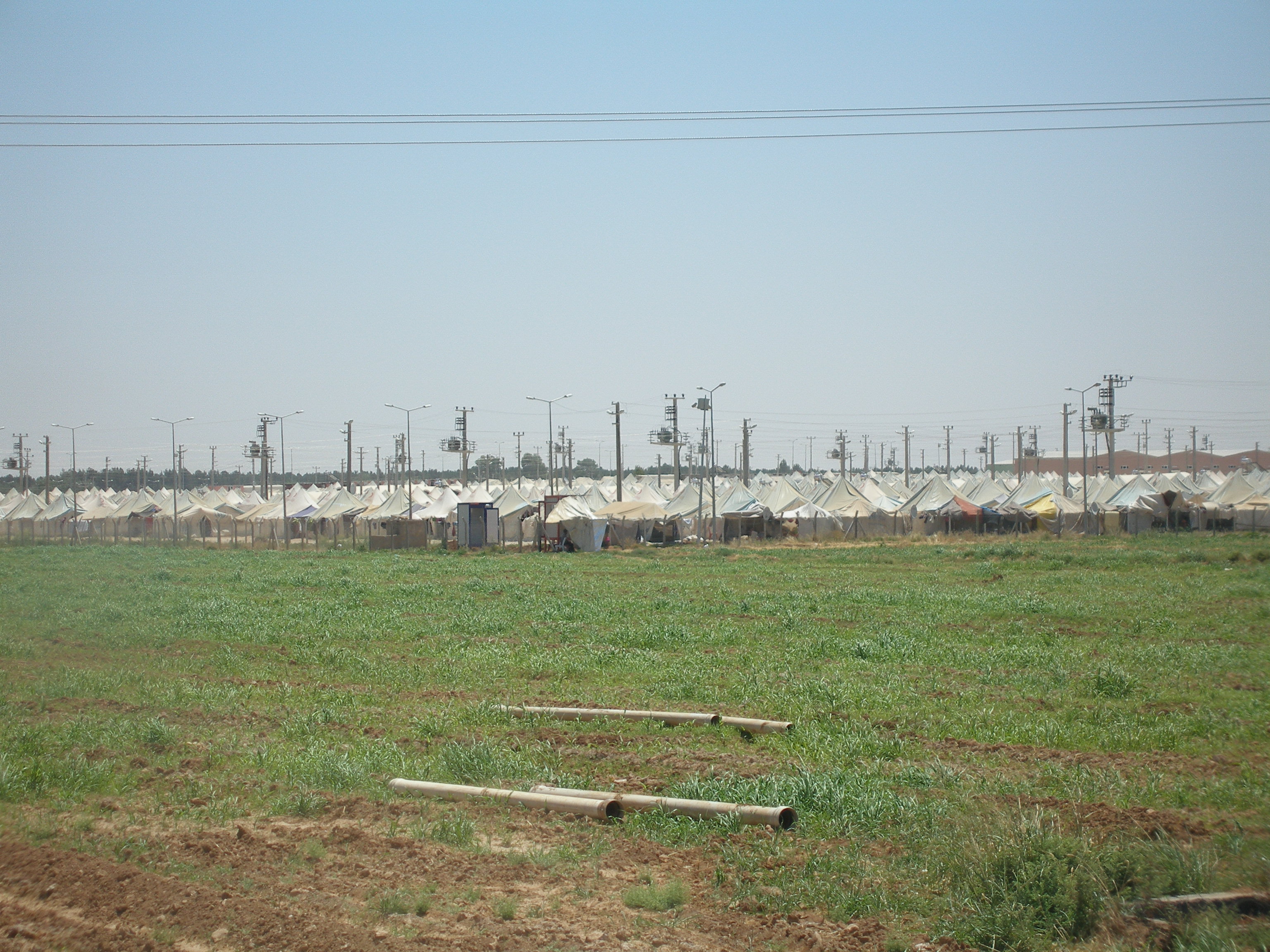
After revisiting Urfa’s Balikli Gol, the sacred fish ‘Pool of Abraham’ in temperatures of 40C, I drove 45km south to Harran to inspect its famous termite-like beehive houses, relics of biblical living, and its ancient university on the site of a pagan moon temple. All was quiet and exactly as I remembered it, so I drove on just 15km kilometres further south to Akcakale, the border town with Syria where five civilians were killed in October 2012 by shells fired from inside Syria. All quiet now, but on the edge of town I was startled to see a heavily crowded tent city, hemmed in by barbed wire fence. Its misery was palpable even from a distance. Designed to house 23,000 Syrian refugees, I later learnt it was now home to 36,000, a figure that defied belief. How could so many possibly live in such conditions in such stifling heat – let alone in Ramadan, due to start in a few days’ time?

I drove back and forth along the main road in front of the camp, feeling helpless, passing  several families hitching lifts, wondering if I should stop for them, but fearful in case I was in turn stopped by the Turkish authorities and in some way implicated for my involvement. Stories had reached me about how some Syrians were starting to run away from the camps, desperate to lead something closer to a normal life, after months of confinement.

In the end I decided my most useful contribution would be to give my food away – my picnic lunch plus two bags of nuts I had bought in Gaziantep market a few days earlier. Driving slowly, I pinpointed two small boys returning towards the camp who were carrying nothing at all. When I stopped and got out of the car to offer them the food, they were visibly startled and frightened, and required some coaxing to take the bags from me. They spoke neither Turkish nor Arabic and I wondered afterwards if they might have been Kurdish, since the area around Tell Al-Abyad across the border was a heavily Kurdish part of Syria. When I looked in the rear view mirror after driving off, I saw they had quickened their pace, hurrying back to the camp with their unexpected gift. It was an image that has stayed with me since.

Syrian refugee camp at Akcakale, south of Harran, Turkey (DD)

Syrian refugee camp at Akcakale, south of Harran, Turkey (DD)

The road past the front of Turkey's Akcakale camp for Syrian refugees (DD)

The road past the front of Turkey’s Akcakale camp for Syrian refugees (DD)

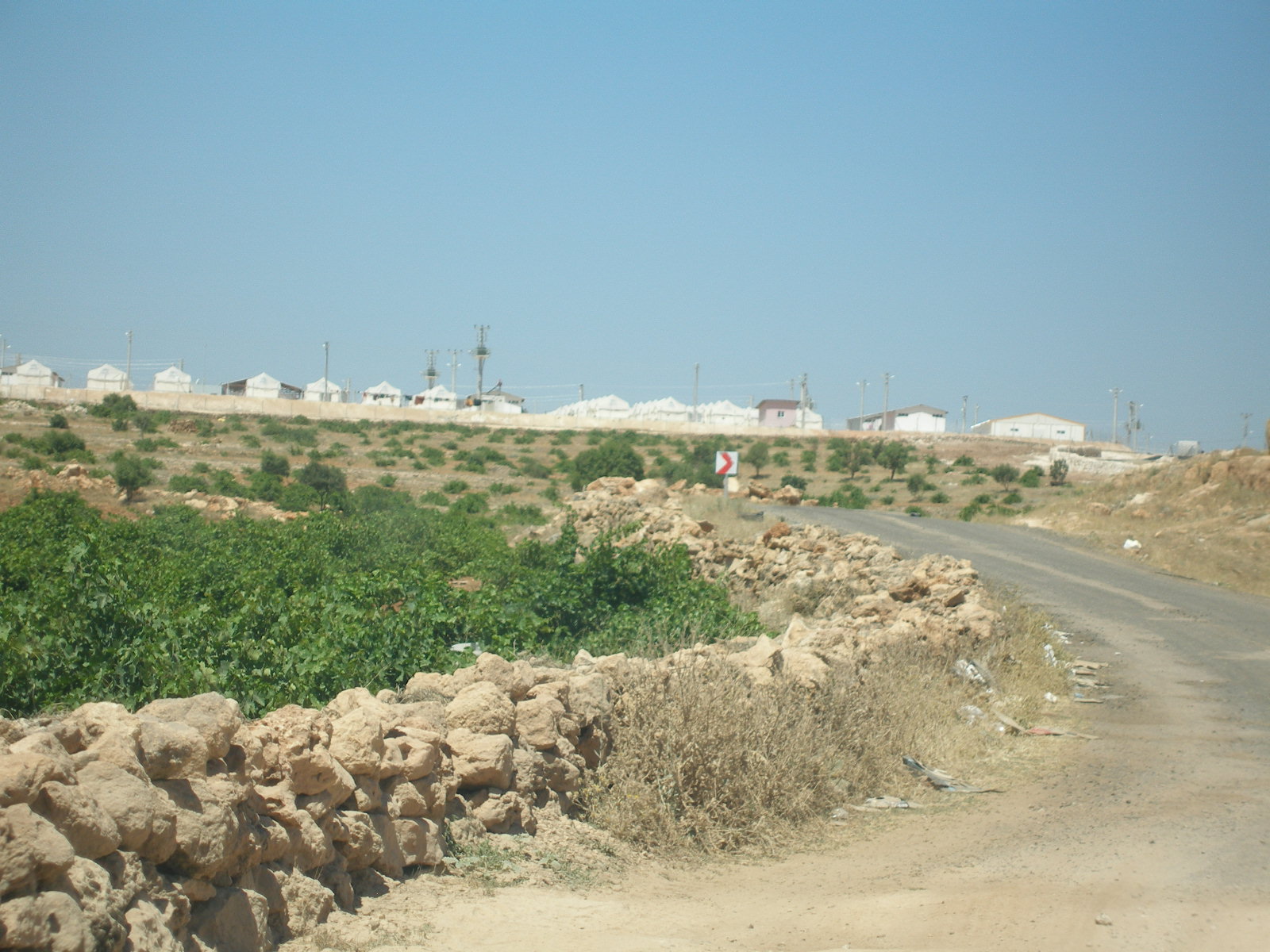
A few days later in Midyat on the way to visit the Syriac Orthodox Monastery at Gulgoze (Syriac name Ainwardo), I stumbled on another refugee camp. In contrast to the camp at Akcakale, this one was spacious and well-appointed, with cabins rather than tents, and numerous bathroom blocks similar to a European camp-site. Far from being overcrowded, it seemed largely uninhabited.

My subsequent enquiries explained why – the camp had only been built about three months ago, on land donated by a wealthy Syriac businessman, and was only for use by Syrian Christians.

Refugee camp for Syrian Christians in Midyat's Turkey (DD)

Refugee camp for Syrian Christians in Midyat’s Turkey (DD)

Syriac Monastery of St Cyriacus at Gulgoze, south of Midyat

Syriac Monastery of St Cyriacus at Gulgoze, south of Midyat (DD)

‘We feel very sorry for the people of Syria, and of course we have to help them when they come across the border to us. But we don’t want our government to go to war against the Syrian regime. We have problems of our own in Turkey, and our government should concentrate on those, not get involved in a difficult war next door.’

But a handful of people, Sunni Turks to a man, went one step further. ‘We don’t want war with Syria. But if this war grows and  becomes a war against Israel, that would be different. For that we would be ready…’

Post Navigation