dianadarke

Syria and Turkey commentary

Archive for the tag “Damascus”

Spiritual Material: William Morris and Art from the Islamic World

Anyone familiar with Islamic art will long have known how heavily William Morris drew his inspiration from the Islamic world. One glance at his patterns is enough  – the repetition to infinity, the twisting foliage, the richly entangled fruit and birdlife, the stylised designs that are often botanically impossible yet speak to us at some deep primordial level – all are hallmarks of Islamic art. Curiously, ever since his patterns were popularised, appearing in every imaginable accessory in our kitchens and living rooms, from curtains to coasters, from tablecloths to mousemats, those same iconic Morris designs have been subsumed as ‘quintessentially English’,  somehow deemed to be an intrinsic part of our British cultural identity. It is the same blind spot that exists with Gothic cathedrals like Notre-Dame, proclaimed to be ‘quintessentially French’, synonymous with the French national identity, by those oblivious to the Islamic origins of such rich architectural styles and ornamentation.

Until, that is, it is pointed out in exhibitions like ‘William Morris and Art From the Islamic World’, still running till 9 March 2025, where the eye can become trained. All credit is due to the William Morris Gallery, the fine Georgian family home in Walthamstow where Morris grew up, for staging this exhibition, and for highlighting to a British audience what has been hiding in plain sight all along. The gallery’s guiding mission has been to bring the communities of Walthamstow, where one in five of the population is Muslim, closer together, an outreach project to show how different cultures have intertwined and inspired creativity since time immemorial. Maybe a future exhibition at the V&A could do the same for Islamic architecture and European medieval styles like Romanesque and Gothic?

The starting point of the exhibition is a smallish room which brings together items from the Islamic world all of which, crucially, once belonged to Morris and his family. Though Morris himself never travelled further east than Italy, he acquired a range of carpets, textiles, metalwork and ceramics mainly from Iran, Syria and Turkey, which clearly served as his prototypes, using them to decorate his homes. This geographic range is very important to the curators’ careful and deliberate choice of phrasing in the title ‘Art from the Islamic world’, a much more accurate description than was common in Victorian times when all Islamic art was labelled ‘Persian’, considered the ultimate in Orientalist chic. Even today, museums like the Jackfield Tile Museum in the Ironbridge Gorge perpetuate such misnomers in their labelling, describing English tiles that are clearly copying Ottoman Turkish tile designs as ‘Iranian-influenced’.
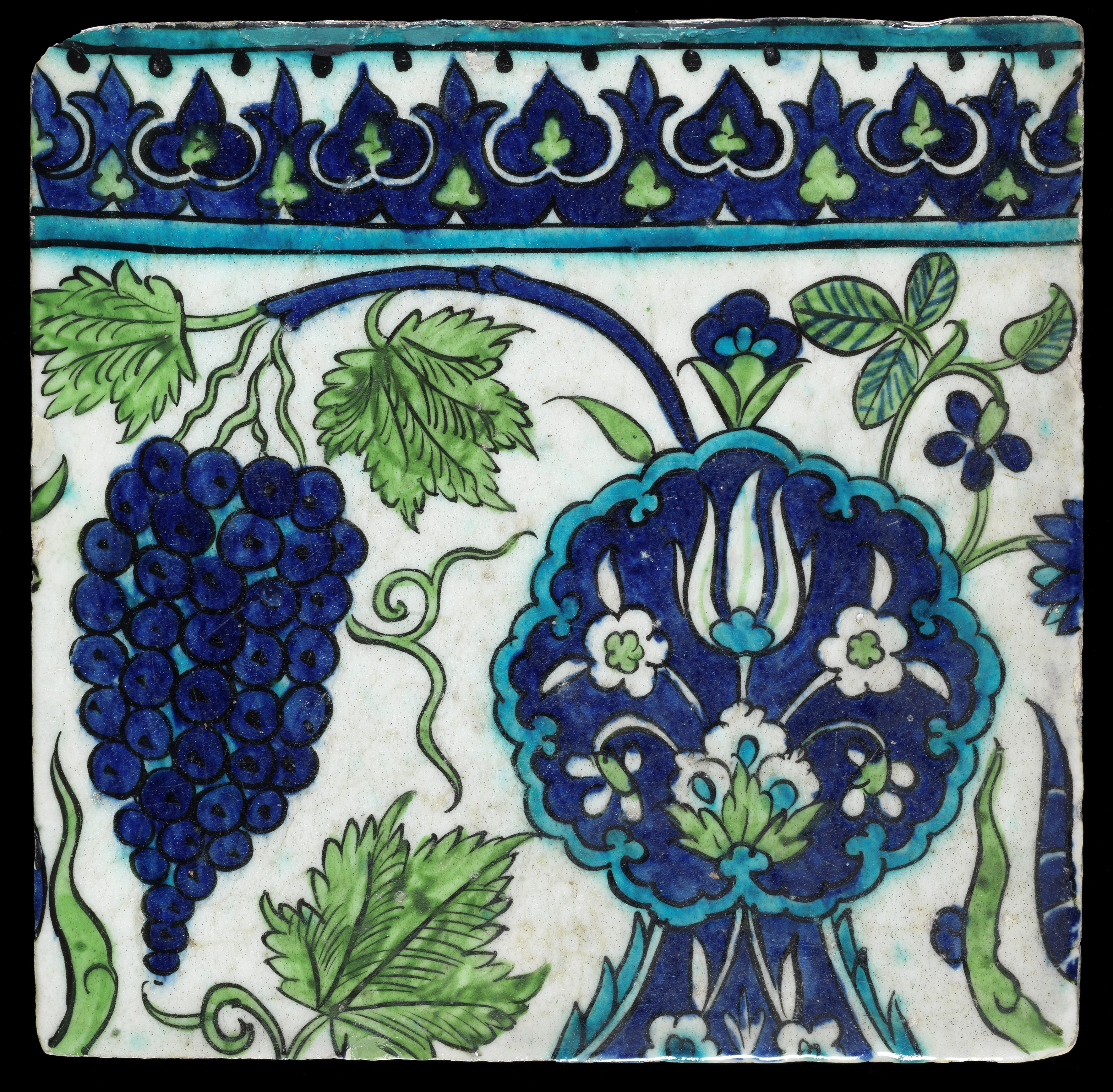
Fritware/Stonepaste Tile. Unknown. Fritware, mould made, painted in blue, green, turquoise and black under a colourless glaze, height 26.6 cm, width 27 cm, depth 2.8 cm, weight 2627 g, circa 1574-1599. Ottoman Period. Syria, Damascus. Forms part of a panel comprising twenty three tiles, C.4-1928. This tile probably formed the edge of the original panel.

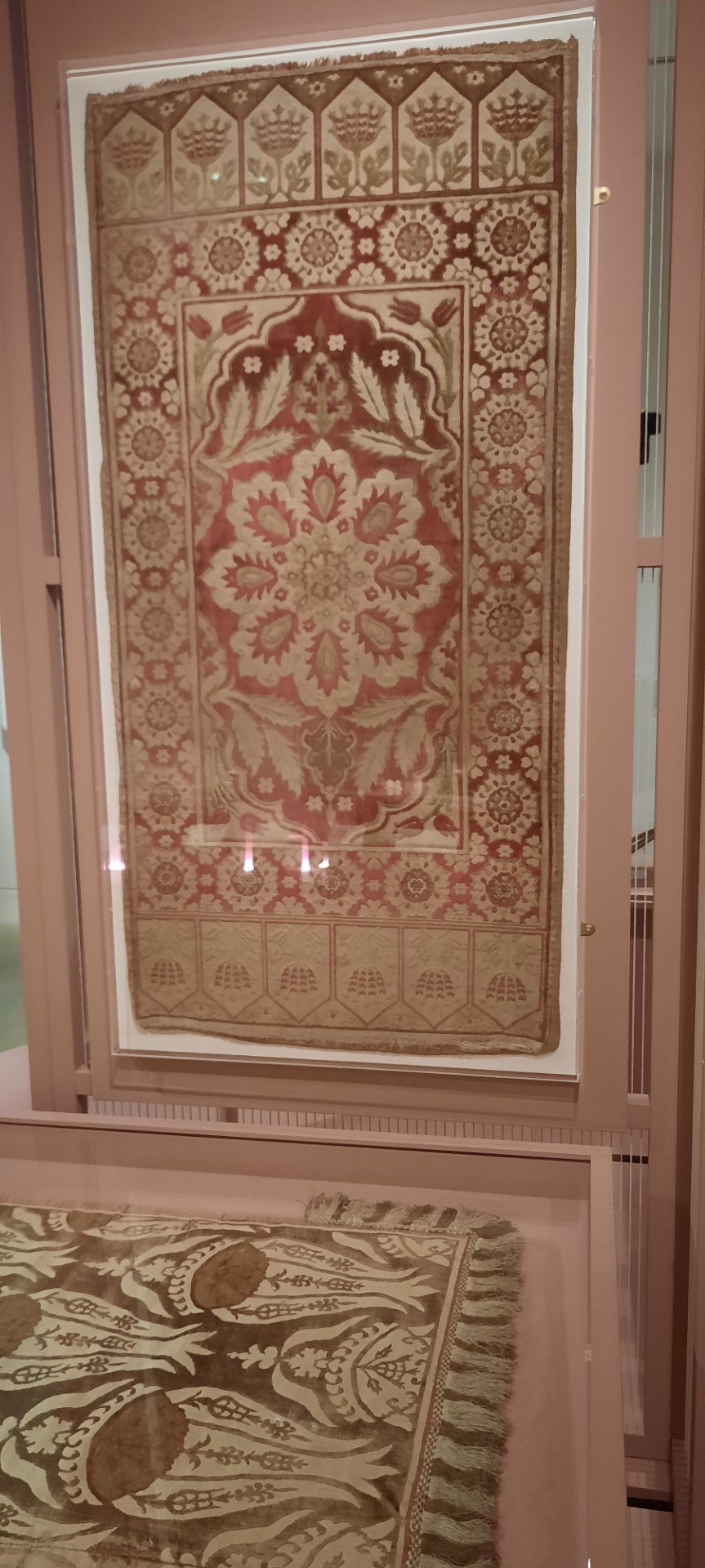
When Morris, who often railed against the privileged society into which he was born, first launched his business  in 1861, opening an interior design shop in Oxford Street, he was trying to bring his styles to the middle classes, well aware that most of his commissions were for wealthy clients with more money than aesthetic sense. ‘I spend my life ministering to the swinish luxury of the rich,’ he lamented. Some mocked his hand-made approach to design and craftsmanship as ‘thoroughly medieval’ and ‘useless’.  At the time, his style of artist-led designs, using quality materials and hand-craftmanship was pushing against the tide of the Industrial Revolution. ‘I have never been in any rich man’s house,’ he declared, ‘which would not have been the better for having a bonfire made of nine-tenths of all that it held.’ It was part of his ‘Crusade against the age’, and in the end his persistence prevailed, for by the turn of the century, Morris & Co had become a by-word for good taste. He sold to important clients in Europe, America, Australia and Canada, exhibiting at international trade fairs in Paris, Boston and Philadelphia to raise the company’s profile. He learned to be a businessman, buying out his partners, and extending his product range to more affordable off-the-shelf items like wallpapers, fabrics and tiles. The Arts and Crafts movement, spearheaded by Morris, began in England and flourished in Europe and America between 1880 and 1920. On his death aged 62 in 1896 his coffin was draped in a magnificent 17th century Ottoman brocaded velvet from his own collection, made from silk and metal thread in Bursa, the first Ottoman capital.
Regret that his products were beyond the reach of the ordinary working class contributed to Morris’s growing political activism. Acutely conscious of his own privileged status in high society, he denounced the increasing industrialisation of the time, and became a socialist aged 50. He criticised the British government’s attempts to drag the country into a Russian-Turkish war in 1877, warning against ‘false patriotism’ and the dubious motives of the ruling classes who were led only by desire for profit.

Becoming a fervent environmentalist, he descried the despoliation of the landscape, and fought to stop pollution of the Thames and the destruction of Epping Forest. Although a nervous public speaker, his belief in his cause led him to give up to a hundred lectures a year, sometimes three a week, determined to make a difference. Driven by idealism, he wanted to imagine a world in which communities were equal, with no concept of private property, where craftsmanship and creativity could flourish. In 1877 he founded SPAB, the Society for the Protection of Ancient Buildings, and led the campaign to save the west front of St Mark’s in Venice. He was also outraged by the appalling restoration of St Albans, where the new pseudo-Gothic west front damaged much of the original fabric.  

In south London at Merton Abbey, the Gothic ruins of which he restored, along with its water mill (another innovation introduced to Europe from Syria via Islamic Spain) on the River Wandle, he recreated an environment of medieval craftsmanship and techniques.  He used natural dyes like indigo, disliking intensely the synthetic dyes of the times, even though it took him ten years of experimentation to achieve good results. So smitten was he with the beauty of Persian and Turkish carpets, hanging them on his walls or draping them over his tables as far too precious to walk on, that he decided to pioneer the production of hand-made rugs in Britain, recruiting experienced weavers from the declining Spitalfields silk industry, and using specially-built hand looms, hoping that eventually their skills would pass down to the next generation so that Britain might build its own hand-woven carpet tradition. One such example, called ‘Peacock and Bird’ is on display in the exhibition, so strikingly inferior in workmanship to the real thing that it serves as a clear marker that, even with the best will in the world, and the money, such traditions take centuries to accumulate and evolve.

All Islamic art ultimately seeks to recreate Paradise in the form of gardens and rivers, flowers and trees, where hierarchy is absent and where all live peacefully in mutual cooperation. The material and the spiritual world are connected through geometry, the unifying intermediary. This is precisely what Morris the idealist clearly felt drawn to in Islamic art, with its egalitarian traditions and deep respect for nature. As a child he had loved observing birds, flowers and plants in the Essex countryside. One of his most sophisticated patterns, which he named ‘Rivers’, after tributaries of the Thames, is based on meandering diagonal stems and natural growth, so that, as he put it, ‘even where a line ends, it should look as if it had plenty of capacity for more growth.’ This, together with his use of stylised birds and animals in pairs, to give underlying geometric structure to his patterns, are further borrowings from Islamic art. Other motifs he used, like flowers in vases, are also common in Islamic art.

Fritware/Stonepaste Tile Panel. Fritware, mould-made, painted in blue green and black under a clear glaze and framed in ebonised wood decorated with gilding, height, whole, 122 cm, width, whole, 92 cm, depth, whole, 8 cm, height, single tile, 26 cm, width, single tile, 27 cm, circa 1550-1650. Ottoman Period. Production Place: Damascus, Syria.

Granada, the most technically complicated textile Morris ever produced, so complex it never reached commercial production, was woven in 1884 at Merton Abbey. Featuring pomegranates and almond-shaped buds, connected by pointed arches and branches, the name tells us that his inspiration came from the patterns of the Alhambra Palace of the Nasrid kings. Though Morris himself never visited the Alhambra, he knew it through the lens of designer-architect Owen Jones (1809-74), who spent six months at the end of his Grand Tour, aged twenty-five, drawing detailed sketches of the stucco wall patterns of the palace, and acquiring a fascination with geometry, colour theory and the use of abstraction in decorative ornament. The result was his seminal work The Grammar of Ornament (1856), still used as a sourcebook in design schools internationally.

As the Gothic Revival got underway, the wealth generated from industry and trade, together with religious reform, resulted in a frenzy of churchbuilding, leading Morris to enter the market for church furnishings, like stained glass, embroidery, furniture and metalwork. Many of Morris’s contemporaries shared his interests and beliefs, like stained glass designer and tile-maker William de Morgan who also joined the Arts & Crafts movement. De Morgan moved his business to Merton Abbey, where he reproduced the fourteenth century ‘lustreware’ techniques of Muslim craftsmen, inspired by Islamic and medieval patterns. His tiles also decorate the walls of Leighton House in London’s Holland Park with its famous Arab Hall, a showcase of original sixteenth-century Damascus tiles procured on behalf of the painter Lord Frederic Leighton (1830-96).

A separate room in the exhibition is devoted to Morris’s daughter, May Morris, who travelled to the Islamic world after her father’s death. It displays the various items, especially textiles, she brought back and clearly valued highly, becoming a collector herself, as well as a donor.

A beautifully illustrated book, titled Tulips and Peacocks in a nod to the most prized flower of the Ottoman Turks, and the most loved bird of the Persians, has been published by Yale University Press specially for this exhibition, featuring a collection of ten essays by different specialists, including excellent contributions from the exhibition’s curators, Rowan Bain and Qaisra M. Khan, each exploring aspects of Morris’s connections to Islamic art. The front cover shows the distinctive 17th century Damascus tiles that Morris had acquired, in a pattern he called ‘Vine trellis’, purchased by Cambridge’s Fitzwilliam Museum after his death, and now reloaned by the Fitzwilliam for display at this exhibition. The book is on sale in the gallery’s shop, along with an impressive array of Morris-themed memorabilia for gifts or souvenirs.

Morris believed that through his work he could act as a bridge allowing craftspeople of the past to pass on their knowledge to contemporary artisans. The enduring popularity of his patterns suggests this may have been no idle dream, as people continue to respond to the same quasi-mystical, other-worldly qualities in his designs which echo those of Islamic art. Just below the surface, there is always the sense that something divine, something bigger than us mere mortals, unites us in our humanity. In this, perhaps, lies Morris’s universal appeal.  

[A version of this article first appeared in The Times Literary Supplement (The TLS) on 17 January 2025]
https://www.the-tls.co.uk/arts/visual-arts/william-morris-and-art-from-the-islamic-world-review-diana-darke

Rebuilding Damascus

With its future in the balance, a cultural historian looks past the corruption, violence and trauma of recent decades to the almost lost history of collaboration and shared traditions between Muslims in Syria and Christians in Europe. By DIANA DARKE [as first published 10 January 2025 in The Tablet]

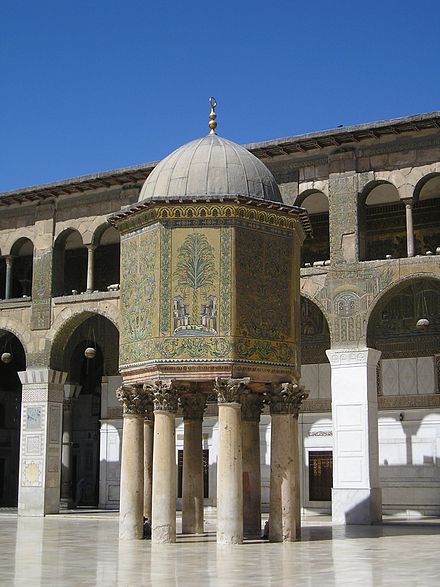
Buildings have stories to tell, in Syria none more perhaps than the magnificent Umayyad Mosque in the heart of the walled Old City of Damascus. It embodies the very soul of Syria, a sacred site where for over two millennia multiple civilisations and religions – Aramean, Greek, Roman, Byzantine and Islamic – have coalesced yet also survived in their own unique form. No surprise, therefore, that the new de facto ruler of Syria, Ahmad al-Shar’a, leader of Hay’at Tahrir al-Sham, the Organisation for the Liberation of Syria (HTS), chose to head straight there to pray after entering the city on 8 December.  

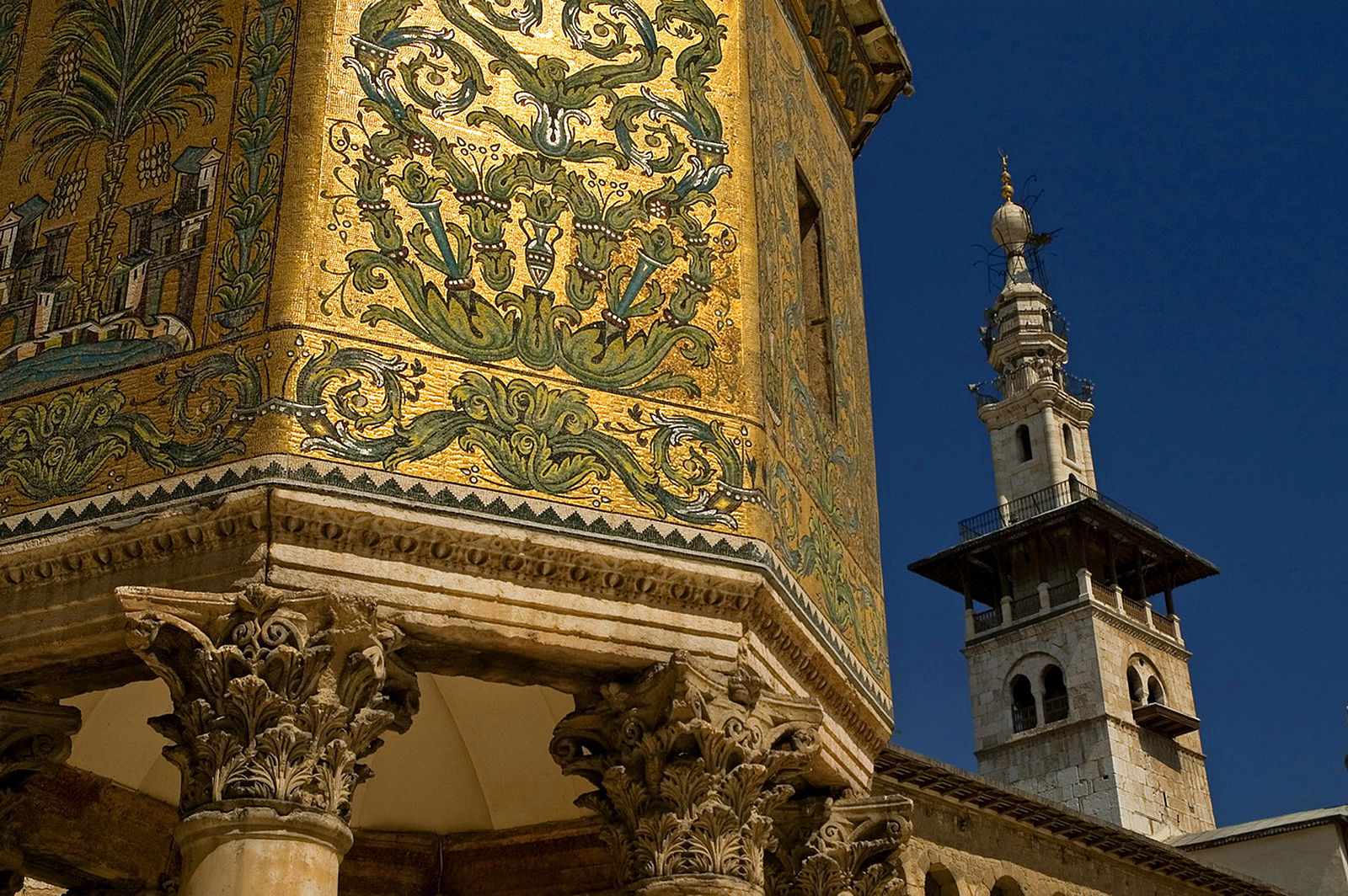
Syria has long been overwhelmingly Muslim but the Umayyad Mosque claims the heads of John the Baptist as well as Hussein, the Prophet Muhammad’s grandson. While still a cathedral, following the Muslim conquest of Damascus in 634, the building was shared by Christians and Muslims for close to a hundred years, as were the cathedrals of Homs and Hama. They were only converted to mosques once the Muslim population, small at first, gradually expanded. Top Byzantine Christian mosaicists then followed the brief of new Umayyad masters to cover the walls of the courtyard with breathtaking visions of the Islamic Paradise, timeless landscapes of fantasised trees, gardens, rivers and palaces in shimmering green and gold. 

When rulers change, life for those uninvolved in the fighting tends to continue as before. The best architects and craftsmen are summoned to work on new prestige projects, irrespective of their religion, just as the most entrepreneurial businessmen find new opportunities. It was the same in Umayyad Spain when elite Muslim craftsmen were summoned by new Christian rulers during the Reconquista, to transfer their innovative engineering technologies like pointed arches and ribbed vaulting, as well as their decorative repertoires, to prestige abbeys and cathedrals. As late as 1492 the Catholic monarchs Ferdinand and Isabella appointed a Muslim master builder to look after all royal buildings in Aragon, a position that then passed to his son. 

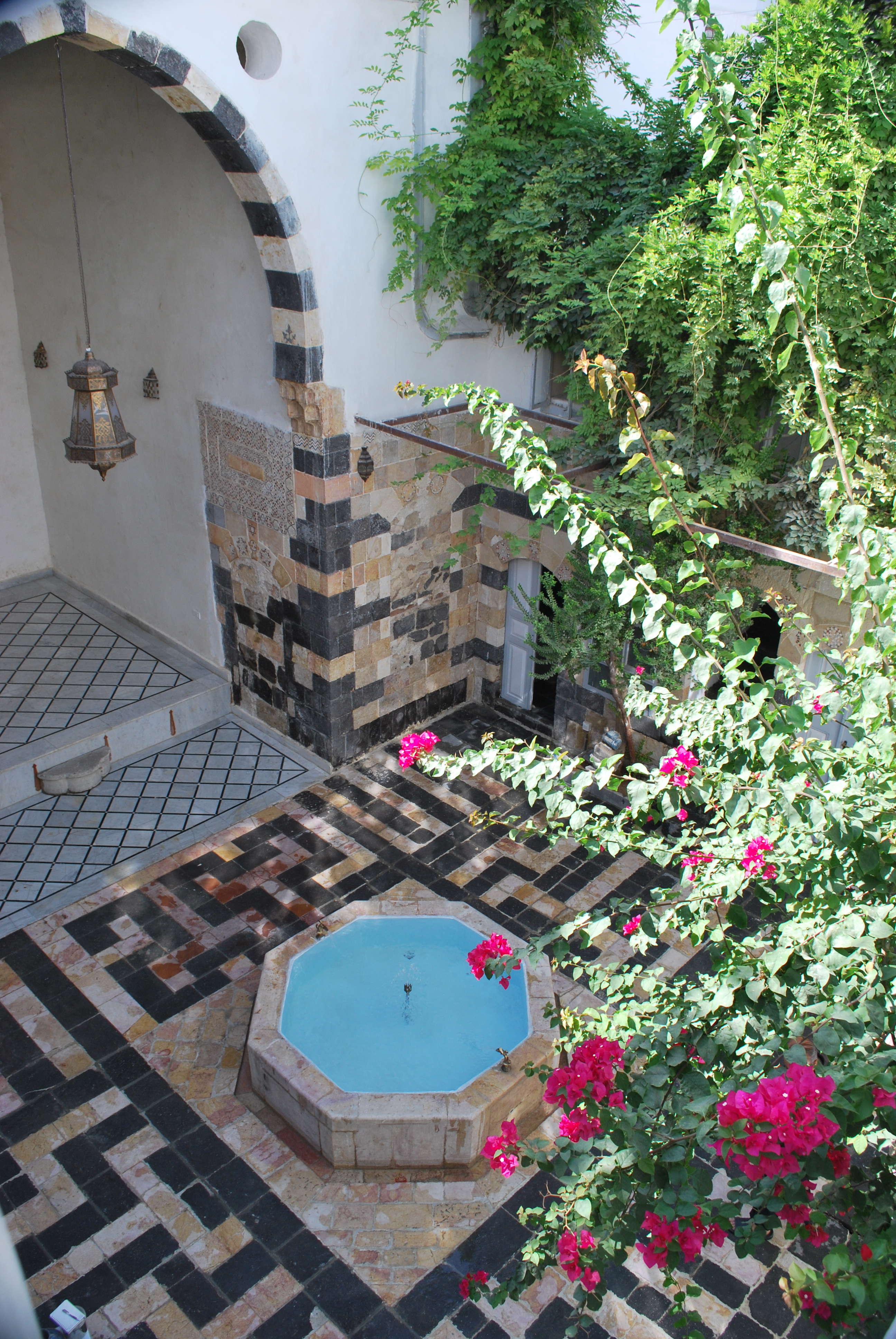
I bought a semi-derelict Ottoman courtyard house in Old Damascus in 2005. Full of wonder that I, as a foreigner, was able to buy a chunk of a UNESCO World Heritage site, I embarked on a three-year restoration project, guided by a Syrian architect and a team of fifteen craftsmen, experiencing first-hand the labyrinthine corruption of government and legal systems. To learn more about the house itself, I re-entered the academic world to study Islamic art and architecture. Deciphering the decorative styles of the house gave me the essential foundation for my subsequent work, connecting the almost lost history of collaboration and shared traditions between Muslims in Syria and Christians in Europe, traditions that formed the springboard for the architectural styles we know in Europe as “Romanesque” and “Gothic”.

In the new Syria of 2025 a Christian wheeler-dealer who made a fortune during the war in the transportation business is now raking it in as a high-end hotelier.  Among Aleppo’s traditional soap-making family businesses, trade is up by 80%. My lawyer, who throughout the war bemoaned the fact that most of his caseload was divorce work, is now kept busy by clients asking questions he cannot answer. Many, like me, had their houses stolen during the war by profiteers writing fabricated intelligence reports against them. By a miracle, despite being labelled a British terrorist with links to armed groups, I went back in 2014 and retook possession, evicting my previous lawyer, his mistress and baby, along with a fake general on a forged lease. 

The interim government faces huge challenges. Disentangling the different currencies, legal and education systems that operate in the different regions of Syria will take a long time. Add to that the complication of how to monitor the movements of returning refugees, as well as compiling a new electoral roll, and the three-year period Al-Shar’a suggested last week will be needed to draft a new constitution – four years for proper elections – in a unified Syria, becomes an ambitious target.  

Al-Shar’a has promised to make Syria inclusive for all, including women. The country’s central bank has just appointed its first-ever female governor. Many commentators outside the country gnash their teeth, convinced that HTS, a Sunni Islamist group once aligned with Islamic State and al-Qaeda, remains a jihadi extremist outfit similar to the Taliban. Yet at least so far, its leaders appear ready, as are the majority of  Syrians inside the country, to take Syria on a new trajectory, and seem prepared to engage pragmatically with the “international community” that failed it so badly, some elements of which even went so far as to rehabilitate Assad as if he were a fact of life, never understanding how hollowed-out his regime was, how unrepresentative of the overwhelming majority of Syrian people. 

Syrian friends forced into exile during the war (along with nearly a third of the Syrian population) are scattered across Lebanon, Jordan, Turkey, Germany, Norway and Canada. From a range of professions – architect, lawyer, hotelier, tour guide, environmentalist – not one of them was able to continue their former work in their host countries. All struggled to make new lives for themselves and they feel they have lost thirteen years of their life. Even harder to bear is how in recent years refugees from Syria have been made to feel increasingly unwelcome, the mood turning against them in their host countries as right-wing populism has risen to heights where it is destabilising Europe as well as Syria’s neighbours. Most now plan to return, to rebuild their lives and their country, bringing with them new expertise and knowledge. After Germany’s 6000-plus Syrian doctors have left, they will be missed by its aging population, their worth only recognised once it is too late. Friends who stayed also feel the last thirteen years have been wasted, their country devastated by aerial bombardment from the Assad regime and Russia, sanctioned and isolated from the outside world.

Nothing screams “CHANGE” to me more loudly than the sudden arrival since 8 December of the world’s media, banned since 2011. During the 54 years of the Assad dynasty’s rule – 30 years under Hafez from 1970 till his death from leukemia in 2000 and 24 years under his second son Bashar – it was never easy for journalists to get visas into Syria. Control of the narrative was always an essential part of the Assad grip on power. 

“Come in and report without restriction” was the message from al-Shar’a. In a country with so many secrets to uncover it is a journalist’s dream come true. Heartwarming scenes like a man exiled for 50 years reuniting with his 100-year-old mother have competed on our screens with tales of torture and abuse from the prisoners streaming out of the “slaughterhouse” in Seydnaya. Thank God the Assads’ filthy linen has been exposed for all to see. 

Blacklisted for years, I was able to slip into Syria seven times since the uprising began in March 2011, most recently as part of the Crazy Club, hiding under the cassocks of the clergy. Now I can return openly. The situation inside Syria is complicated and varies considerably from region to region but prices for most things have got cheaper and the Syrian pound’s exchange rate has stabilised. Embassies are re-opening, schools and universities have reopened and civil servants are back at work. In Damascus the hotels and restaurants are brimming, not just with journalists but also with foreign delegations – even from the US – queuing to offer support and investment. But water and electricity remain in short supply. As the architect living in my house explains: “They told us, ‘You were silently patient for 54 years, be patient for a few more days and you will have bright times to come.’ But it turns out we have no infrastructure. We still have electricity for only one hour in the day and one hour in the night.” 

Even so, he is happy, along with my other Syrian friends, that they are starting the New Year without Assad. Turkey has taken on responsibility for repairing the airports, roads and trains while Qatar will get priority in the energy sector. The White Helmets, trained to dig bodies out from under the rubble of Russian and regime air strikes, are now redeployed to clear that same rubble left untouched by Assad for years. 

None of Syria’s museums were looted during the lightning offensive led by the Idlib-based HTS. In fact, their government-in-waiting, now installed in Damascus with the same ministers in the same portfolios, reopened the Idlib museum after its priceless cuneiform tablets had been ransacked by the Assad regime’s soldiers. Assad posed as the protector of Syria’s cultural heritage, and claimed all his opponents were extremist terrorists, but when the rebels entered Damascus, historical sites like the National Museum and the al-Azm Palace were guarded. Sectarianism, too, was a narrative pushed hard by the Assad regime, yet in Idlib, al-Shar’a took care to foster positive relations with Druze and Christian communities, as he is doing now in Damascus. 

Much of Syria’s cultural heritage, damaged across the centuries by fires, earthquakes and wars, has later been rebuilt, each time more beautiful than before. The Umayyad Mosque’s Jesus Minaret, added in the eleventh century, resembles a campanile, and is named for the spot where, according to local folklore, Christ will descend on the Day of Final Judgement, a blending of Christian and Muslim beliefs typical of Syria. Mary receives more mentions in the Qu’ran than in the New Testament, and Old Testament stories like Abraham and the sacrifice of his son form key festivals in Islam. Syrian Muslims have historically attended church services at Christmas and Easter with Christian friends, while mosques have welcomed those of all faiths and none. 

The pressures are great and the future is precarious, but the Syrian people have the skills, the ingenuity, the innovative mindset and instinct for survival, despite the obvious deep trauma and hurt, to create a new Syria, one that may ultimately serve as a model for the wider Middle East.  

[A version of this article was first published on 10 January 2025: https://www.thetablet.co.uk/features/rebuilding-damascus-the-liberation-of-syria/]

A Surreal Trip to Syria

Through a quirk of fate, I was on a bus travelling from Beirut to Damascus on the day that the US, Britain and France launched airstrikes on Syria. The group I joined was on a pastoral visit arranged months earlier, at the invitation of the Syriac Orthodox church, to offer support and solidarity to Syria’s Christians.

The name of the bus, Al-Ma’arri Travel & Tourism, was well-chosen, for Al-Ma’arri was an 11th century blind Syrian poet-philosopher whose Treatise on Forgiveness is thought to have directly influenced Dante’s Divine Comedy. His poems expressed the cynicism and pessimism of his times, where political anarchy and social decay were prevalent. He became a vegetarian and adopted a life of seclusion.

IMG_20180417_162129

Breezing through the checkpoints with no obvious bribery or checking of luggage, our bus clearly shone with the sanctity of those on board.  My previous trip in late 2014 to rescue my Damascus house from war profiteers had involved packets of cigarettes passed to soldiers and profuse sweating as grubby hands rummaged among my bags. Our clergy-led coach party was treated like royalty throughout; there was no need even to sully our feet with a descent from the bus at the border.

When I bought my crumbling courtyard house in 2005 at the centre of the UNESCO World Heritage Site of the Old City of Damascus, I did so as an individual, with no shortcuts or favours. For three years I battled to complete its restoration, fighting the labyrinthine bureaucracy, helped only by ordinary Syrians like my architect and his team of craftsmen, my lawyer and my bank manager. Various friends who lost their homes in the suburbs to regime bombardment have lived there since 2012 – up to five families at some points, more after the Ghouta chemical attack in August 2013 when the courtyard was full of mattresses. Today, just one extended family lives there at my invitation, in residence since 2015.

In the Christian quarter of the city, we were whisked on to a smaller bus that wiggled its way past the Damascus citadel into the pedestrianised square, directly in front of the spiritual heart of the city, the Umayyad mosque. Its magnificent courtyard had been cleared of worshippers in our honour and we were ushered into an audience hall I had never known existed, despite scores of previous visits. Here, the grand mufti – the country’s most senior Muslim authority – Ahmad Badreddin Hassoun, presided over an atmosphere of bonhomie and spoke of the joy of Muslim-Christian relations. Amnesty International notes that the grand mufti’s approval would have been required for between 5,000 and 13,000 executions carried out at Saydnaya prison since 2011.

IMG_20180414_121535

In Homs, our next stop, we passed countless chilling posters of the Syrian president, Bashar al-Assad, mainly in his dark glasses and military fatigues, the slogan beneath assuring his people he would protect Syria from “the terrorists”. Before the war the Assad look was more tracksuited, on a bicycle taking his son to school, or tenderly planting trees at the roadside. In posters of Christian martyrs, he appears opposite the Virgin Mary in his role as the ‘God Bashar’.

Homs was shockingly empty, acres of devastation, with only the famous Khalid ibn al-Walid mosque hastily restored by the military construction department to be viewed from afar. It is an empty shell for show, like so much else.

Through accidental timing, we were in Aleppo for Syria’s national day on 17 April and found ourselves invited to an elaborate concert put on for the country’s elites inside the citadel. As we walked up the ramp of one of the world’s greatest pieces of military architecture, we looked down over the destroyed souks and mosques, and were issued little Syrian flags to wave and shout “Hurriya” (freedom) followed by “Halab” (Aleppo) when prompted. It seemed like a cruel echo of the earliest peaceful chants for freedom in 2011. Freedom is now on the regime’s terms only.

Back in Damascus, on 19 April I visited my house and watched helplessly from the roof as Russian/Syrian fighter jets from Mezzeh airbase flew in broad daylight over central Damascus and dropped cluster bombs on the residential southern suburbs of Yarmouk and al-Hajar al-Aswad. Through accidental timing again, it was the first day of weeks of incessant bombing, day and night, till the ISIS rebels agreed a deal and were bussed out into the eastern desert.

“Trapped” was the word I heard again and again from my Syrian friends, Muslim and Christian, to describe their predicament. While the world debates the legality of airstrikes, to those on the ground the action amounts to no more than hot air. Not one of my friends even mentioned the strikes, knowing their fate remains unchanged – to be killed if they dare to protest or to submit to the will of Assad. It is far too late for the west and the international community to intervene militarily in Syria – that should have been done in 2011, or 2013 at the latest, before Islamic State or Russia came in to fill the lawless vacuum we ignored.

Now the only option is to keep up all forms of pressure on the Assad regime and on Putin, to make both feel the heat. In the past, Assad has caved in quickly to pressure, such as when he removed his troops from Lebanon in a matter of weeks following the international outrage at the assassination of Rafiq Al-Hariri, the former prime minister of Lebanon, in 2005. Assad and Putin are umbilically connected at present, but if the cord were cut, leaving Assad stripped of his Russian shield, he would capitulate much faster than anyone imagines. All it needs is a united and coherent policy. That’s something that has been sadly lacking so far.

IMG_20180417_155900

Putin and Assad merchandise for sale in a hotel lobby in Aleppo

A version of this article appeared in The Guardian on 1st May 2018:

https://www.theguardian.com/commentisfree/2018/may/01/syria-rebuke-western-inaction-military-intervention-assad

Related article:

https://www.thetimes.co.uk/article/guests-rebelled-at-syria-trip-lunacy-6hcpgmkdg


Finally, Assad addresses the real “terrorists” on his Damascus doorstep

President Bashar al-Assad makes no distinction between ISIS and other rebel groups – all are “terrrorists” to be annihilated, legitimate targets. He could have expelled ISIS years ago from their pockets of control in Hajar Aswad and Yarmouk in the southern suburbs of his capital Damascus. But he was content to let them to be there because since 2015 they were doing his job for him – fighting against the more moderate rebels in the suburbs and weakening them year by year.

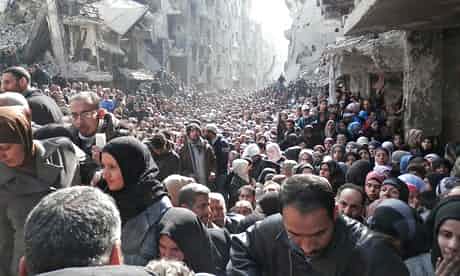
Residents-wait-to-receive-012 Yarmouk

The famous photo from February 2014 showing the residents of Yarmouk under siege, flowing out like a river of humanity to get aid.

But while I was inside Syria last week the campaign against them started, following on directly from the ‘liberation’, that is, total displacement of residents from Douma, the Ghouta’s most rebellious area. I stepped into the courtyard of my house and almost immediately the sound began of fighter jets – Russian ones by most accounts – flying in broad daylight across the centre of Damascus and almost casually dropping their cluster bombs on Hajar Aswad.

IMG_20180419_162327

Smoke from cluster bombs exploding over Hajar Aswad, southern suburbs of Damascus

It took me a while to see them, they were flying so much higher than I expected, but as my eye grew accustomed to them, I traced their course from the Mezzeh military airport, over the Presidential Palace, and in a loop over the southern suburbs and back again. It was utterly surreal. Yet this is the new normal inside Syria. A government dropping bombs on its own people, in its own capital, and everyone helpless to do anything about it. It is impossible not to think about the people being killed and maimed beneath those bombs. Even if they survive, thousands are sleeping in the streets, their homes destroyed. There is no longer any running water and the last hospital has been targeted and destroyed. The bombing continued all that Thursday 19 April and has been going on relentlessly for a week.

‘Trapped’ was the word I heard again and again, as people are forced to listen to the constant soundtrack of destruction. They feel totally helpless in the face of Assad’s overwhelming grip, backed by the might of Russian air power and military planning.

Yarmouk was one of the earliest refugee camps in Syria, formed after 1948 when the first waves of Palestinians were displaced from the newly created state of Israel.  It was home to 160,000 Palestinian refugees and over 100,00 Syrians. Now the survivors are being bussed to Idlib, where the final showdown awaits in this barbaric war.

IMG_20180419_162428 (1)

The Orwellian outline of the Presidential Palace lowering over the city of Damascus

Related articles:

https://www.telegraph.co.uk/news/2018/04/26/palestinian-refugee-camp-syria-turns-unimaginably-brutal-assad/

https://www.theguardian.com/world/2018/apr/26/10m-syrians-at-risk-of-forfeiting-homes-under-new-property-law

https://www.theguardian.com/commentisfree/2014/feb/28/shocking-image-syria-brutal-war-yarmouk

Assad bombs the Ghouta, but ignores ISIS in Damascus – why?

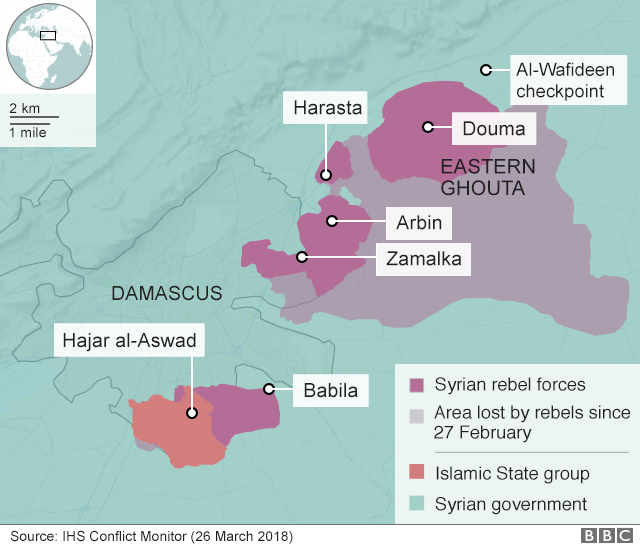
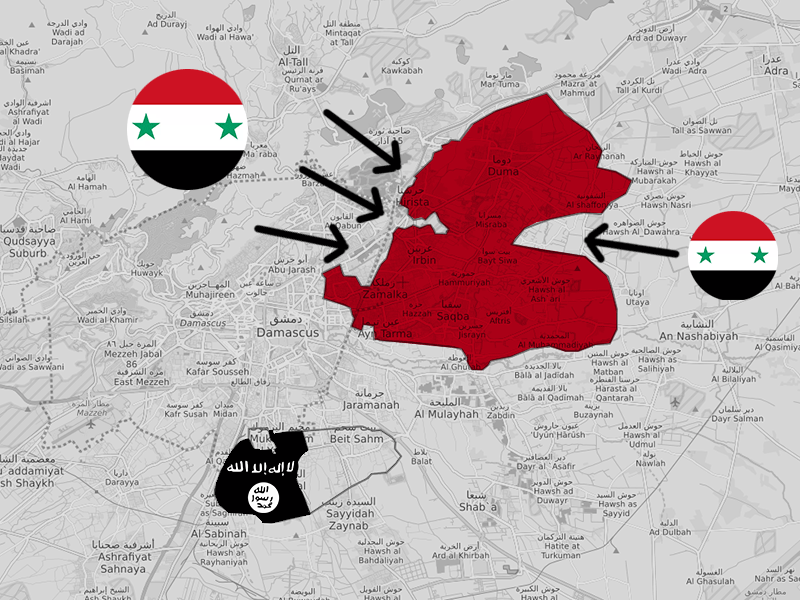
Damascus suburbs who controls what 28 March 2018

There is a mystery in this map of Damascus that requires explanation. It shows clearly the Eastern Ghouta rebel suburb where all the current focus in the media is concentrated. But just as clear is the area of Hajar al-Aswad in Damascus’s southern suburbs, marked as under the control of the Islamic State group (ISIS). So why are the ISIS rebels in Hajar al-Aswad allowed to stay, while the rebels in the Ghouta are forced out?

Al-Ghouta means ‘the basin’ in Arabic, the fertile area of land fed by the River Barada which supplied Damascus with its agricultural produce like milk, cheese and yogurt, chicken, eggs, fruit and nuts. Historically it is one of the locations claimed as the Garden of Eden. Since mid-February 2018 it has become instead Hell on Earth.

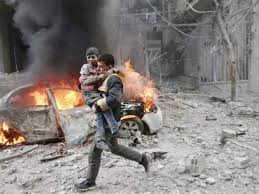
Ghouta bombing March 2018

Today the final pocket of Douma, largest town in the Ghouta, awaits what many expect will be the final massive bombardment that will force its inevitable surrender to the Syrian regime. Other parts of the Ghouta – Harasta, Arbin and Zamalka – have all surrendered, worn down by years of siege, rounded off by the recent burst of apocalyptic Russian bombing. Douma, headquarters of the rebel group Jaysh Al-Islam, has been a thorn in Assad’s side since 2012, yet was considered moderate enough by the international community to participate in the Geneva peace talks, even heading the opposition delegation.

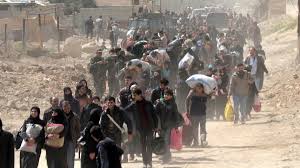
Ghouta evacuation March 2018

So why has Assad allowed ISIS to sit on his doorstep unmolested for years, despite them being closer to the presidential palace than rebels in the Ghouta and despite ISIS being unquestionably far more extreme in its ideology than any of the Ghouta rebels? The answer is that it suits him to do so, because they fight each other, not him, and over the last five years the ISIS fighters have weakened and depleted the FSA groups in Babila, Yalda and Beit Sahem. Neither Al-Nusra nor ISIS are present in the Ghouta, yet the Russians and the Syrian regime have continued to bombard the area with impunity, in violation both of their own agreed ‘de-escalation zones’ and of the UN ceasefire resolution unanimously passed in February 2018.

ISIS in Yarmouk and Hajar al-Aswad Damascus

The Assad regime has shown itself to be calculated and astute in its strategic management of the war. Early on in the uprising that erupted  in March 2011 the regime branded everyone who protested against them as a ‘terrorist’, and labelled the uprising a ‘foreign conspiracy’. Through its violent crushing of the early peaceful protests, along with wholesale and widely documented rape of women from the rebel neighbourhoods, often in their own homes in front of their male family members, it systematically goaded the local populations to take up arms. Whilst people passing through checkpoints were carefully scrutinised, lorry-loads of weaponry were allowed easily through – the regime wanted demonstrators to weaponize and become fighters. Then it could call them all ‘terrorists’ and kill them indiscriminately.

The leader of Jaysh al-Islam, Zahran Alloush, was killed on Christmas Day 2015 by a targeted airstrike with the help of Russian intelligence, less than three months after Russia entered the Syrian war arena to help its ailing ally Bashar al-Assad stay in power. Zahran’s brother, Muhammad, was sent in his place to represent the group in UN-brokered peace talks in Geneva, but the talks stalled like all the others, and he resigned soon after in May 2016.

Every time the Ghouta enclaves have been subjected to heavy regime bombardment, the rebels have retaliated with sporadic mortar fire sent into the heart of Damascus. Innocent residents of the city have been killed this way, it is true, just as in the western regime-held side of Aleppo when the east Aleppo rebels fired retaliatory mortars. But mortar shells can hardly be said to equate to the massive aerial bombardment inflicted by the Syrian regime and the Russians, whose response has by any measure been totally disproportionate. No matter, the text is in place and the Assad regime has succeeded in provoking the violent reaction from the rebels which it has been seeking all along. Now it is on familiar territory – violence is its default setting for problem-solving, as it showed in Hama in 1982.

The biggest threat to the Assad regime, as both Assad and Putin well know, has never come from ISIS rebels, many of whom are foreign and have little to do with the Syrian people. It has come from the more moderate opposition rebels, most of whom are Syrian and who have long wanted his overthrow. That is why Assad forces have rarely fought ISIS, and why he leaves them sitting on his doorstep – for now. They fit his narrative perfectly, that he is fighting ‘terrorists’.

Syria-ISIS Damascus map

Related articles:

http://www.bbc.co.uk/news/world-middle-east-43127189

http://www.bbc.co.uk/news/world-middle-east-32356307

https://rfsmediaoffice.com/en/2017/10/13/entire-family-rubble-hajar-al-aswad-damascus/

ISIS ADVANCES IN SOUTHERN DAMASCUS, CAPTURES MORE POSITIONS INSIDE YARMOUK CAMP

https://www.newsdeeply.com/syria/articles/2018/02/06/how-de-escalation-zones-in-syria-became-a-war-management-strategy

https://www.theguardian.com/world/2015/dec/25/zahran-alloush-leader-syria-rebel-group-killed-airstrike

https://www.albawaba.com/news/assad-leveling-eastern-ghouta-leaving-isis-unchecked-

inside-damascus-1097302

http://syriadirect.org/news/%E2%80%98ghouta-is-a-glimpse-into-the-future-of-south-damascus%E2%80%99-says-rebel-negotiator/

Syria’s Cultural Life

OLYMPUS DIGITAL CAMERAWhen a country has been at war for over five years, it might seem natural to assume that all cultural life is suspended. In the case of Syria, this is far from true. But just as with the war itself, there are many levels and layers to be unravelled, and the definitions of “culture” vary according to who, and where, you are.
In the areas firmly under the control of the Syrian government, the Assad regime has, from the start, kept to a “business as usual” narrative. In September 2016 Damascus boasted several “cultural” events on its SANA (Syrian state media) website under the title of “Arts and Culture”, including the“St Ephrem the Syrian Patriarchal Choir”, staging a performance at Al-Thawra Sports stadium (al-thawra means “revolution” in Arabic – not the current revolution of course but the Ba’athist revolution of 1963 which ultimately brought Hafez al-Assad to power). Christian events like this are always high on the agenda since the Syrian government is keen to project itself as the “protector of the minorities”, who then give their loyalty in return.  There was also the twenty-eighth Book Fair at Al-Assad National Library – “beyond disappointing” was the comment of one hopeful Syrian who visited but who wishes to remain anonymous, “we cannot fool ourselves”.

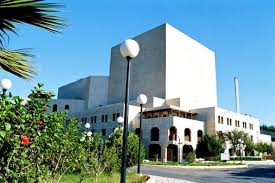
Dar al-Assad (the Damascus opera house) still holds concerts, music festivals, cinema screenings and poetry readings in its three halls, the largest of which seats 1,200 people. In April 2014 it was struck by a mortar and closed briefly. Fewer than half of its employees and musicians remain, the other half having either fled or been conscripted. Prices have been slashed to increase audience size. Many Syrians might question whether “culture” is the right word for such contrived and unreal occasions, when “propaganda” might be closer to the truth, but many would also acknowledge the strong public desire to keep the wheel of life turning.

dar-al-assad

Beyond Damascus, other festivals have also been held across the summer in the government-held areas on the Mediterranean coast, such as Tartous and Safita, while at the village of Ma’aloula in the Qalamoun Mountains, north of the capital, a widely publicized song festival was held in Aramaic to preserve the language of Christ – another example of the government showcasing support for minorities.

Even in Aleppo, divided between the regime-held west and rebel-held east, the population remains highly receptive to cultural events. In fact the need for them is arguably greater than in Damascus as people seek respite from the horrors of daily life. Abdul Halim Hariri, a sixty-year-old violinist, feels it is more important than ever to run theatre performances and festivals for filmmakers in defiance of the political situation. “We have turned our anger and sorrow into a source of music”, he says, echoing the widely held sentiment that war can drive creativity, as people struggle to prove they are still human despite the inhumanity that surrounds them. Abdul Halim holds his concerts “for young people who are lost. I also wanted to show through art that Aleppo is still united and that its thought is still progressive and civilised . . . as soon as the war is over, Aleppo will be reunited. Aleppo citizens don’t hate each other. Their life is love and intertwined”. Audiences for his concerts, a mix of classical and traditional pieces, have been huge, with hundreds gathering inside the theatre and hundreds outside, even as mortars fall, and despite the fact that many musicians, including Abdul Halim’s own son, have now left.

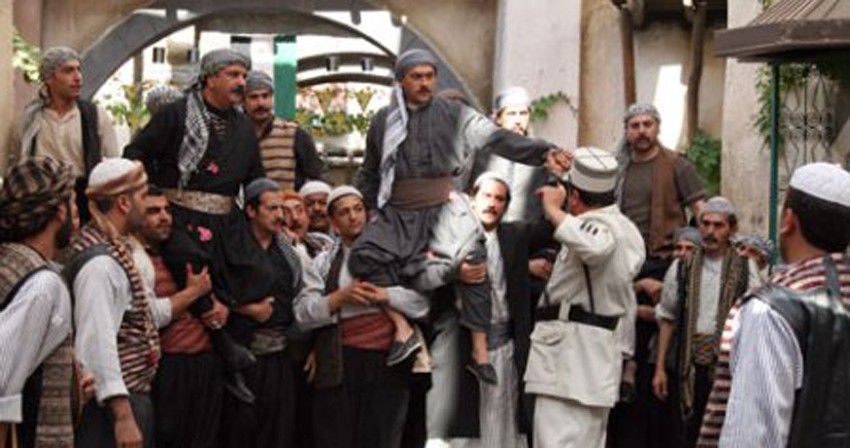
During the holy month of Ramadan, soap operas, musalsalat, grip audiences in all Arab countries, and Syrian soaps are generally the most popular – one of the country’s most prized exports, especially to the Gulf. In 2010 no fewer than forty soaps were made by Syrian television production companies, but the number has now dropped to less than half that because so many actors and producers have left the country. One of the most popular, Bab al-Hara, depicts life in a Damascus quarter of the Old City under the French Mandate of the 1920s and 1930s. Rife with political digs and overtones, it has just completed its eighth season, but Syrians outside the country, such as the actress Sawsan Arsheed, the actor and theatrical director Maher Sleibi, and the director Abdulrahman Dandashi, say the regime is increasingly using such soaps to promote its own version of the crisis, to distort the image of the moderate opposition, portraying them all as armed terrorists and radical Islamists.

bab-al-hara-6

In rebel-held parts of the country, the lack of infrastructure makes life very difficult, with limited electricity, water, cooking gas or fuel. Yet even there, in areas like the Idlib countryside, culture is flourishing. Though they do not have the financial means needed to produce competing TV dramas, local people have started their own radio channels such as Radio Fresh (recently closed down by extremists for employing a woman), and internet channels such as SouriaLi (a clever play on words meaning both “Syria is mine” and “surreally”).

In the Damascus suburb of Darayya, subjected to a “starve or surrender” siege for over four years and now forcibly evacuated since its fall in August, the local residents established a secret library deep underground with over 14,000 books, including poetry, plays and novels in Arabic, French and English. It was hugely popular with children out of school reading to their mothers, doctors and dentists looking for academic or technical handbooks, and even Free Syrian Army soldiers taking a supply to the frontline with them. Particular favourites were books about earlier rebellions, such as those by the Syrian author Al-Tantawi. “We read about how in the past everyone turned their backs on a particular nation, yet they still made it”, says Omar Abu Anas, a former engineering student. “So we can be like that too. Books motivate us to keep us going. They help us plan for life once Assad is gone. We want to be a free nation. And hopefully, by reading, we can achieve that.”

secret-library-darayya-summer-2016

Many of the library users were students whose studies had been interrupted. “In a sense,” says Adbulbaset al-Ahmar, a former student in his mid-twenties who discovered Shakespeare and especially Hamletthanks to the books in it, “the library gave me back my life. It’s helped me to meet others more mature than me, people who I can discuss issues with and learn things from. I would say that just like the body needs food, the soul needs books. I believe the brain is like a muscle. And reading has definitely made mine stronger. My enlightened brain has now fed my soul too.”

The fate of this secret library is currently unknown.

Syria’s soul is being erased – Britain’s role

The world thought it could ignore the Syrian crisis with impunity. Let them kill each other; it’s so far away and nothing to do with us. Bruised by failures in Iraq and Afghanistan, the West had no appetite for involvement. But four years of indecision disguised as “noble non-intervention” has been a decision with deadly consequences, as Syrian refugees quite literally wash up on Europe’s shores. After remaining unmoved by thousands of images of carnage and devastation caused by President Assad’s barrel bombs, one image has changed perceptions overnight.

Aylan Kurdi drowned on beach Sept 2015

Syria is the cradle of civilisation, where the cross-fertilization of cultures and ideas resulted in a highly creative and innovative people. It is no accident that the first phonetic alphabet was invented here, the first musical notation, the first hymns, the first female choirs and even female orchestras. This blend and fusion of cultural influences is part of the Syrian identity, an identity that has been traditionally open, tolerant and welcoming.

Palmyra, the desert oasis city on the Silk Road linking the Mediterranean to the Euphrates River, Mesopotamia and beyond, represented this fusion of cultures through the blended Roman Oriental style of its architecture, its statues, its temples and its funerary monuments. Open to trade and the worship of many gods of the region, it too was part of the Syrian identity.

OLYMPUS DIGITAL CAMERAOLYMPUS DIGITAL CAMERA

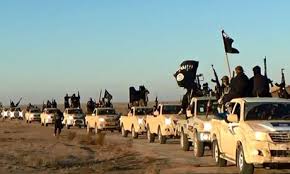
This is the identity which ISIS is intent on destroying. Masquerading as true Muslims, they are blowing up anything they can claim is idolatrous, anything with human or animal forms, while in practice Islam has always coexisted with earlier cultures – except in Wahhabi Saudi Arabia of course, which has also destroyed all manifestations of earlier religions.

Palmyra Baal Shamin destruction

But ISIS is only part of the jigsaw. Syria’s cultural heritage is also being destroyed by the Assad regime’s relentless aerial bombardment and barrel bombing of opposition-held areas like Aleppo, along with residential areas, schools, hospitals and ordinary citizens. All are inextricably linked, all are part of Syria’s identity and this rich, multicoloured fabric of Syrian society is being shredded systematically, day after day with no end in sight and no one coming to help.

Syrian fighter jetbarrel bombing syria

The result is the wave of Syrian refugees  in ever greater numbers fleeing to Europe, their only option since the wealthy Gulf Arab countries have closed their doors, and their official asylum applications are repeatedly turned down. Today I heard Raida, a former resident of my Damascus house, speaking to the BBC from Beirut about her six failed applications to Saudi Arabia, her failed applications to Canada, Austria, France and the UK. Her dignity shone through when she ended by saying she would never resort to people smugglers, neither would she give up her struggle for a better life.

My Damascus House (photo credit copyright Fiona Dunlop)

My Damascus House (photo credit copyright Fiona Dunlop)

The dignity also shines through in the Syrian refugees interviewed on the road as they walk through Hungary to Germany. They are well-behaved and respectful of each other, in spite of their ordeals. They have not lost their humanity. Neither has Angela Merkel, with her vision and leadership, making me proud to be half-German.

Germany Merkel poster mimicking Bashar's August 2015

Of my British half however, I am ashamed. The British government has shown no vision or leadership, feebly waiting for an American strategy on Syria that never came, then taking a cowardly vote (thanks to Ed Milliband) in the House of Commons against military intervention in Syria after the supposed “red line” of the August 2013 chemical weapons attack. The Department for International Development’s much vaunted overseas aid projects are about as effective as a sticking plaster for a man whose guts have been blown out.

For the last four years Syria has been left like an open wound, untreated, slowly bleeding to death. Had Syrian pleas for a safe haven to be established on the Turkish border in summer 2011 been heeded, hundreds of thousands of refugees now fleeing the country could have stayed inside Syria; their destabilising pressure on the infrastructures of Lebanon, Jordan and Turkey would have been avoided; the Assad regime’s handling of the uprising would have been challenged early on; the germ of ISIS would not have been left to multiply exponentially in Raqqa since April 2013 and to grow into the Frankenstein monster it is today, hijacking Syria’s revolution, overrunning Iraq and distorting perceptions of Islam.

isis on move

Syria’s soul is being systematically erased. Only intervention can stop it. It will be infinitely more difficult to establish a safe haven now, four years too late, but it still has to be the first step, to stem the exodus of refugees. For those already on the road, Britain needs to adopt the German approach – take thousands according to each region’s wealth and population spread evenly and equally across the country. If Germany can take in 1% of its population, so can we. The only alternative is to stop Syria’s war, something for which there is, it seems, neither the strategy nor the political will so far.

Related posts:

Syria is not Iraq: 10 key differences https://dianadarke.com/2013/09/01/syria-is-not-iraq-10-key-differences/

A Syrian in Saarbrucken https://dianadarke.com/2015/08/17/a-syrian-in-saarbrucken/

The Prophet Muhammad in Islamic Art https://dianadarke.com/2015/02/15/the-prophet-muhammad-in-islamic-art/

How ISIS misuses early Islamic history to justify its actions https://dianadarke.com/2014/08/23/how-isis-uses-early-islamic-history-to-justify-its-actions/


A Syrian in Saarbrucken

“Politics is all about interests, everyone knows this of course,” said Muhammad, his earnest brown eyes looking directly into mine. “But none of us imagined it would end like this.”

In those intelligent philosophical eyes I could see echoes of Ramzi Read more…

The “Iranification” of Syria

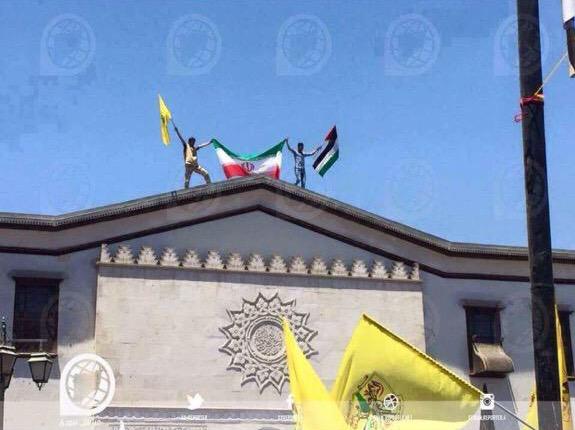
Iranification of Syria Iranification of Umayyad Mosque

The pictures say it all. Iranian and Shia militia flags are now paraded in the spiritual heart of Damascus, the magnificent Umayyad Mosque, using the legend that the head of Hussein, martyred at Kerbala in 680AD, was buried here beneath a shrine in the eastern precincts.

Iran’s involvement in Syria used to be discreet but these days it is blatant. The ‘Iranification’ of Syria is gathering pace, almost as if it is a race to seize as much as possible before its puppet Assad regime collapses. Iran may be prepared to sacrifice chief puppeteer President Bashar al-Assad and his corrupt elite, but under no circumstances is it prepared to surrender its vast economic investment in Syria, or more precisely, in regime-controlled Damascus and the “Shia crescent” that links to the coast via Hizbullah heartlands in Lebanon.

The most recent manifestation of this open determination to control Syria’s capital is the forced confiscation of hundreds of acres of land around the Iranian Embassy in the western suburb of Mezzeh.

iranification of mezzeh

Dubbed “Iranian Towers”, the scheme is tantamount to changing the demographic of this entire neighbourhood of Damascus. Residents displaced by the eviction order, mainly Sunni families on low incomes, are reported not to have been offered compensation. Evidently the opinions of such people will count for nothing in the Syria of the future which Iran is seeking to engineer.

On my recent visit to Damascus to retake my house from war profiteers, Iranian influence was already evident behind the scenes. Friends and neighbours in the Old City told me that the CCTV cameras along Al-Amin Street, a Shia quarter, had been installed by Iran, and the only building projects underway were all known to be Iranian-funded. Wealthy Iranians are also distorting the property market by buying up prestige homes in the affluent areas including the Old City, especially near Shia shrines like Sayyida Rouqqaya. Among ordinary Damascene residents the strong perception is that Iran is increasingly pulling the strings behind the facade of the Assad regime: as the regime weakens, Iran is taking advantage.

Masquerading as religious affinity between Shia Iran and Alawi-ruled Syria, this relationship has never been anything other than a marriage of convenience. It began when Syria supported Iran in the Iran-Iraq War back in 1980 to spite Saddam Hussein. But these days the partnership has become so unequal it is more like a master/slave relationship, one of total dependence.

Since the 2011 Syrian uprising the Iranian government has been maintaining the Assad regime in power by supplying riot control equipment, intelligence monitoring techniques, snipers and oil to sustain its war activities. Using experience honed during its own 2009 Green Revolution, Iran developed  the world’s most sophisticated “cyber-army” technology in the world after China. Assad’s shabiha paramilitary forces were trained by Iranian militia, and General Qasim Sulaimani (commander of the Iranian clandestine Quds Force) personally masterminded Syrian military strategy and oversaw the creation of the volunteer reserve “National Defence Forces” (NDF) modelled on the Iranian basij paramilitary force.

Qasim Sulaimani

In early June this year General Sulaimani deployed thousands of extra Iranian, Afghan and other foreign fighters round Damascus to protect the city after ISIS victories in Palmyra and Deir ez-Zour left it vulnerable. Reports of the numbers range between 7,000 and 15,000. Iranian President Hassan Rouhani has publicly announced Iran will support the Damascus regime “till the end of the road”, not for ideological reasons, but because he knows that the current weakness and dependence of the Syrian regime means that Iran can secure political and strategic goals that had previously been out of reach.

With the announcement of the new nuclear deal and its accompanying sanctions relief, Iranian investment and wealth is set to soar. Iran has been described as the ‘world’s largest untapped market’ by British business guru Martin Sorrell and it boasts the world’s third largest oil reserves. Already major oil companies have visited Tehran to discuss the future of Iran’s oil industry.

Will Iran divert large amounts of this new wealth to fund its military activities in Syria, to protect its investment? Almost certainly, which makes it more and more likely that Iran will be enlisted by the P5+1 (the US, UK, France, Russia, China plus Germany) to fight ISIS, a common enemy to them all, inside Syria and to jettison Assad, but leaving Iran’s investment in Syria intact. It is almost certainly part of the deal. In this latest twist of the game, the Syrian people are again helpless pawns on the chessboard, with the big international players moving their pieces around to fit their own economic and political interests as ever.

Related articles: 

http://www.alaan.tv/news/world-news/133872/starting-iranian-project-demographic-change-damascus-syria

http://syrianobserver.com/EN/News/29389/Resentment_Soars_Shiite_Militias_Flood_Damascus/

https://www.alsouria.net/content/%D8%B5%D8%AD%D9%8A%D9%81%D8%A9-%D9%85%D8%B4%D8%B1%D9%88%D8%B9-%D8%A5%D9%8A%D8%B1%D8%A7%D9%86%D9%8A-%D9%81%D9%8A-%D8%AF%D9%85%D8%B4%D9%82-%D9%8A%D9%87%D8%AF%D8%AF-%D8%A8%D9%87%D8%AF%D9%85-%D9%85%D9%86%D8%A7%D8%B2%D9%84-%D9%85%D9%84%D9%8A%D9%88%D9%86-%D9%85%D9%88%D8%A7%D8%B7%D9%86

http://www.haaretz.com/opinion/.premium-1.664456

https://now.mmedia.me/lb/en/NewsReports/565473-damascus-residents-displaced-for-iran-project-report-says

http://www.alaraby.co.uk/english/news/2015/6/24/syrias-economy-lies-in-tatters-says-uk-report

http://www.alaraby.co.uk/english/news/2015/6/25/iranian-oil-fuels-syrian-regimes-war-machine

http://www.alaraby.co.uk/english/comment/2015/6/16/body-bags-from-syria-and-irans-state-of-denial

http://www.irishtimes.com/news/world/middle-east/iranian-fighters-go-to-syria-to-help-defend-damascus-1.2240812


ISIS Road to Damascus starts at Palmyra

OLYMPUS DIGITAL CAMERA

ISIS has confounded its critics. Instead of dynamiting the priceless temples and colonnades of Palmyra, Syria’s most visited UNESCO World Heritage site, it has blown up the cells and torture chambers of nearby Tadmur prison, Syria’s most powerful symbol of Assad regime brutality. Palmyra’s prison, synonymous with suffering in the minds of Syrians, represents perhaps more than any single building in Syria, the 40-year Assad stranglehold on its people.

Tadmur prison

This carefully staged PR coup will have gained it many friends, even from among those who would have thought themselves anti-ISIS. It is like a loud fanfare announcing: Beware, Bashar, your days are numbered and we are on our way to get you.

Think of the wealth that ISIS now has at its disposal through its capture of Palmyra. With the prize of the ancient city came other prizes: the oilfields to the north and the military hardware captured from the regime’s nearby airbase, T4, thought to include 21 tanks, 12,000 machine guns and 40 ammunition stores. Then came capture of the last regime-held border crossing into Iraq, at al-Tanf due east of Damascus with its own road linking into the Palmyra highway to the capital. And don’t forget the sheep. The Sunni tribes of this Syrian semi-desert steppeland, known as Badiat ash-Sham, still number around one million, and are mainly nomadic Bedouin from the Rwala, Beni Sakhr and Beni Khaled tribes. Syria was one of the first lands to be inhabited by the Bedouin outside the Arabian Peninsula and today these Bedouin still rear most of Syria’s sheep, considered the tastiest in the Middle East. Every year 10 million of them are exported to Saudi Arabia, earning high yields.

badia sheep bedouin

Four centuries before the advent of Islam the historic oasis city of Palmyra grew wealthy from the taxes it levied on goods transiting the Silk Road via camel caravans. The highest taxes, according to the famous bilingual Greek/Aramaic ‘Palmyra Tariff’ stone, were due on perfumes, dried fish, olive oil, water and prostitutes. Now ISIS has captured today’s equivalent wealth for itself – oil, military equipment, sheep plus potential extra manpower from the local Sunni tribes. In addition it will no doubt harvest the archaeological site for artefacts, levying its usual 20% tax on anything dug up from the outlying areas.

Armed with all Palmyra’s many forms of wealth, ISIS sees the open road to Damascus, to the exposed heart of the Assad regime.

isis on move

There are few settlements en route, just two more airbases where even more military hardware can be harvested. Inside Syria ISIS has seen that the international community is impotent, with no unified strategic policy, while Assad’s army is in retreat.

The world’s media pours out articles eulogising the ruins, while ISIS thrives like a germ in the perfect environment on the chaos deep inside Syria. May the world’s attention remain focussed on Palmyra long enough to understand that until Syria’s chaos is solved, ISIS will multiply exponentially and grow beyond anyone’s ability to stop it. Damascus is in their sights and Palmyra has been their launchpad.

Related posts:

Palmyra’s Double Life

Palmyra’s legacy to ISIS


Post Navigation