dianadarke

Syria and Turkey commentary

Archive for the category “Islamic art”

Spiritual Material: William Morris and Art from the Islamic World

Anyone familiar with Islamic art will long have known how heavily William Morris drew his inspiration from the Islamic world. One glance at his patterns is enough  – the repetition to infinity, the twisting foliage, the richly entangled fruit and birdlife, the stylised designs that are often botanically impossible yet speak to us at some deep primordial level – all are hallmarks of Islamic art. Curiously, ever since his patterns were popularised, appearing in every imaginable accessory in our kitchens and living rooms, from curtains to coasters, from tablecloths to mousemats, those same iconic Morris designs have been subsumed as ‘quintessentially English’,  somehow deemed to be an intrinsic part of our British cultural identity. It is the same blind spot that exists with Gothic cathedrals like Notre-Dame, proclaimed to be ‘quintessentially French’, synonymous with the French national identity, by those oblivious to the Islamic origins of such rich architectural styles and ornamentation.

Until, that is, it is pointed out in exhibitions like ‘William Morris and Art From the Islamic World’, still running till 9 March 2025, where the eye can become trained. All credit is due to the William Morris Gallery, the fine Georgian family home in Walthamstow where Morris grew up, for staging this exhibition, and for highlighting to a British audience what has been hiding in plain sight all along. The gallery’s guiding mission has been to bring the communities of Walthamstow, where one in five of the population is Muslim, closer together, an outreach project to show how different cultures have intertwined and inspired creativity since time immemorial. Maybe a future exhibition at the V&A could do the same for Islamic architecture and European medieval styles like Romanesque and Gothic?

The starting point of the exhibition is a smallish room which brings together items from the Islamic world all of which, crucially, once belonged to Morris and his family. Though Morris himself never travelled further east than Italy, he acquired a range of carpets, textiles, metalwork and ceramics mainly from Iran, Syria and Turkey, which clearly served as his prototypes, using them to decorate his homes. This geographic range is very important to the curators’ careful and deliberate choice of phrasing in the title ‘Art from the Islamic world’, a much more accurate description than was common in Victorian times when all Islamic art was labelled ‘Persian’, considered the ultimate in Orientalist chic. Even today, museums like the Jackfield Tile Museum in the Ironbridge Gorge perpetuate such misnomers in their labelling, describing English tiles that are clearly copying Ottoman Turkish tile designs as ‘Iranian-influenced’.
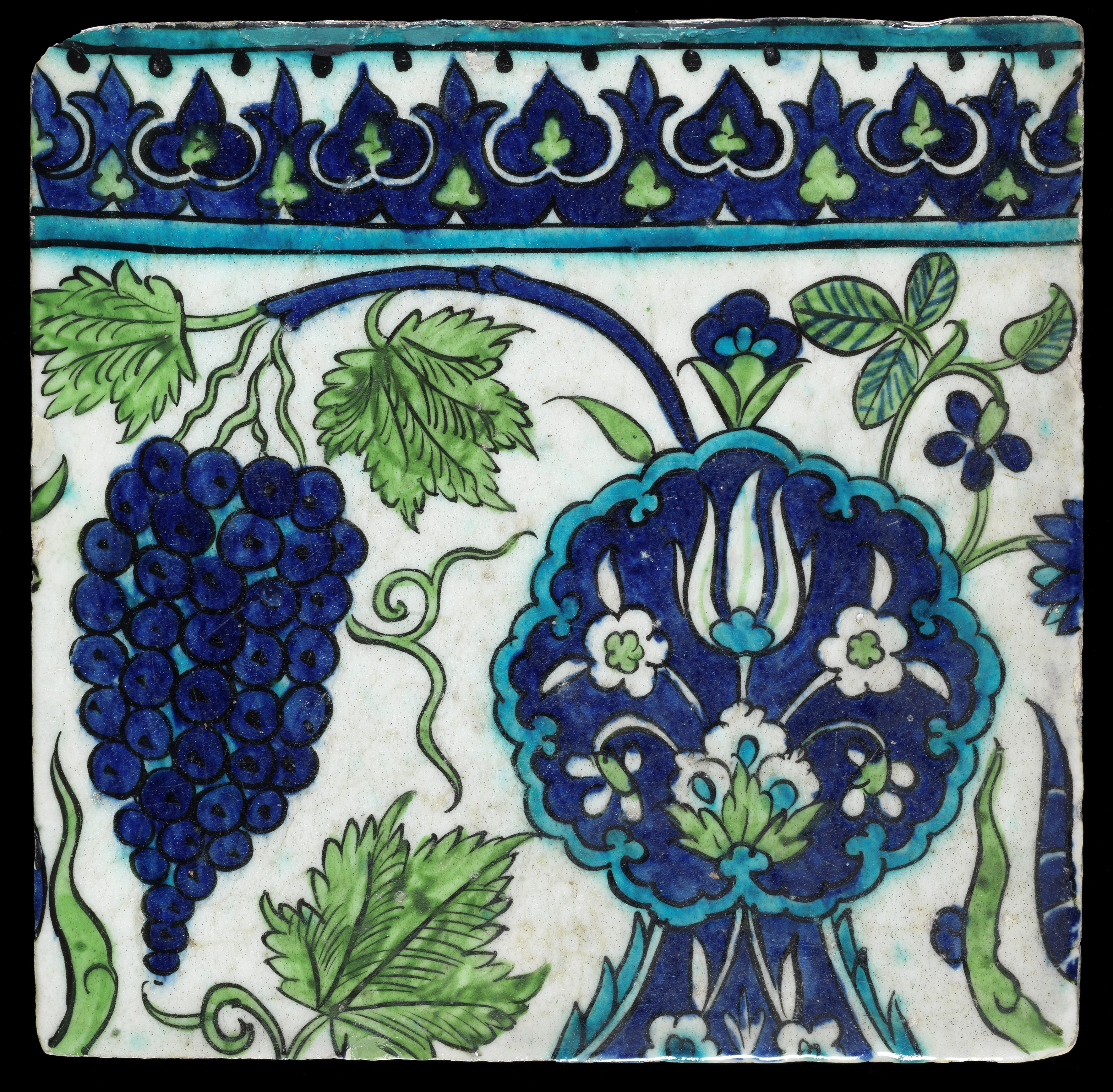
Fritware/Stonepaste Tile. Unknown. Fritware, mould made, painted in blue, green, turquoise and black under a colourless glaze, height 26.6 cm, width 27 cm, depth 2.8 cm, weight 2627 g, circa 1574-1599. Ottoman Period. Syria, Damascus. Forms part of a panel comprising twenty three tiles, C.4-1928. This tile probably formed the edge of the original panel.

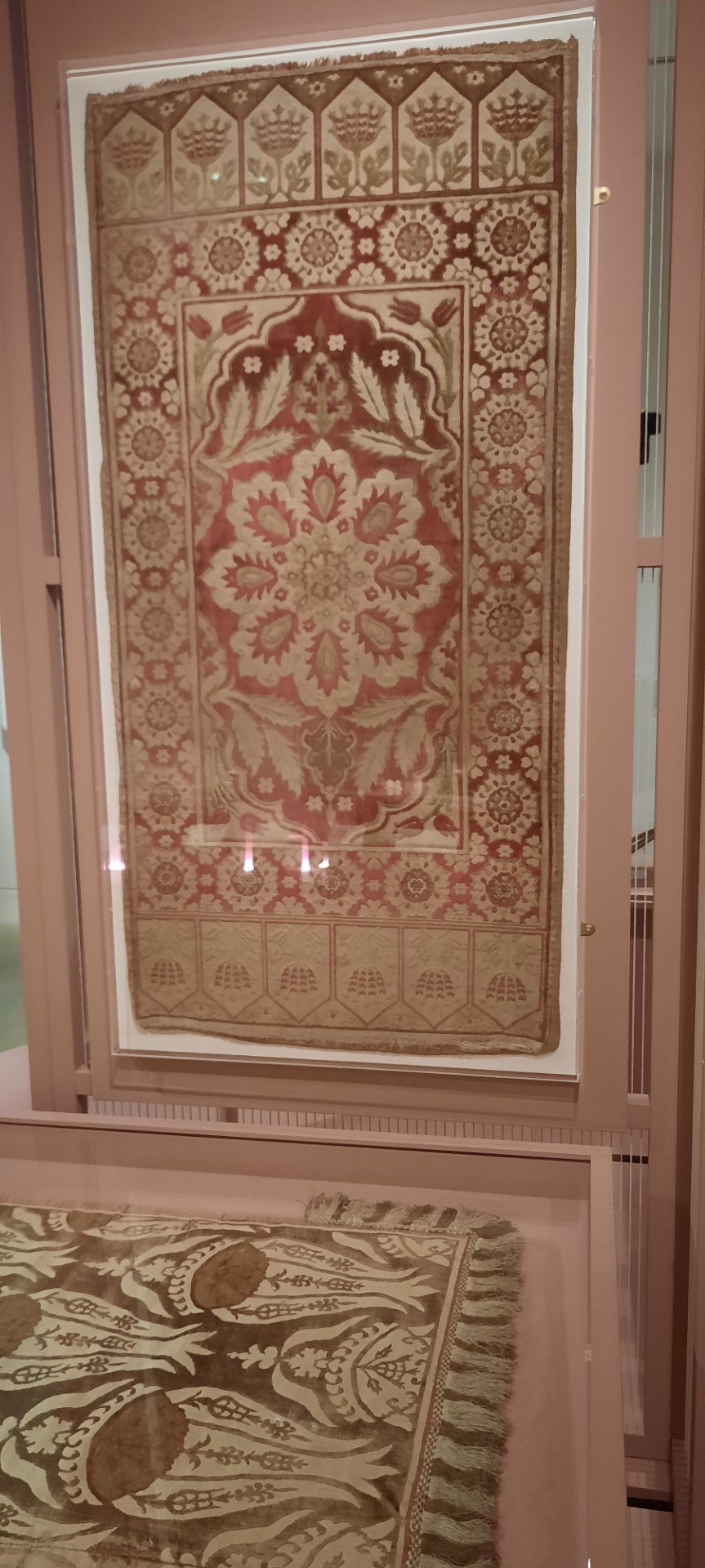
When Morris, who often railed against the privileged society into which he was born, first launched his business  in 1861, opening an interior design shop in Oxford Street, he was trying to bring his styles to the middle classes, well aware that most of his commissions were for wealthy clients with more money than aesthetic sense. ‘I spend my life ministering to the swinish luxury of the rich,’ he lamented. Some mocked his hand-made approach to design and craftsmanship as ‘thoroughly medieval’ and ‘useless’.  At the time, his style of artist-led designs, using quality materials and hand-craftmanship was pushing against the tide of the Industrial Revolution. ‘I have never been in any rich man’s house,’ he declared, ‘which would not have been the better for having a bonfire made of nine-tenths of all that it held.’ It was part of his ‘Crusade against the age’, and in the end his persistence prevailed, for by the turn of the century, Morris & Co had become a by-word for good taste. He sold to important clients in Europe, America, Australia and Canada, exhibiting at international trade fairs in Paris, Boston and Philadelphia to raise the company’s profile. He learned to be a businessman, buying out his partners, and extending his product range to more affordable off-the-shelf items like wallpapers, fabrics and tiles. The Arts and Crafts movement, spearheaded by Morris, began in England and flourished in Europe and America between 1880 and 1920. On his death aged 62 in 1896 his coffin was draped in a magnificent 17th century Ottoman brocaded velvet from his own collection, made from silk and metal thread in Bursa, the first Ottoman capital.
Regret that his products were beyond the reach of the ordinary working class contributed to Morris’s growing political activism. Acutely conscious of his own privileged status in high society, he denounced the increasing industrialisation of the time, and became a socialist aged 50. He criticised the British government’s attempts to drag the country into a Russian-Turkish war in 1877, warning against ‘false patriotism’ and the dubious motives of the ruling classes who were led only by desire for profit.

Becoming a fervent environmentalist, he descried the despoliation of the landscape, and fought to stop pollution of the Thames and the destruction of Epping Forest. Although a nervous public speaker, his belief in his cause led him to give up to a hundred lectures a year, sometimes three a week, determined to make a difference. Driven by idealism, he wanted to imagine a world in which communities were equal, with no concept of private property, where craftsmanship and creativity could flourish. In 1877 he founded SPAB, the Society for the Protection of Ancient Buildings, and led the campaign to save the west front of St Mark’s in Venice. He was also outraged by the appalling restoration of St Albans, where the new pseudo-Gothic west front damaged much of the original fabric.  

In south London at Merton Abbey, the Gothic ruins of which he restored, along with its water mill (another innovation introduced to Europe from Syria via Islamic Spain) on the River Wandle, he recreated an environment of medieval craftsmanship and techniques.  He used natural dyes like indigo, disliking intensely the synthetic dyes of the times, even though it took him ten years of experimentation to achieve good results. So smitten was he with the beauty of Persian and Turkish carpets, hanging them on his walls or draping them over his tables as far too precious to walk on, that he decided to pioneer the production of hand-made rugs in Britain, recruiting experienced weavers from the declining Spitalfields silk industry, and using specially-built hand looms, hoping that eventually their skills would pass down to the next generation so that Britain might build its own hand-woven carpet tradition. One such example, called ‘Peacock and Bird’ is on display in the exhibition, so strikingly inferior in workmanship to the real thing that it serves as a clear marker that, even with the best will in the world, and the money, such traditions take centuries to accumulate and evolve.

All Islamic art ultimately seeks to recreate Paradise in the form of gardens and rivers, flowers and trees, where hierarchy is absent and where all live peacefully in mutual cooperation. The material and the spiritual world are connected through geometry, the unifying intermediary. This is precisely what Morris the idealist clearly felt drawn to in Islamic art, with its egalitarian traditions and deep respect for nature. As a child he had loved observing birds, flowers and plants in the Essex countryside. One of his most sophisticated patterns, which he named ‘Rivers’, after tributaries of the Thames, is based on meandering diagonal stems and natural growth, so that, as he put it, ‘even where a line ends, it should look as if it had plenty of capacity for more growth.’ This, together with his use of stylised birds and animals in pairs, to give underlying geometric structure to his patterns, are further borrowings from Islamic art. Other motifs he used, like flowers in vases, are also common in Islamic art.

Fritware/Stonepaste Tile Panel. Fritware, mould-made, painted in blue green and black under a clear glaze and framed in ebonised wood decorated with gilding, height, whole, 122 cm, width, whole, 92 cm, depth, whole, 8 cm, height, single tile, 26 cm, width, single tile, 27 cm, circa 1550-1650. Ottoman Period. Production Place: Damascus, Syria.

Granada, the most technically complicated textile Morris ever produced, so complex it never reached commercial production, was woven in 1884 at Merton Abbey. Featuring pomegranates and almond-shaped buds, connected by pointed arches and branches, the name tells us that his inspiration came from the patterns of the Alhambra Palace of the Nasrid kings. Though Morris himself never visited the Alhambra, he knew it through the lens of designer-architect Owen Jones (1809-74), who spent six months at the end of his Grand Tour, aged twenty-five, drawing detailed sketches of the stucco wall patterns of the palace, and acquiring a fascination with geometry, colour theory and the use of abstraction in decorative ornament. The result was his seminal work The Grammar of Ornament (1856), still used as a sourcebook in design schools internationally.

As the Gothic Revival got underway, the wealth generated from industry and trade, together with religious reform, resulted in a frenzy of churchbuilding, leading Morris to enter the market for church furnishings, like stained glass, embroidery, furniture and metalwork. Many of Morris’s contemporaries shared his interests and beliefs, like stained glass designer and tile-maker William de Morgan who also joined the Arts & Crafts movement. De Morgan moved his business to Merton Abbey, where he reproduced the fourteenth century ‘lustreware’ techniques of Muslim craftsmen, inspired by Islamic and medieval patterns. His tiles also decorate the walls of Leighton House in London’s Holland Park with its famous Arab Hall, a showcase of original sixteenth-century Damascus tiles procured on behalf of the painter Lord Frederic Leighton (1830-96).

A separate room in the exhibition is devoted to Morris’s daughter, May Morris, who travelled to the Islamic world after her father’s death. It displays the various items, especially textiles, she brought back and clearly valued highly, becoming a collector herself, as well as a donor.

A beautifully illustrated book, titled Tulips and Peacocks in a nod to the most prized flower of the Ottoman Turks, and the most loved bird of the Persians, has been published by Yale University Press specially for this exhibition, featuring a collection of ten essays by different specialists, including excellent contributions from the exhibition’s curators, Rowan Bain and Qaisra M. Khan, each exploring aspects of Morris’s connections to Islamic art. The front cover shows the distinctive 17th century Damascus tiles that Morris had acquired, in a pattern he called ‘Vine trellis’, purchased by Cambridge’s Fitzwilliam Museum after his death, and now reloaned by the Fitzwilliam for display at this exhibition. The book is on sale in the gallery’s shop, along with an impressive array of Morris-themed memorabilia for gifts or souvenirs.

Morris believed that through his work he could act as a bridge allowing craftspeople of the past to pass on their knowledge to contemporary artisans. The enduring popularity of his patterns suggests this may have been no idle dream, as people continue to respond to the same quasi-mystical, other-worldly qualities in his designs which echo those of Islamic art. Just below the surface, there is always the sense that something divine, something bigger than us mere mortals, unites us in our humanity. In this, perhaps, lies Morris’s universal appeal.  

[A version of this article first appeared in The Times Literary Supplement (The TLS) on 17 January 2025]
https://www.the-tls.co.uk/arts/visual-arts/william-morris-and-art-from-the-islamic-world-review-diana-darke

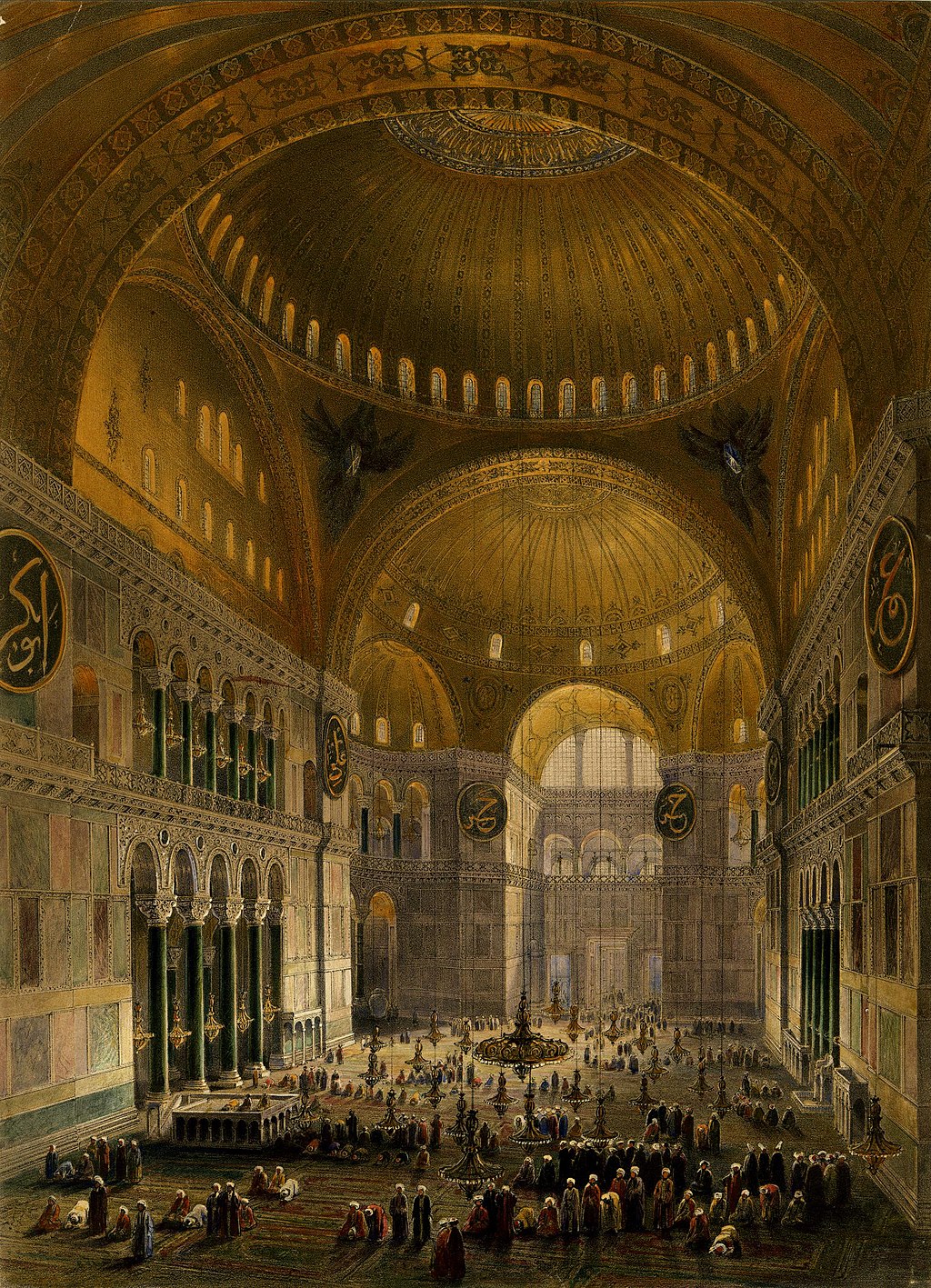
Hagia Sophia, not just a building…

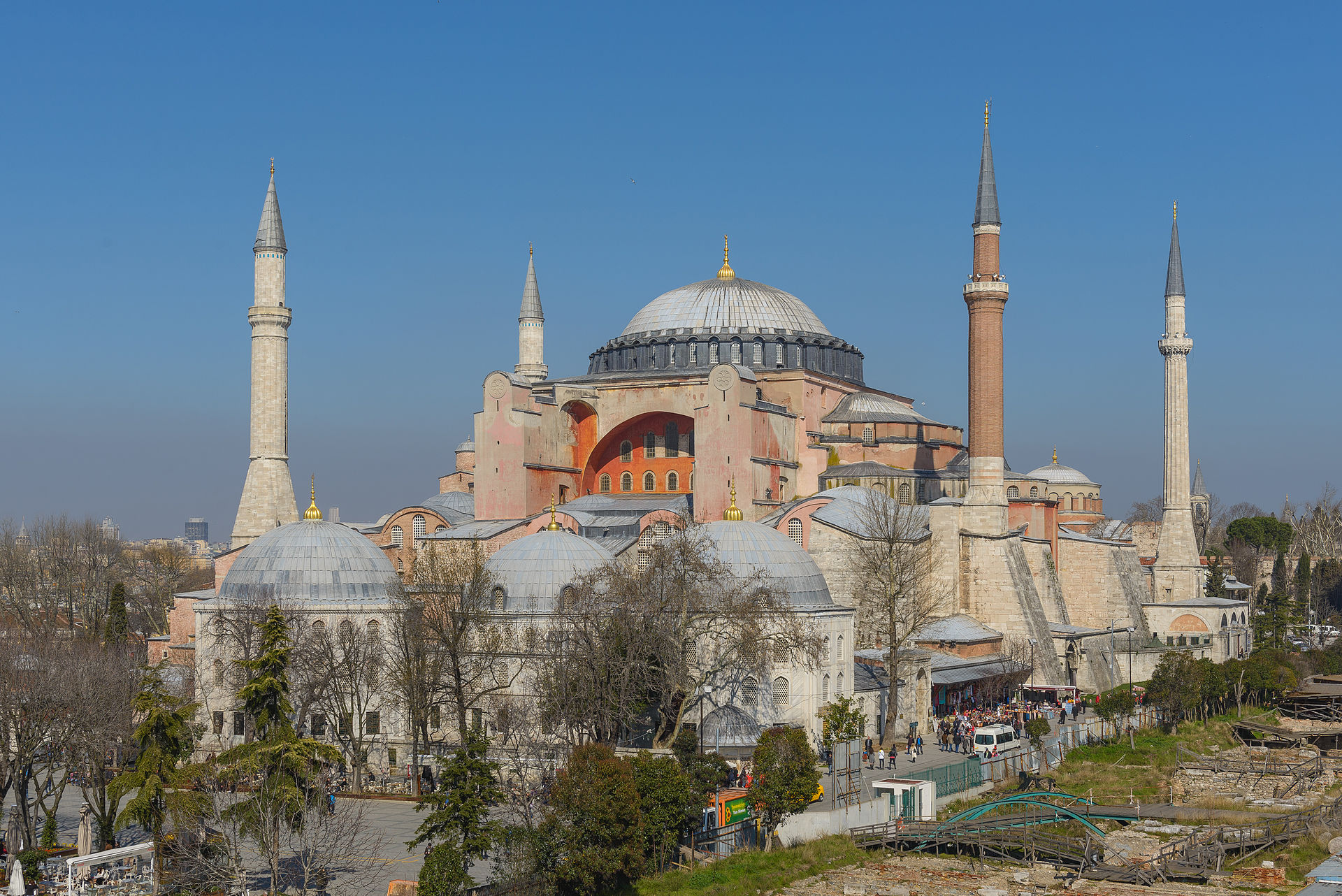
Hagia Sophia exterior

Hagia Sophia’s conversion from a museum into a mosque has seen thousands and thousands of words committed to the page across the globe.

Most of it recycles the same information – that the great church was built in the sixth century under the Byzantine emperor Justinian, that it was converted to a mosque when Mehmed the Conqueror captured Constantinople in 1453 and that Mustafa Kemal Ataturk, founder of modern Turkey, repurposed it as a museum in 1934.

All this is true but misses so much of the flavour and historical context of this hugely important building.

The tone of much western coverage is pained, as if the Hagia Sophia is somehow part of a European Christian cultural heritage now wrenched away into the dark folds of Islam by a Turkish president with neo-Ottoman delusions.

There can be no doubt that President Erdogan does indeed have his own agenda for converting Hagia Sophia into a mosque, and his timing is clearly political. It heightens his popularity with his core Islamic supporters at a time when the Coronavirus pandemic is running amok with Turkey’s struggling economy, and provides a welcome distraction. He makes no apology for his actions – and an Optimar poll show 60% of Turks support the move.

The important thing to understand is that the Hagia Sophia – like so many religious buildings – has its own highly political backstory. As ever the architecture reflects the politics in visible form and the current events are but the latest in a long line of twists and turns.

Ethnically diverse

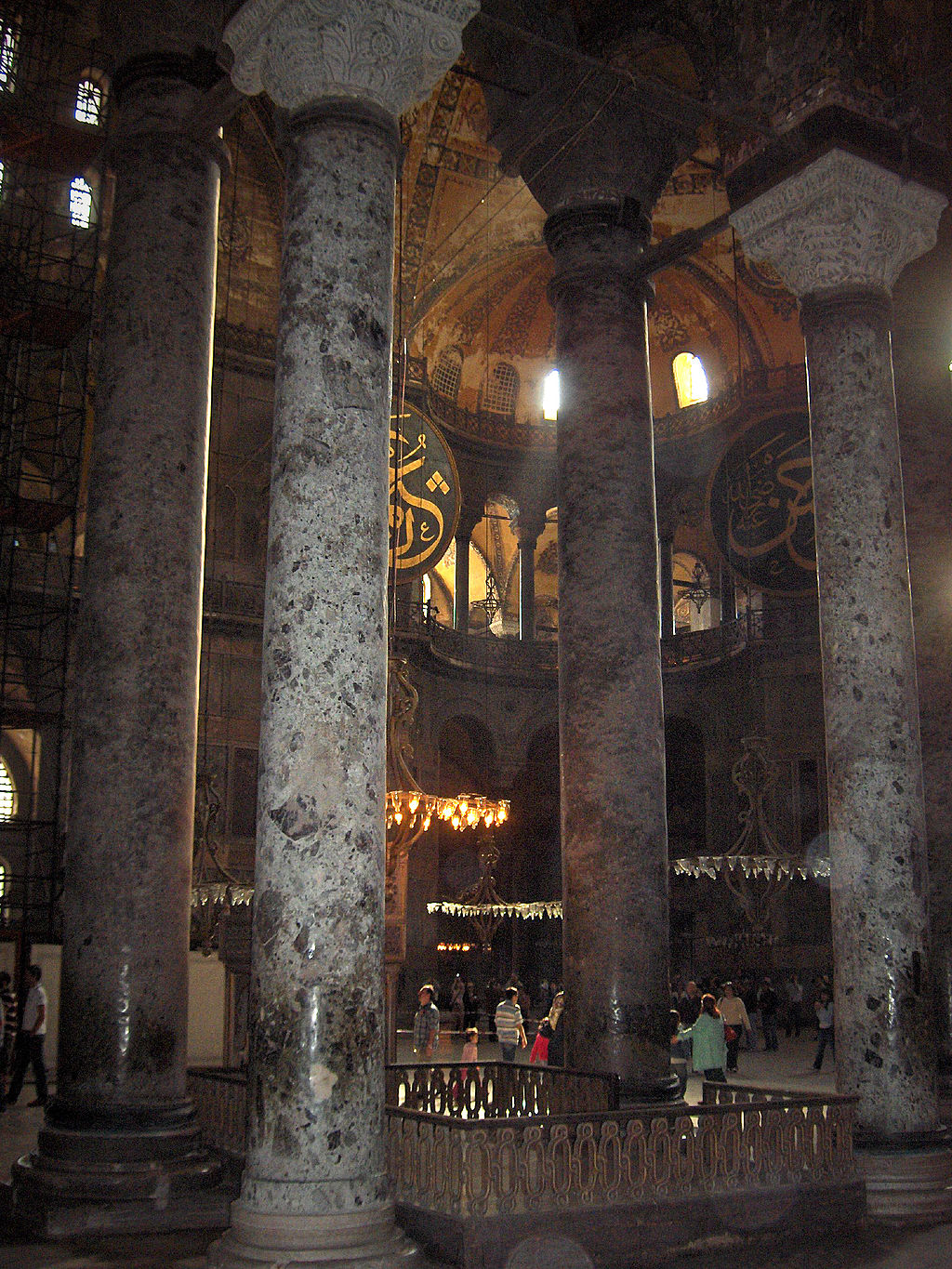
The first church on the site was built in 360, but there is no evidence that it had Christian mosaics on the walls of the type found from the fifth and sixth century onwards. Walls instead were covered with marble revetments, plaster, and painted and gilded stucco in decorative patterns. Constantine denuded virtually every city in the empire of its pagan statuary to adorn Constantinople, his new Rome, just as Justinian scoured the empire for precious marble two centuries later, like the eight green columns from the Temple of Artemis in Ephesus, to build Hagia Sophia.

Hagia Sophia marble columns from Ephesus

When the Western Roman Empire and Rome itself collapsed in 476, Constantinople became the largest and wealthiest city in Europe, and the influences upon it were wide and varied, including from the Roman Latin culture, the Egyptian Copts, the Thracians, Macedonians, Illyrians, Bythinians, Carians, Phrygians, Armenians, Lydians, Galatians, Paphlagonians, Lycians, Syrians, Cilicians, Misians, Cappadocians, Persians, and later the Arab Muslims.

Many Europeans call the Byzantine Empire ‘Greek’, when in practice it was very ethnically diverse. Greeks composed a relatively small portion of this multi-ethnic empire, and most Byzantine emperors were not ethnic Greeks.

Justinian was obliged to build the current Hagia Sophia after it was damaged beyond repair by angry crowds protesting his high taxes. According to art historian John Lowden, Justinian was ‘a person of vision and extraordinary energy, both intensely pious and utterly ruthless … his military ambitions matched by his grandiose building programme.’

Reconstructing Hagia Sophia

To re-establish control as quickly as possible, he commissioned two famous architects in 532, both from western Asia Minor, to complete the project with a huge workforce over an intense five-year period. Both ignored numerous stylistic quotations and detailed instructions from the emperor to come up with their own unique creation, universally recognised as the highpoint of Byzantine architecture and admired round the world for the stunning achievement of the central dome.

A very different image is conveyed by the western European Latin manuscript now held in the Vatican Library, in which an enormous Justinian, many times bigger than the Hagia Sophia itself, is seen directing a small, rather nervous-looking mason who is balancing on a ladder.

The inspiration for Hagia Sophia was never Hadrian’s Pantheon, but earlier Eastern traditions. St Simeon’s Basilica, in Syria west of Aleppo, completed in 490, was the largest and most important religious establishment in the world for fifty years before the construction of Hagia Sophia.

It also inspired the UNESCO World Heritage Site basilicas of Ravenna, briefly capital of the Western Roman Empire, where all the bishops up till 425 were Syrian and whose patron saint Apollinaris was a native of Antioch.

Famed across Europe as a site of pilgrimage, the Santiago de Compostela of its day, St Simeon’s could hold 10,000 worshippers, more than Notre-Dame de Paris or the Benedictine Abbey of Cluny.

The heavenly temple

Hagia Sophia was the largest cathedral in the world for over a thousand years, a major influence on and inspiration for future religious architecture, both Christian and Muslim. A series of earthquakes caused it to fall in 558, just twenty years after it was completed, by which time Justinian was seventy-six and both architects had died.

Sections of this second dome, completed in 562, collapsed again in 989 and in 1346, but were restored and repaired without material change. It was a remarkable achievement, openly praised by later Ottoman historians—following the typical Byzantine tradition, they used language implying that the architect must have worked in direct union with God, with descriptions of a guardian angel watching over the church.

Even before the Ottoman conquest of the city, Islamic tradition had identified Hagia Sophia as the heavenly temple that the Prophet Muhammad had seen on his nocturnal journey to heaven from Jerusalem’s Dome of the Rock, which was understood to predestine the church’s conversion to a mosque.

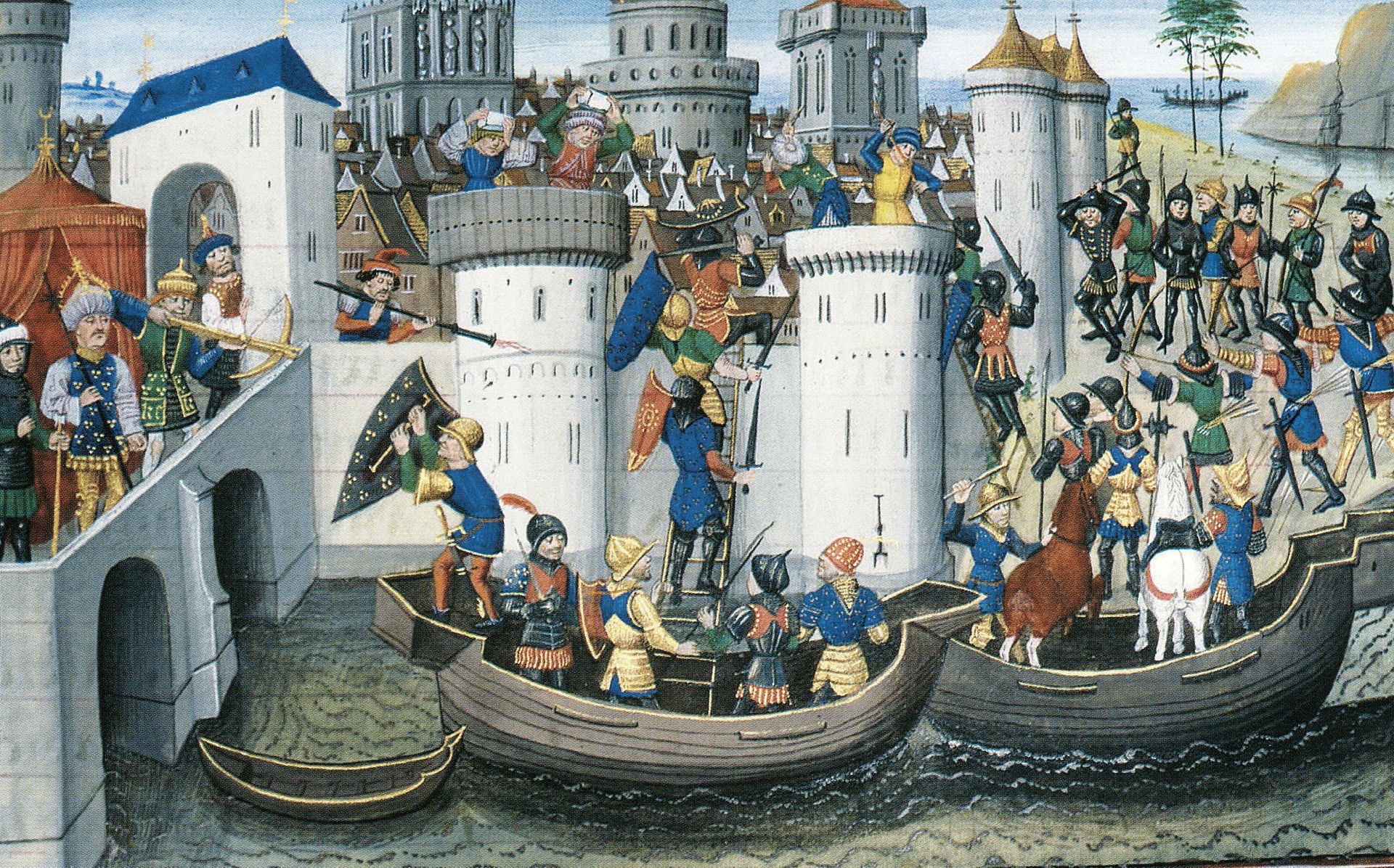
In 1204, during the Fourth Crusade, Hagia Sophia suffered the greatest damage in its long history, looted and sacked, along with the whole of Constantinople, thereby consummating a major schism between the Latin and Greek churches—Roman Catholics against Greek Orthodox Christians.

For three days they murdered, raped, looted and destroyed.

The Fourth Crusade

The defeat of Byzantium, already in a state of decline, accelerated political degeneration so that the Byzantines eventually became an easy prey to the Turks. The Fourth Crusade and the crusading movement generally thus resulted, ultimately, in the victory of Islam, a result which was of course the exact opposite of its original intention.

Pope Innocent III, who had unintentionally launched the ill-fated expedition, rebuked them:

“How, indeed, will the church of the Greeks, no matter how severely she is beset with afflictions and persecutions, return into ecclesiastical union and devotion to the Apostolic See, when she has seen in the Latins only an example of perdition and the works of darkness, so that she now, and with reason, detests the Latins more than dogs? As for those who were supposed to be seeking the ends of Jesus Christ, not their own ends, who made their swords, which they were supposed to use against the pagans, drip with Christian blood, they have spared neither religion, nor age, nor sex. They have committed incest, adultery, and fornication before the eyes of men. They have exposed both matrons and virgins, even those dedicated to God, to the sordid lusts of boys. ..They violated the holy places and have carried off crosses and relics.”

The pope’s outrage however did not prevent him accepting the stolen jewels, gold, money and other valuables, and the Church was much enriched as a result. A great deal of this wealth was in turn repurposed into huge building projects throughout Europe— much of it decorates St Mark’s Basilica in Venice and some of it certainly would have helped to finance Europe’s Gothic cathedrals.

Remorse was expressed 800 years later by Pope John Paul II for the events of the Fourth Crusade. Writing to the archbishop of Athens in 2001, he said:

“It is tragic that the assailants, who set out to secure free access for Christians to the Holy Land, turned against their brothers in the faith. The fact that they were Latin Christians fills Catholics with deep regret.”

Shared symbolism

When Mehmet the Conqueror took Constantinople in 1453, he permitted his armies three days of looting, as was the custom, but then called a halt.

Most churches were allowed to continue functioning, but the Hagia Sophia was adopted as a mosque. Mehmet erected a minaret and subsequent sultans erected three more, so there is now one at each corner, but the interior remains largely as it ever was.

There is much shared symbolism between Christianity and Islam in the meaning of the dome as the physical representation of heaven and the afterlife, but the flavour of Hagia Sophia as a building was always different to the sacred buildings of Rome like the pagan Pantheon and Michelangelo’s St Peter’s.

Its design was rooted in Eastern traditions, where Persian mausoleums had a circular dome resting on a square drum. The transition between the circle and the square resulted in an octagon, which came to represent, both in Christianity and Islam, the resurrection and the journey between earth and heaven, which is why so many tombs are octagonal in both religions.

As well as shared concepts, Christians and Muslims in the eastern Mediterranean enjoyed a common heritage of building materials, techniques and tools passed on from the Graeco-Roman, Persian and even earlier Etruscan worlds.

They also shared workers, builders and craftsmen, who moved around according to demand, following the next or the most profitable commission from a wealthy patron, no matter what his religion. Byzantine mosaicists, for example, were frequently employed to decorate Islamic mosques, such as the Dome of the Rock, the Umayyad Mosque of Damascus, and the Cordoba Mezquita.

In 1573 the great Ottoman architect Sinan was commissioned to strengthen Hagia Sophia, which was again starting to show signs of possible collapse. Extra buttressing was added to the outside to ensure its resistance to earthquakes.

In total, twenty-four buttresses have been added over the centuries to ensure its stability, making its external appearance quite different to how it would have looked originally.

In today’s world of intense economic pressures, a final mention should be made of the loss of revenue to the Turkish treasury through the conversion of Haghia Sophia to a mosque. Like the Blue Mosque next door, and like all mosques in Turkey (unlike many cathedrals and churches in Europe) entry will now be free to all.

The entrance fee to Hagia Sophia as a museum was expensive, c$15 per person. Maybe we should celebrate the fact that Muslims and non-Muslims alike can today make repeated visits to admire the blended architecture of Christianity and Islam on display for free in this unique building, standing on its promontory between East and West.

This article first appeared in Middle East Eye on 31 July 2020:

https://www.middleeasteye.net/opinion/hagia-sophia-backstory-Islam-Christianity-shared-history

Palmyra’s legacy to ISIS

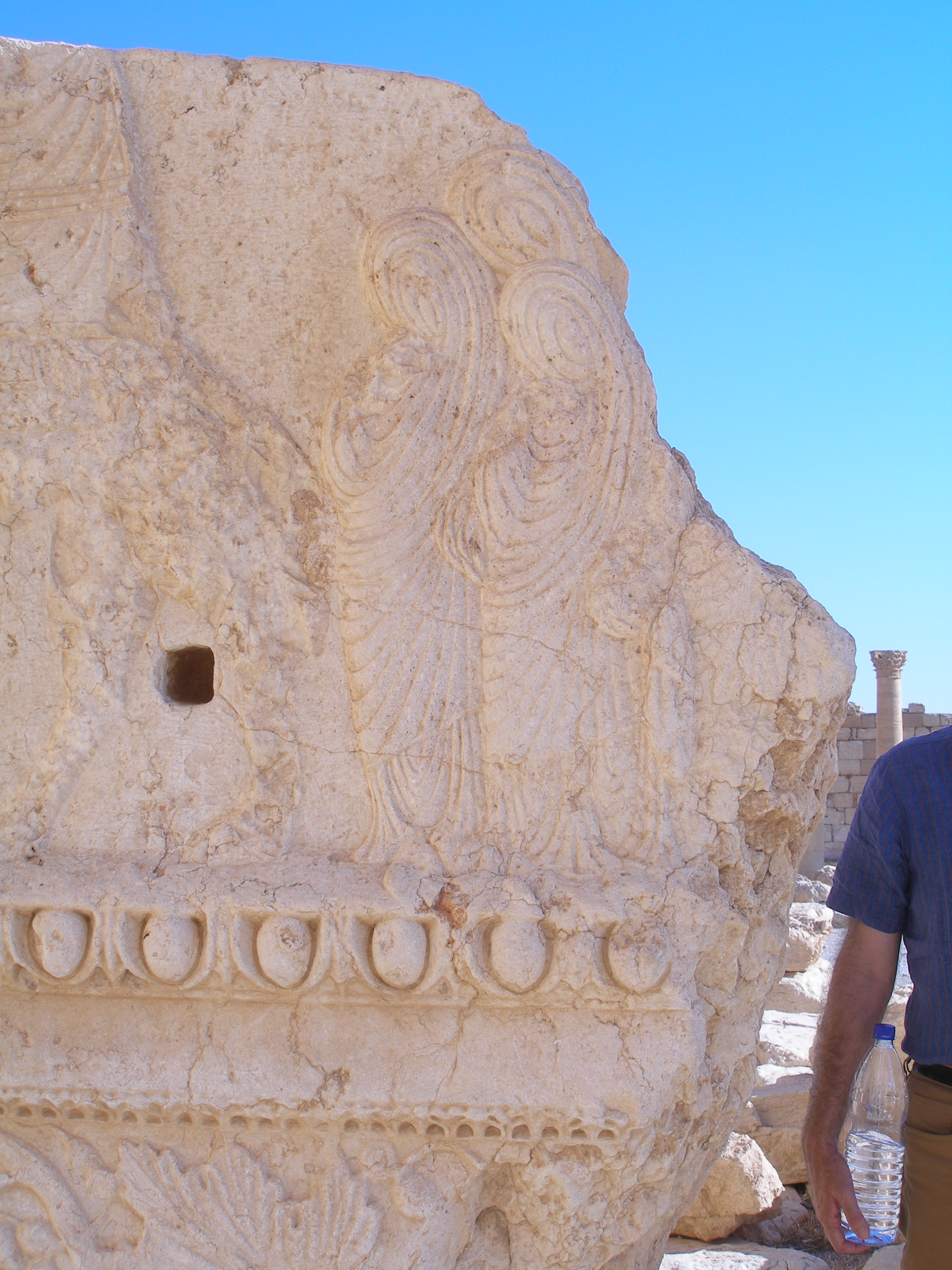
OLYMPUS DIGITAL CAMERA

This carved block at Palmyra pre-dates the advent of Islam by four centuries, and is thought to show the world’s earliest representation of veiled women, top right. It is one of the countless examples of how practices we now consider Islamic were often traceable to pagan times.

The early Muslim armies captured Damascus in 636 just four years after the death of the Prophet Muhammad, and went on to make it the capital of their Umayyad Caliphate. It was the first encounter Muslims had with cultures of the Eastern Mediterranean and Mesopotamia, cultures which were themselves the products of rich intermingling of Babylonian, Assyrian, Egyptian and Persian influences and which had in turn been under Greek and Roman influence for centuries. Commerce, as ever the driver of human inter-action, was thriving as new trade routes evolved, while religious and cultural trends co-existed.

The Umayyad Caliphate, far from seeking to ban or wipe out this multicultural heritage of earlier empires and civilisations, simply took over the existing infrastructure from the previous Byzantine and Sassanian rulers, going on to develop its own unique contribution to the art and architecture of the region. The Umayyads absorbed and adopted the customs of the cities they conquered. With the fall of borders, they unified the region thereby encouraging additional cross-fertilisation of ideas and artistic traditions. The results can be seen in all their buildings, from Jerusalem’s famous Dome of the Rock to the lesser known desert palaces like Mushatta (see photos below) and Khirbat Mafjar now scattered all over the deserts of Jordan, the West Bank and Syria.

Mshatta facade 2mshatta facade

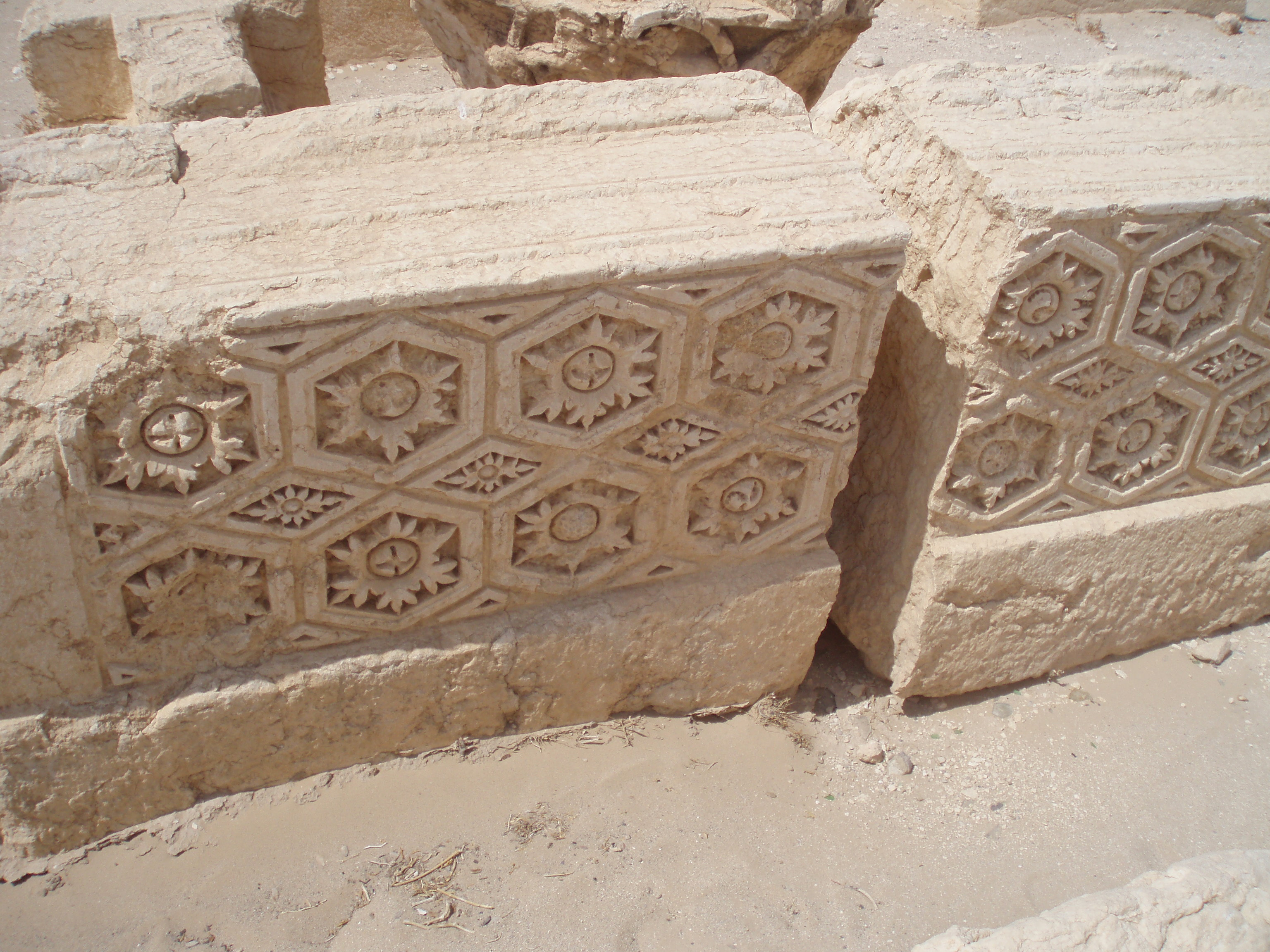
When it comes to the case of Palmyra, this rich cultural legacy is especially clear. The carved stone blocks carry motifs of flowers, including the famous Palmyrene Rose, ringed with acanthus and lotus leaves.

OLYMPUS DIGITAL CAMERAOLYMPUS DIGITAL CAMERAOLYMPUS DIGITAL CAMERA

The Palmyra drawings by English architects Wood and Dawkins went on to influence directly the classical revival of the 18th century, where Palmyrene roses are often to be seen on the ceilings of grand British country houses.

The Umayyad desert palace of Qasr al-Hayr al-Sharqi which stands in the desert some 100km northeast of Palmyra, has a mosque which incorporates columns and capitals brought from the site of Palmyra. The architecture of its monumental gateway displays an eclectic mix of Byzantine, Mesopotamian and Persian styles, with many recycled Roman and Byzantine capitals. Its twin, Qasr al-Hayr al-Gharbi, which lies in the desert  80km southwest of Palmyra, likewise boasted a monumental 8th century facade, now incorporated into the modern entrance of the Damascus National Museum.

OLYMPUS DIGITAL CAMERA

These fusions are clearly visible in the vine scrolls, the bunches of grapes symbolising wealth, fertility and prosperity in both the stone carvings of Palmyra and the decorative patterns of the Umayyad palaces, not to mention later Islamic tile patterns.

OLYMPUS DIGITAL CAMERAOLYMPUS DIGITAL CAMERA

Mythical creatures like griffins, together with birds like peacocks and eagles, animals like gazelles and lions are often found entwined in the Tree of Life, an ancient concept pre-dating Islam by centuries, yet all such motifs are still found on the borders of prayer rugs across the Muslim world. If ISIS claims that such things are idolatrous, it would also have to destroy most of the Islamic carpets and tiles of the Middle East.

And what of the many mosques across the Muslim world that were built on the foundations of earlier churches and temples, such as the Umayyad Mosque of Damascus?

OLYMPUS DIGITAL CAMERAOLYMPUS DIGITAL CAMERA

Would they too have to be destroyed, like these early Islamic mosaic visions of fantasised trees and palaces?

In the nihilistic vision of ISIS there is, it seems, no room for diversity. They have set their course on the total destruction of relics from earlier cultures, thereby denying the roots of the very Islamic civilisation to which they claim to be returning. By destroying Palmyra, they will be destroying their own roots, ensuring their own eventual downfall, since a caliphate devoid of culture cannot endure. What a perfect contradiction.

The Prophet Muhammad in Islamic Art

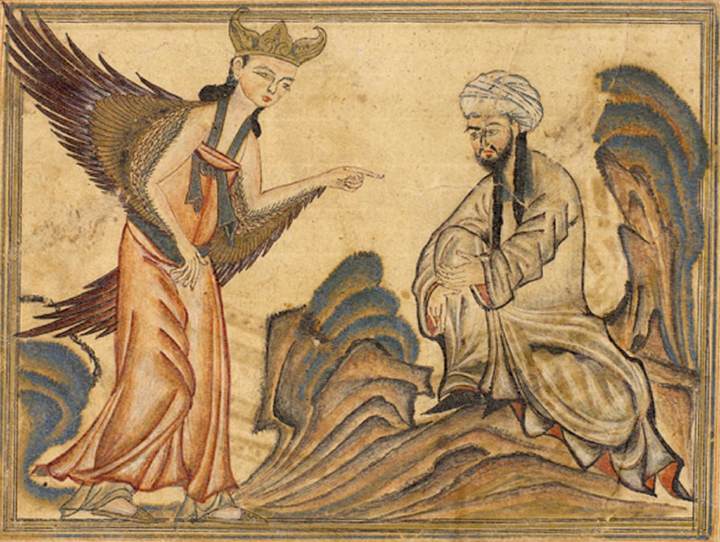
The Prophet Muhammad receiving his first revelation from the Angel Gabriel

The Prophet Muhammad receiving his first revelation from the Angel Gabriel, Tabriz 1307, Edinburgh University library

The Prophet Muhammad solving dispute over who should rebuild Kaaba and dedicate black stone - they do it collaboratively on cloth, so all together Tabriz 1307, Edinburgh Univ library

The Prophet Muhammad solving a dispute over who should rebuild the Kaaba and dedicate the sacred black stone – they do it collaboratively on the cloth, so all together, Tabriz 1307, Edinburgh University library

Detail of the Prophet Muhammad in paradise with houris

Detail of the Prophet Muhammad in paradise with houris, 18th century Ottoman, Topkapi Palace Museum

Muhammad carried by Gabriel arriving at gate of paradise guarded by angel Ridwan, 1360-70, Tabriz, Mi'rajnama, now in Topkapi Palace Library

The Prophet Muhammad carried by the Angel Gabriel arriving at gate of paradise guarded by the Angel Ridwan, 1360-70, Tabriz, Mi’rajnama, now in Topkapi Palace Library

The Prophet Muhammad flies over houris harvesting flowers, Persian 15th c

The Prophet Muhammad flies over houris in Paradise harvesting flowers, Persian 15th c

The Prophet Muhammad on his horse Buraq (upper right) visiting Paradise with the Angel Gabriel (upper left). Below are camels ridden by fabled houris, 'virgins' promised to martyrs, Persian 15th c

The Prophet Muhammad on his horse Buraq (upper right) visiting Paradise with the Angel Gabriel (upper left). Below are camels ridden by fabled houris, ‘virgins’ promised to martyrs, Persian 15th c

The Prophet Muhammad on his horse Buraq sees women strung up on hooks by their tongues by a green demon, punishment for mocking their husbands and leaving their homes without permission, Persia 15th c

The Prophet Muhammad on his horse Buraq sees women strung up on hooks by their tongues by a green demon, punishment for mocking their husbands and leaving their homes without permission, Persia 15th c

The Prophet Muhammad watching a demon punish shameless women in hell (with Buraq and Gabriel) who have shown hair to strangers, and are strung up and burnt for eternity, Persian 15th c

The Prophet Muhammad watching a demon punish shameless women in hell (with Buraq and Gabriel) who have shown their hair to strangers, and are strung up and burnt for eternity, Persian 15th c

The Prophet Muhammad watching a red demon hanging up women by their breasts, as they are engulfed in flames for giving birth to illegitimate children whom they falsely claimed were fathered by their husbands, Persia 15th c

The Prophet Muhammad watching a red demon hanging up women by their breasts, as they are engulfed in flames for giving birth to illegitimate children whom they falsely claimed were fathered by their husbands, Persia 15th c

Since the Charlie Hebdou cartoons controversy in January 2015, and now the cafe attacks in Copenhagen on 14 February 2015, more attention has been focused on the depictions of the Prophet Muhammad that do exist in Islamic art. They are not widely known: even on my Islamic Art and Architecture MA course at SOAS in 2008-9, they were never mentioned. Today there is increasing speculation that such images, as found for example in early illustrated Korans, are being steadily bought up by wealthy individuals in Saudi Arabia, specifically in order to be destroyed.

It is striking that the early images originate overwhelmingly from either Sunni Ottoman lands or from Persian Shi’ite lands, with almost nothing similar coming out of the Arab heartlands. In subject matter and style the drawings are reminiscent of saints’ icons, especially in their depictions of heaven and hell, complete with angels and demons.

Islamic art Algerian postcard from 1920s or 1930s showing Muhammad' Flight from Mecca in 622, entering the cave, pursued by the Quraysh

Algerian postcard from 1920s or 1930s showing the Prophet Muhammad’s Flight from Mecca in 622, entering the cave, pursued by the Quraysh on horseback

Islamic art German 1928 advert for meat extract (Bovril equivalent) showing Gabriel guiding Muhammad on flying horse to God

German 1928 advert for meat extract (Bovril equivalent) showing the Angel Gabriel guiding the Prophet Muhammad on his flying horse to God

These two final images from the 1920s are testimony to the fact that such images were evidently not seen as blasphemous a hundred years ago. The German Bovril equivalent did not have its factories blown up.

As Paul Chevedden, author of A New History of the Crusades, recently put it: “The great strength of Islam historically has been its ability to adapt itself to local cultures. Syncretism was one of its strong suits. Just think of all the pagan Arabian practices incorporated into the faith, not to mention its debt to Judaism and Christianity. Now it is only scandalized by syncretisms, and what passes for Islamic creativity amounts to ridding the faith of the accumulated traditions going back many centuries. If the trend continues, we will see a Salafī-Wahhābī wasteland. A richness and diversity of Islamic cultures replaced by a desert.” Too true.

With thanks to Paul Chevedden for sharing his thoughts.

Also thanks to the following:

Copyright � 2009 The New Criterion | http://www.newcriterion.com http://www.newcriterion.com/articles.cfm/Yale—the-Danish-cartoons-4180

http://tarekfatah.com/images-of-prophet-muhammad-from-islamic-art-and-history-before-the-clan-of-ibn-saud-took-islam-hostage/

http://www.newsweek.com/koran-does-not-forbid-images-prophet-298298


Post Navigation